
Is this a symptom of the University of Cambridge expanding far too quickly – beyond the capacity of its own resources and those of the city it gets its name from?
You can read the article by Apeike Umolu here. It should lead to tough questions being asked by politicians of the big decision-makers holding executive office at the University. Because the decisions taken by the University on student numbers inevitably has an impact on the wider city – including on the social stability of its population. Having a growing proportion of the population flowing through the city at an increasing rate inevitably reduces the ability of the city to cater for its own residential population – mindful of the number of homes in residential areas that have also bee converted into private student accommodation and/or Air BnB, regulation of which rests with ministers in terms of the rules, and resources for enforcement.
“With academic salaries being what they are, even Cambridge’s top professors would struggle to get on the city’s property ladder. What sort of prospect is that for a young graduate? But it is not just the city’s high house prices that make it uninviting, its high rents and scarcity of rental properties are having that effect too. “
Apeike Umolu in Varsity UK, 18 March 2025
And that affects everyone – as Cllr Elliot Tong (Greens – Abbey) highlighted in this video clip from Cambridge City Council here.
An issue of governance structures – and systems of accountability
Ever since the University of Cambridge and its earliest colleges received their first royal charters, there has been a tension between the borough of Cambridge (whose royal charter pre-dates those of the first colleges) and the University that bears its name. One of the few historical figures who tried to change the culture of the University very publicly was Sir Ivor Jennings, with his very public declaration as Vice Chancellor back in 1962.
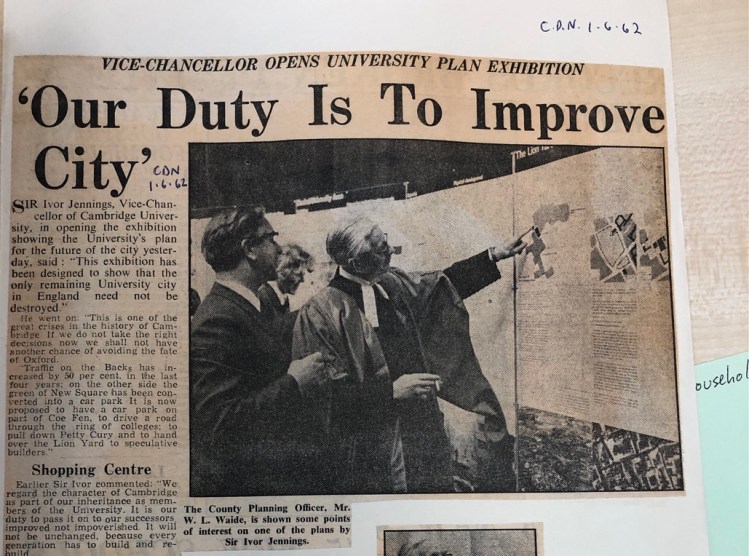
Sadly too many senior decision-makers within the University have shown no interest in the example that Sir Ivor showed to his contemporaries at the time. An awkward piece of gown history best forgotten, like the Spinning House? (Which they still haven’t apologised for – something the institution could easily and meaningfully do via an annual grant in perpetuity to the Cambridge Women’s Resources Centre which supports this generation of town women).
Who gets to tell the University of Cambridge: “No!”?
The existing fragmented governance structures show that it’s not the elected representatives of the people, and in anycase as the Migrant Democracy Project points out, there are thousands of people across towns and cities in England who are barred from voting because, unlike in Scotland, England does not have residence-based voting for local elections.
If the University of Cambridge has expanded its post-graduate student numbers beyond its own capacity to house them, who within the University can call them out on it? Who outside of the University can rein the ancient institution in so that its expansion plans do not further damage the interests of other communities within our city? Part of the problem is that too many powers are held by ministers who have a very limited time-and-attention span on what happens to any individual settlement. Hence why lobbyists focus much of their attention on Whitehall.
As I’ve mentioned before, the lack of transparency from central government over the future of a rapidly-growing Cambridge, both under this and the previous Conservative Government, has been depressing. 20 months ago – in July 2023, Michael Gove effectively as Housing and Local Government Secretary was reported as drawing up plans for a massive expansion of Cambridge. This was followed by a formal announcement just before Parliament broke for summer recess. In the 10 months that followed, he did not make any announcement/publish maps on the geographical area around Cambridge that fell within his plans. We are still waiting for the same from the current ministerial team which confirmed it would be continuing with the broad aims, if not the means, of achieving that growth.
There is a wider issue of principle – and that is where a single institution is so large that it dominates a settlement
It’s not just with higher education – Oxford and Cambridge standing out as rare examples, but in other sectors where for example a single large employer such as a heavy industry in times gone by can make or break a town or city. In Cambridge’s case the larger institutions inevitably bypass a weak local government tier as it has done for decades. You only have to look at some of the recent interventions by planning inspectors overturning sound planning refusals from the local planning authorities which is now a shared service.
What should the relationship be between local government – the new unitary council, and the University of Cambridge? Where does one draw the line on academic freedom vs accountability to the democratically-elected municipal authority of the area it resides in? Even more so the Combined Authority which has got a much wider geographical area to look out for.
There’s an essay question for some students out there!
- Follow me on BSky
- Like my Facebook page
- Consider a small donation to help fund my continued research and reporting on local democracy in and around Cambridge.
Below – coming up on Thursday evening for those of you 16-21 (do sign up – it’s free), an event where you get to question councillors on what they do – but without the party politics

 The Cambridge Town Owl