
This post in part looks at some of the things that can bring people together but not involve politics or religion. One of the best ideas I’ve seen is The Rebel Badge Club who are coming to Cambridge on 26th April 2025! (Hence the image!)
Call for ideas from former Abbey Ward Councillor Alex Bulat
You can watch her video with fellow Labour candidate Luke Viner:
“Many people don’t know who their local councillors are – before I was involved in politics and started voting, I was one of the people who could not say who the mayor or local councillor is.
“What should local councillors do to be more visible? Surgeries, all year round door-knocking, social media presence? Let us know in the comments!”
Above – Dr Alex Bulat, Labour’s county council candidate for St Ives South and Needingworth
Do let her know what suggestions you have!
In the meantime, something from the olden days.
Just over a century ago it was normal for candidates to publicise the list of places they would be speaking at, in order for the public to come and listen/question/heckle them. That’s not to say such things should be taken lightly given the threats of violence that happen all too frequently – as we heard in Parliament earlier in Sorcha Eastwood MP’s debate. Which is also why for me Active Bystander training (eg here) for communities has to be part of the solution too.
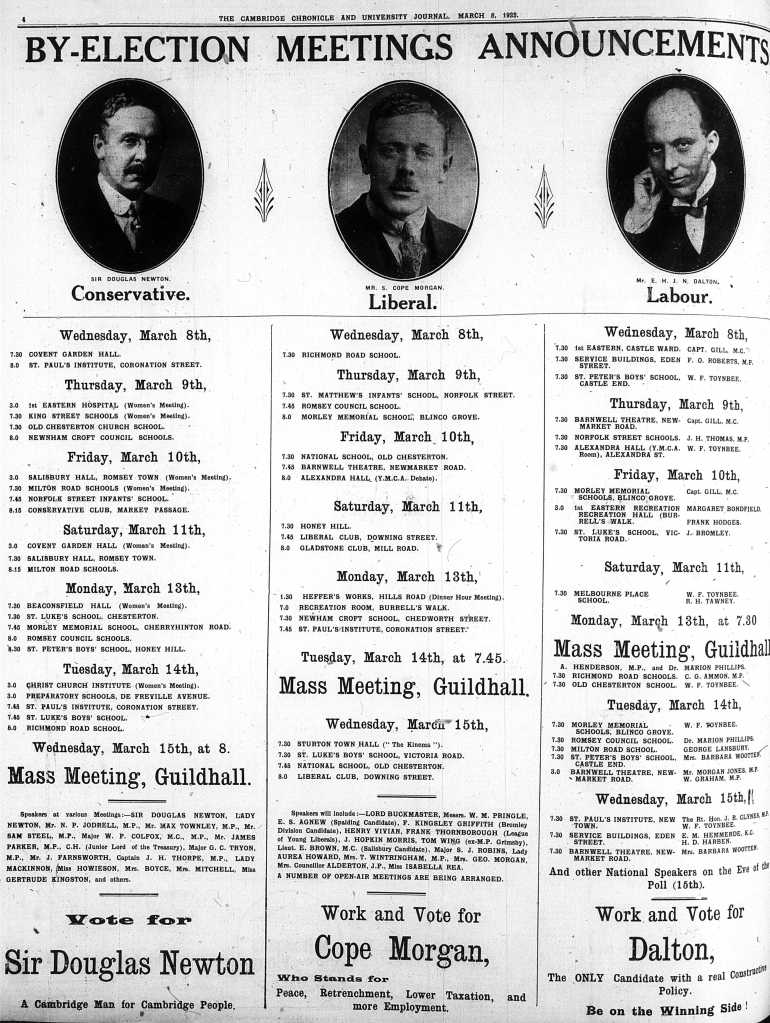
Above – Cambridge Chronicle, 08 March 1922, Cambridge By-Election where Dr Hugh Dalton stood as the Labour Candidate. From the Cambridgeshire Collection
Councillors and candidates are fighting against the atomisation of society
“Technology has enabled our retreat into increasingly homebound lives of frictionless convenience – but at what cost? Trust expert Rachel Botsman says it’s time to get up and get out”
Intro to Rachel Botsman’s article for the RSA Journal 26 March 2025
I first came across Ms Botsman during my civil service days with her book on collaborative consumption. But all of the ‘let us innovate and do Big Society things’ messaging and goodwill that came from civic society’s response to the Coalition Government inevitably got crushed by austerity. As I mentioned to some visiting politicians at Anglia Ruskin University in the mid-2010s, one thing that ministers in my old department (today The Ministry of Housing, Communities & Local Govt) was that they did not appreciate the close links and dependencies that so many community groups had on their local councils. Which is one of the reasons we are in the state we’re in.
While her analysis sounds compelling, her proposed solutions (as she acknowledges herself) are lacking. I don’t mean that in a pejorative sense, because if we had the solutions to hand along with the ability and willpower to implement them, we’d have done so by now. But we haven’t.
The big picture is also as much structurally economic as it is political.
After all, how has the changing structure of our economy over recent decades affected the day-to-day ability of people to meet up casually and informally? Or spend time in environments where they are interacting with lots of people every day? Schools and hospitals are becoming those rare exceptions it seems.
Cambridge is a microcosm of that effect where the speculative bubble on land in and around the city, and the failures/unwillingness of successive ministers in successive governments to empower local councils to respond radically to this, has resulted in the shocking decline of community spaces and places – especially for teenagers and young adults.
The failure of politics and society to give teenagers the same opportunities that my generation had speaks volumes. And the use of things like automated checkouts at retail outlets and shops has been a factor.
Walking back through Cambridge’s city centre on the Saturday night after the first post-lockdown concert of We Are Sound – which took place on the final Saturday before Christmas Day, I noticed how dead the city centre was. Too many restaurants and bars appeared closed – and those that weren’t were largely empty. Empty. On the last Saturday night before Christmas? Where were the sixth form college students? Where were the older students returning from university? Where were all the young people?
It’s not as simple as this I know, but there are a whole host of different factors that have come together to create the perfect storm. Things like:
- The unaffordability of family housing
- The removal of homes designed for family occupants from the housing market due to its conversion to Air BnB, student accommodation, and apart-hotel-style booking
- The growth of second homes, the impact of which causes acute housing shortages combined with acute financial sustainability issues for small businesses dependent on trade from local residents (hence some responses from devolved and central government)
- The substantial reduction in public-facing part-time entry jobs normally popular with teenagers and school leavers – reducing their available disposable income
- The rising costs of nights out – not helped by forever-rising rents
…and many more.
It’s all very well putting on local meetings – but as we’ve found out in Queen Edith’s ward in Cambridge, people are not interested in ‘doing politics’ – whether local or national
“I have a not-so-secret love of approaching strangers in the street and asking them about cycling or buses, but throw in the word ‘elections’ and suddenly many people are not so keen to engage.”
Anna Williams of CamCycle, 04 April 2025
The moral of the story on local public engagement for councillors?
Help organise and support regular/routine/scheduled community events at ward level that don’t involve party politics. Have a small local council presence and be there for council officers to refer local residents to you for things that they don’t have the authority to respond to. (And wear something that makes it easy for the public to identify you as a councillor when close up!)
For me, one potential solution that I’ve spent over a decade unsuccessfully trying to persuade councils to fund is a city-wide Freshers’ Fair-style event, but for town and county societies
I’ll spare you the details in this post – my most recent piece on the issue is here. Once the very large annual event becomes embedded, councillors can make suggestions for similar events in neighbourhoods. Some communities already have them in the form of local summer fairs or carnivals – such as the Arbury Carnival which has been going for over half a century. My take is that every council ward and/or identifiable neighbourhood should have the equivalent of a summer fair. The absence of such events in South Cambridge is, in my view one of the reasons why we don’t have nearly a strong a community spirit compared with previous generations. Whether that will change or not ultimately depends on decisions made by ministers. Which is depressing because it’s the opposite of what local government supporting local communities should be.
“Happy to talk about local transport issues, but not wanting to talk about politics? Why does that sound familiar?”
Above – from the Electoral Commission in the early 2000s
It still applies today, but the fact that the Prime Minister is making a big thing about potholes shows how utterly disempowered local communities are in raising sufficient revenues and/or being provided with sufficient funding from central government for their elected councils to do the very basics.
“At an event in Derbyshire, a key target council which is currently run by the Conservatives, Sir Keir said Labour councils would “work hand-in-hand” with the government on its plan for change, including bringing back community policing, supporting High Streets and fixing potholes.”
In a more ideal world, any minister would – and should be in a position to respond:
“Potholes are an issue for the local council. Central Government has no powers or role in resolving hyper-local issues”
The problem here is that potholes are a symptom of a much wider problem of under-funded and under-powered local councils. They are not simply a standalone problem in and of themselves – i.e. ones which, when a road surface is repaired, will stay in good repair for long afterwards. Rather, their presence and persistence on our roads reflect decades of public policy failures both on funding/resourcing/empowering of local councils, and of providing world class public transport and active travel alternatives, and overhauled urban design of our built environments so that fewer people need to travel such long distances, and that when they do there are sufficient non-car alternatives to make doing anything other than driving the preferred option.
If you are interested in the longer term future of Cambridge, and on what happens at the local democracy meetings where decisions are made, feel free to:
- Follow me on BSky <- A critical mass of public policy people seem to have moved here (and we could do with more local Cambridge/Cambs people on there!)
- Like my Facebook page
- Consider a small donation to help fund my continued research and reporting on local democracy in and around Cambridge.

 The Cambridge Town Owl