
In one of the least surprising decisions of year, DEFRA Secretary Steve Reed continued the pattern of Cabinet Ministers going against the advice of planning inspectors and approving large infrastructure developments in the name of growth
You can see:
- The press release here
- The application documents and consent notice here
- BBC Cambridgeshire here
- What the examiners said in the Cambridge News
- The songs from the Save Honey Hill campaign
“The recommendation was for refusal – so why did the Secretary of State go against it?”
The recommendation for refusal is highly contextualised within the framework of the law. In particular, the proposals being developed for the existing Milton water works site – the Hartree development, have not been submitted for consideration in the planning system. Therefore the Planning Inspectorate could not consider the work done so far as admissible for their considerations. However, the law enables the Secretary of State to go against the recommendations of planning inspectors – because otherwise what would be the point of ministerial sign off? In order to do so however, ministers need to have very sound reasons to go against such recommendations. These include such proposals being consistent with Government Policy – formal statements of policy that have been made to Parliament (Such as a Government White Paper) which automatically require ministers to appear before Parliament to take questions from MPs.
Hence:
“…the Secretary of State disagrees with the [Examining Authority] on one central issue, namely whether the need for, and principle of, the Proposed Development has been justified and the consequent weight to be attached to the benefits arising from meeting that need.”
Above – Secretary of State for Environment, Food and Rural Affairs decision letter (08 Apr 2025) Para 4.2
“The Secretary of State considers that the relocation of the existing WWTP will unlock a long-held ambition to redevelop North East Cambridge (“NEC”) and enable the delivery of thousands of new homes and new jobs in a highly sustainable location where development has been frustrated for decades by the presence of the existing WWTP. Approval of development consent is consistent with the Government’s objective of significantly boosting the supply of homes and consistent with the achievement of sustainable development”
Above – Secretary of State for Environment, Food and Rural Affairs decision letter (08 Apr 2025) Para 4.2
The report from the examining authority – the Planning Inspectorate, all 623 pages of it
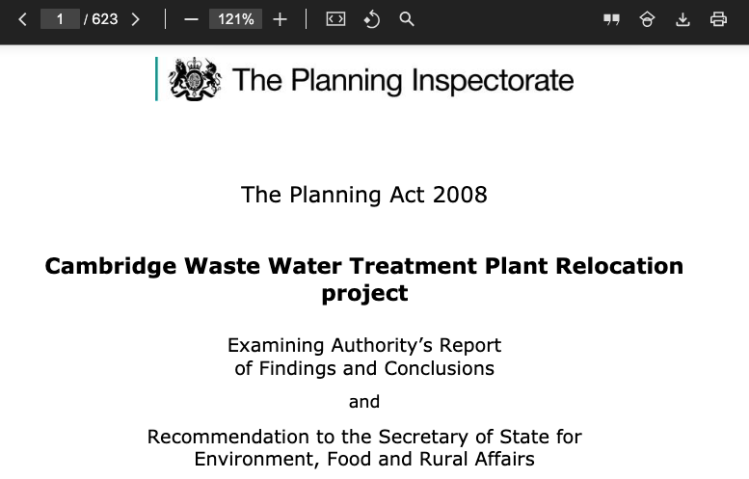
Above – the immense report submitted to the Secretary of State.
“The [Inspectors] found that the Applicant’s need case for and principle of the Proposed Development has not been adequately justified in either infrastructure or wider policy terms. The [Inspectors] also found that, on this basis, the harm which would arise to designated and non-designated heritage assets as a result of the Proposed Development would not be outweighed by any public benefits.
“In addition, the [Inspectors] has further found that the harm to the Green Belt which would arise from the Proposed Development, and other harms identified would not be clearly outweighed by other considerations. Consequently, the [Inspectors] considers that very special circumstances do not exist to justify the approval of inappropriate development in the Green Belt.
“Accordingly, the [Inspectors] takes the view that the Proposed Development would fail to accord with relevant policy, including that set out in [The National Policy Statement for Waste Water], the National Planning Policy Framework] and the development plan.“
Policy statements from ministers in the previous Conservative Government
Interestingly, the report listed a number of formal policy statements from the previous government that influenced the conclusions of the inspectors. (See from p431 of their report).
One of those was Michael Gove’s announcement to supercharge Cambridge back in July 2023. It also included the follow-up in March 2024 which I wrote about here. This inevitably became a debating point in the run up to the general election because local Conservative candidates were much more sceptical about the scale and pace of development than their ministerial chiefs. As it turned out, their candidates defending their seats around Cambridge were turfed out by their electorates.
The Housing Infrastructure Fund award.
Theresa May’s Government awarded over £200million back in 2019 from their Housing Infrastructure Fund (HIF) to meet the costs of the relocation of the Anglian Water site from Cambridge to outside of the city. Again, the report picked up on this.
“The strategic case made in support of the HIF award was that Relocating the CWRC [Cambridge Water Recycling Centre] will release the CNFE [Cambridge Northern Fringe East] Core Site, a major brownfield area for 5,600 homes (including 40% affordable) in line with the Cambridge
Sustainable Housing Design Guide. It will also remove ‘odour zone’ restrictions around the CWRC that limit 82 hectares of land to industrial use. This would enable a further circa 3,000 homes to be built on adjacent land and nearby employment sites to more than double employment densities.”
Above – Inspector’s Report p432
Policy statements from the incoming Labour Government.
“The March 2024 Case for Cambridge underscores that support, identifying NEC as an early opportunity to help realise Cambridge’s long term potential. On 29 January 2025, the Chancellor of the Exchequer reinforced the policy support for growth in Cambridge, with an announcement of plans to deliver the Oxford- Cambridge Growth Corridor, prioritising growth in an area with potential to be “Europe’s Silicon Valley”. While those documents and statements do not set specific planning policy requirements, the Secretary of State considers them to be important and relevant documents in the determination of this application.”
Above – Secretary of State for Environment, Food and Rural Affairs decision letter (08 Apr 2025) Para 7.4
The Secretary of State also noted that other large sites for housing would need to be identified if the move did not go ahead.
“Consequently, [the Secretary of State[ accepts that if the existing Waste Water Treatment Plant is not relocated (either by way of Development Consent Order or otherwise) the Councils will likely need to identify alternative strategic scale sites to meet housing needs. That will delay the progress of the emerging local plans and is likely to require the allocation of sites in the Green Belt or in new settlements in less sustainable locations than the site of the existing WWTP.
Above – Secretary of State for Environment, Food and Rural Affairs decision letter (08 Apr 2025) Para 7.13
In the grand scheme of things, the planning inspectors correctly recommended refusal on the basis of what the law enabled them to consider as admissible issues. The flexibility that the law given to ministers in going against the recommendations of the inspectors by considering issues additional to what planning inspectors considered, enabled the Defra Secretary to approve the application. (Such additional considerations included recent formal statements of government policy, through to the allocation of funding to enable specific related developments to go ahead *in support of government policies and objectives* (in this case a substantial amount of new housing in an area of chronic housing shortage).
“A final note on ‘Take out the trash’ day? “
The announcement was made on the day Parliament broke for Easter recess – which means that MPs cannot table difficult debates or ask awkward questions at the time the decision was made. By the time Parliament returns, the political agenda will have moved on. Governments of all parties have done this. (I called out Michael Gove on it here this time last year). It’s so predictable!
If you are interested in the longer term future of Cambridge, and on what happens at the local democracy meetings where decisions are made, feel free to:
- Follow me on BSky <- It’s much less abusive on here compared with Birdsite (in my experience)
- Like my Facebook page
- Consider a small donation to help fund my continued research and reporting on local democracy in and around Cambridge.

 The Cambridge Town Owl