So why is Labour not saying anything about light rail in these public debates? That’s something you’ll have to ask their mayoral and county council candidates – and MPs too.
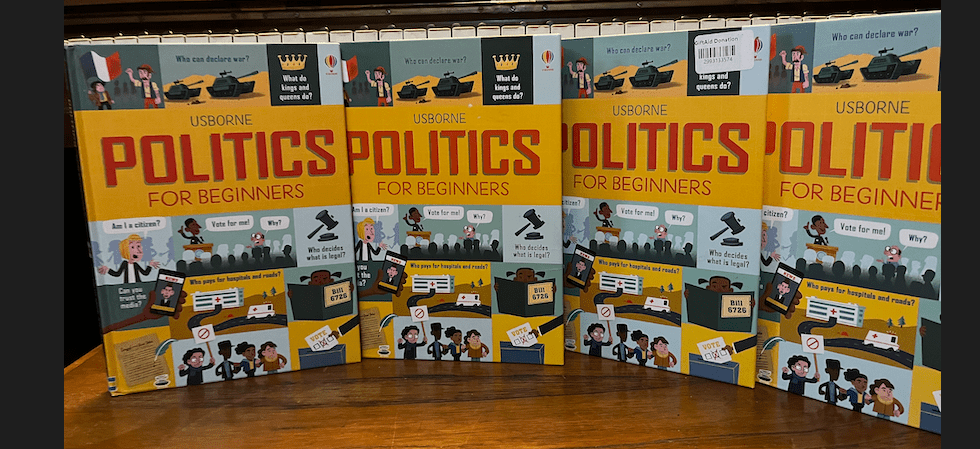
Image – books on politics that were gathering dust in a warehouse. Feel free to help get them into the hands of readers while also supporting local charity shops too!
(Before I start, note that I’ve known Cllr Anna Smith, Labour’s candidate, for over a decade, and that she is one of my local ward councillors in Coleridge, Cambridge)
Along with around 100 other people I listened into the mayoral debate hosted by the CDF, chaired by the former Health Secretary and MP for South Cambridgeshire.
I tried to live-post some of it on BlueSky:
I can’t pretend to have been impressed by the content of the debate – not because of any personal shortcomings of the candidates, but more because there are so few meaningful powers and such a pitifully small budget to work with that I still don’t see the point of combined authorities as a concept.
The biggest policy-change I picked up on was the clear statement of support for Cambridge Connect from The Green Party’s Bob Ensch.
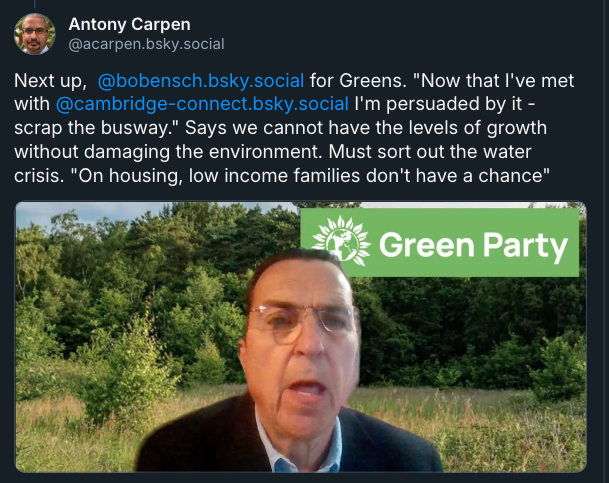
Above – Bob Ensch on the CDF livestreamed hustings.
We’re awaiting to see if the CDF will make a video available – several people have requested that they do.
Two questions I’d like to have seen asked and answered were:
- What extra powers (in particular wider and deeper tax raising ones) would candidates seek from ministers and Parliament to help pay for new infrastructure in CPCA Area?
- Do they propose extending adult education and lifelong learning beyond very narrow skills remit?
Without those substantial new independent powers, combined authorities will remain the delivery agent of central government, dependent on whatever pots of funding ministers choose to make available with the inevitable strings attached.
For all of the diversity of candidates, the very limited powers meant that there was very little of policy substance to separate the candidates
The Chancellor of the Exchequer was asked about the Leeds Tram on 09 April 2025 and confirmed Government support for the Leeds-Bradford Mass Transit scheme via the West Yorkshire Combined Authority. The problem is that ministers are yet to make a formal statement on its policy for trams and light rail. Not surprisingly, the LRTA magazine finds itself showcasing trams and light rail systems all over the world because the UK has so few of them.
From what I have seen, Cllr Anna Smith’s campaign for the mayoralty has been co-ordinated regionally
– with very strong connections to Westminster – reflected by the significant number of senior ministerial visits of late. Have a browse through her campaign videos here. Visitors have included:
- Chancellor Rachel Reeves
- Science and Technology Secretary Peter Kyle
- Culture Minister Sir Chris Bryant (who also covers telecoms and data protection)
- Education Secretary Bridget Phillipson
For the videos where there are two people speaking to the camera, Cllr Smith’s presence is far more confident compared with other campaign videos I have seen over the decades where the local candidate is all too often star-struck by the very senior politician campaigning with them. This was especially noticeable with both David Cameron and Tony Blair.
Compared with the campaigns of 2017 and 2021, neither Nik Johnson nor his predecessor Kevin Price had the depth of institutional support that Cllr Smith is receiving. At the same time, I would be astonished if on her campaign she had not received negative feedback about Labour’s policies in national government. Furthermore, the refusal of ministers to table the legislation needed to reverse the voting system changes that enabled Nik Johnson to win the mayoralty for Labour in an earthquakingly-huge political upset, could be something that the national party comes to regret bitterly. And they were warned on multiple occasions too.
Four mayoral candidates declare their support for a light rail for Cambridge at the CDF online hustings
I last wrote about the proposals when Cambridge Connect Light Rail submitted updated proposals shortly after the 2024 General Election here.
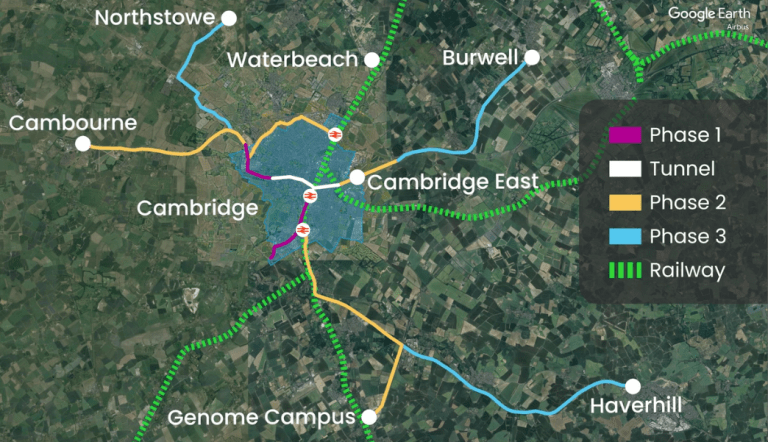
Above – screengrab of what the network might look like after the first three phases
The problem is that ministerial silence and things like the seventh carbon budget not mentioning light rail all make for very depressing reading. Given the over-centralised nature of both government and also the Labour Party when it comes to command and control, there is no way Cllr Smith would announce a policy that did not have clear ministerial support. That was crystal clear in her responses to some of the proposals from her Conservative opponent, the former MP for Peterborough Paul Bristow who is also using video media to get his messages across – in particular in longer form interviews with his party colleague and Fulbourn candidate Harriet Gould here.
Where Mr Bristow falls short is on how he proposes funding both the Cambridge Light Rail, and his proposed dual carriageway schemes. (See the Labour-leaning Cambs News here). Recall the A14 upgrade for 21 miles of road had £1.5billion budgeted for it. When the proposed funding for the Combined Authority was first announced I mentioned to people that they’d be lucky to get ‘half an A14’ over the timescale for the money proposed.
“The geographical area is too large for a total amount of funding that is too small over such a long period of time to deliver anything more than half a motorway through the region”
Above – Devolution in East Anglia – ADBF 21 March 2016
…Which was over nine years ago! (See how long I’ve been following this stuff for?!?)
On large infrastructure for the Combined Authority Area, we’ve reached a fork in the road – one that only ministers can decide on which way to go. Because whoever wins, the office they are seeking election to simply does not have the existing legal or financial powers to do anything…anything ‘fun’ with in terms of policy.
I’ve watched far too many local government meetings where all that happens is the committee agrees to go out to procurement for something as a commissioning organisation, and rubber-stamp the process and final decision. Adult Education is a textbook example and is a thematic responsibility I’ve found incredibly frustrating to engage with. What’s the point on having any ‘Political’ office if all that happens is a technocratic exercise?
This was also reflected in the criticism from Cambridge-based architect Tom Holbrook below.
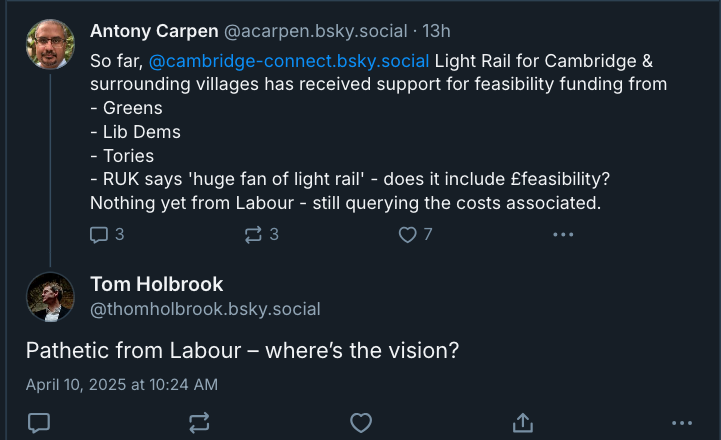
Above – Tom Holbrook, 10 April 2025.
Ministers have a choice:
Either:
- Provide Cllr Smith with the authority to take forward proposals for light rail and indicate the support they are willing to give, or
- Tell the other candidates that central government will not provide the funding or powers for light rail for Cambridgeshire and be done with it so they may as well stop talking about it in their campaigns.
At the moment, all that is happening is that the debates of 2017 and of 2021 are being had all over again but with absolutely zero progress having been made because central government has dithered over whether it wants to make such a radical choice on sustainable transport. This applies both to Conservative and Labour governments. Michael Gove and colleagues had the chance to make substantial policy statements on this but could not get past their fantasy vision statements. I picked up on one of them in March 2024 in Michael Gove’s Case for Cambridge in this blogpost.
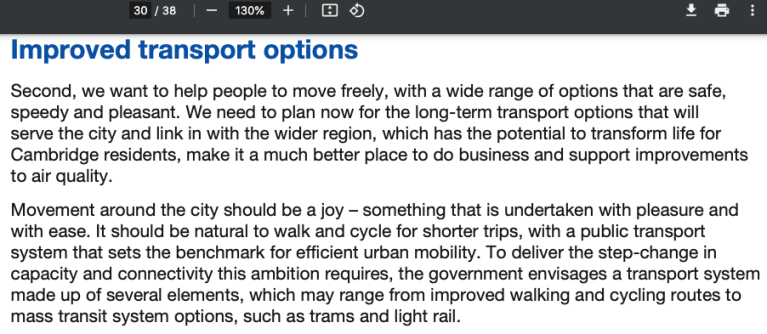
“To deliver this step-change in capacity and connectivity this ambition requires, the government envisages a transport system made up of several elements, which may range from improved walking and cycling routes to mass transit options, such as trams and light rail.”
Above – The Case for Cambridge (2024) HMT p30
The resignation of Lou Haigh seemed to have set back what early hopes I had for trams and light rail generally. By now we really should have had a light rail strategy or policy statement from ministers – if only to provide some sort of clarity over the systems available, the funding mechanisms, and planning processes for getting them built. Essential given that UK manufacturing industries need to get their supply chains ready. Had these been in place much earlier, the decision on whether to nationalise the Scunthorpe steel works might already have been taken.
What of the LibDems and RUK/Team Nigel?
Cllr Lorna Dupre, who leads her group on East Cambridgeshire District Council covered her six priorities:
- Health – healthy population contributes to healthy economy
- Roads – potholes – struggling by decades of neglect and now climate change on peat-based roads. £530m needed to upgrade
- Connectivity more broadly – bringing work to people. ‘Huge fan’ of light rail. Also Bus franchising – next mayor will have to implement it, & cross-ticketing
- Environment, retrofitting, and built environment, & water crisis.
- Housing crisis – genuinely affordable housing
- Skills
The problem again was that there was little for her opponents to disagree with because the powers and funding available are ever so restricted.
And Mr Coogan?
Same funding challenge applies to his proposed ‘Great North Road’ to connect cut-off parts of the county. All candidates are dependent on ministers handing out pots of funding unless/until HM Treasury decides to relax its iron grip on tax-raising powers.
And that doesn’t look like happening anytime soon.
Contact the candidates!
You can find the mayoral candidates here. Feel free to ask them lots of questions. Or alternatively, put the same set of questions to all of them, and compare the responses. Then decide how to cast your vote.
If you are interested in the longer term future of Cambridge, and on what happens at the local democracy meetings where decisions are made, feel free to:
- Follow me on BSky <- It’s much less abusive on here compared with Birdsite (in my experience)
- Like my Facebook page
- Consider a small donation to help fund my continued research and reporting on local democracy in and around Cambridge.

 The Cambridge Town Owl