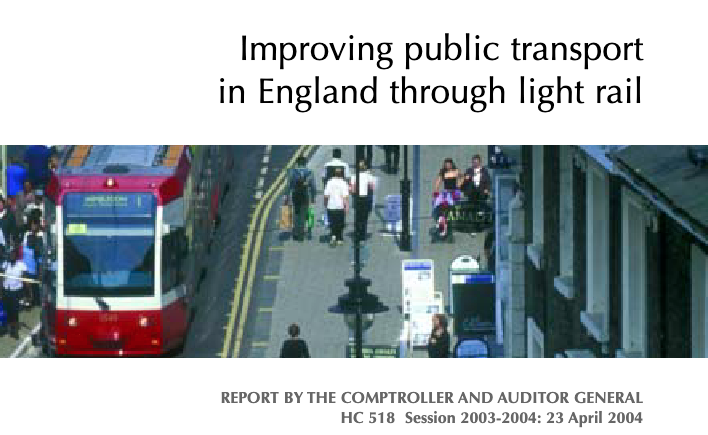
One for Cambridge Connect supporters (myself included!) on some of the lessons learnt from a previous generation of failed light rail projects that never came to fruition
TL/DR? Read the summary from the National Audit Office’s report on light rail here
It started with such high hopes – the ten year transport plan presented to Parliament in the Year 2000.
“Local transport spending will also be increased substantially to a ten-year total of £59 billion. Within this, Local Transport Plan budgets will rise to £1.3 billion next year and to £1.7 billion by 2003/04. The considerable backlog in road maintenance will be eliminated by 2010. Investment will fund more modern bus, tram and light rail systems supported by park and ride schemes. Rural areas will get increased support for more flexible and innovative services. After half a century of decline, bus travel is still the most frequently used mode of public transport and this investment should see it grow by 10% over the next ten years.”
Above – Minister Lord Macdonald Transport Ten Year Plan 2000, p3
By the time Alistair Darling became Transport Secretary – the department having been hived off of what became the Department for Communities and Local Government a few years later, the view was that the money was no longer there to pay for it. (What if the UK had not taken part in the Gulf War II in 2003?)
“CONTRACTORS have criticised poor cost consultancy following Transport Secretary Alistair Darling’s decision to pull the plug on a string of light rail schemes.”
Construction News, 29 July 2004.
These included the Leeds Tram (still not built) and the Manchester Metrolink which was already partly in place only had significant additions to it post-2010.
What the 10 year Transport Plan proposed/promised:
Locally across England:
- “up to 25 new rapid transit lines in major cities and conurbations, more than doubling light rail use
- 10% increase in bus passenger journeys
- extensive bus priority schemes, including guided bus systems and other infrastructure improvements, also benefiting coaches
- new Urban Bus Challenge Fund to improve links to deprived urban areas
- more cities and towns with park and ride schemes
- extension of Rural Bus Subsidy Grant to cover more journeys serving market towns
- extension of fuel duty rebate to more community transport services, and more support for flexible
- transport in rural communities
- half fare or better on the buses for elderly and disabled people
- modern and integrated transport information, booking and ticketing services
- safer cycling and walking routes, more 20mph areas and Home Zones for safer roads, particularly around schools.”
Above – Transport Ten Year Plan 2000, p6
Additionally, the plan proposed delivering the following by 2010:
- “[A] modern, high quality public transport, both locally and nationally. People will have more choice about how they travel, and more will use public transport
- more light rail systems and attractive bus services that are fully accessible and integrated with other types of transport
- high quality park and ride schemes so that people do not have to drive into congested town centres
- easier access to jobs and services through improved transport links to regeneration areas and better land use planning
- a modern train fleet, with reliable and more frequent services, and faster trains cutting inter-city journey times
- a well-maintained road network with real-time driver information for strategic routes and reduced congestion
- fully integrated public transport information, booking and ticketing systems, with a single ticket or card covering the whole journey
- safer and more secure transport accessible to all
- a transport system that makes less impact on the environment”
Above – Ibid: p7
The desired outcomes were meant to:
- “sharpen the competitiveness of British industry
- boost the economic development of all regions
- promote the renaissance of towns and cities
- enhance access and opportunity in rural areas
- reduce social exclusion
- lessen the impact of transport on the environment at both local and global levels.”
Above – Ibid: p8
“So…what went wrong according to the NAO?”
The key challenges that came with the massive increase in state spending following the 2001 General Election (as highlighted in the National Audit Office’s January 2004 report Increased resources to improve public services) were:
- “Complexity of the delivery chain, where delivery of light rail schemes depends upon several partners to be fully effective;
- Capacity of delivery organisations, where local authorities that promote schemes need to have the capacity in terms of staff with the right skills to deliver new light rail systems;
- Targeting of resources to improve public transport where there is greatest need, and for the most effective use of resources; and
- Monitoring and evaluating performance, to determine the extent to which schemes are delivering the expected benefits, on time and within budget.”
Above – NAO (2004) Summary para 3, p1 / p6PDF
The report noted in the summary that while up until then all bar one of the existing light rail schemes had been functioning within budget the were a number of big issues:
- incomplete evaluation of existing systems
- Anticipated benefits have been over-estimated, however, and were ‘not being exploited to the full’
- Light rail systems in France and Germany are designed differently to their English counterparts [perhaps reflecting very different structures, powers, and independence of local and regional government from central/federal governments?]
- Systems in England have been running at a loss
- The forecast costs of schemes currently under development have risen [hence why Alistair Darling scrapped the plans]
- There are fewer barriers to light rail in France and Germany
In the summary document the issues highlighted in the text beneath each headline ***are significant*** and should form essential reading for anyone proposing new light rail in the UK
Even if it’s only the summary and recommendations you read, there is more than enough in them to generate some public questions for the Combined Authorities and for ministers to find out if their departments have acted upon those recommendations.
“Such as?”
The costs of compensating the privatised utility companies – gas, water, electricity.
“The costs of diverting utilities are lower In England, promoters have to pay 92.5 per cent of the costs of diverting utilities. In Germany, promoters contribute less, while in France they pay nothing.”
Above – NAO (2004) p9 / p14pdf
Cherry Hinton Road in Cambridge should have had painted cycleways as part of a revamp of the road

Above from Cambridgeshire County Council 2019.
The reason we didn’t get it is because of the huge cost-overruns from additional charges from the utility companies.
“A spokesman for Cambridgeshire County Council said the initial £800,000 cost had been an “early estimate” and “did not include the additional utility work now required”.”
Above – BBC Cambridgeshire 10 March 2020
If ministers want to drive down the cost of transport infrastructure schemes, they have to put more of the costs onto the utility companies.
The problem is that successive governments enabled asset-stripping owners to load up the companies with such huge debts while paying executives and shareholders huge sums (case study: Thames Water and Macquarie) that any additional costs will be met either with squeals and requests to increase already high bills, or threats to make the firms insolvent (and more squeals from shareholders – including pension funds – about the financial haircut they’ll have to take).
Guided buses – this is where the origins of the Cambridgeshire Guided Busway reside
The plan proposed “extensive bus priority schemes, including guided bus systems and other infrastructure improvements, also benefiting coaches”
Above – Transport Ten Year Plan 2000, p6
The concept of a guided busway had long been discussed in the 1990s in Cambridge – here’s Top Tory Graham Edwards squabbling with senior Lib Dem Councillor Geoff Heathcock over guided buses and an Addenbrooke’s Railway Station – the former making the case for the guided busway.

Above – Cllr Graham Edwards (Cons – Queen Edith’s) on Cambridge City Council vs his Lib Dem opponent Cllr Heathcock who represented the county seat of the same area.
The following year, the Tories in Government made noises supporting the guided busway concept too.
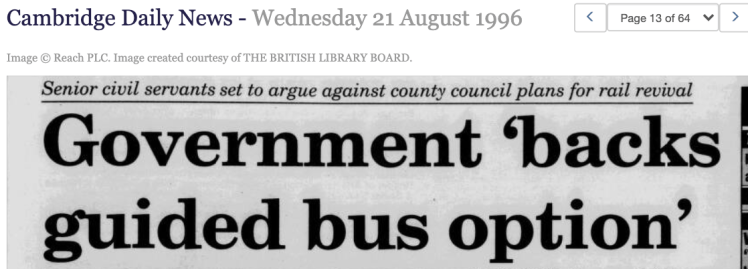
When Labour came into power, not surprisingly given the choice between what looked like fairly well-developed plans for a guided busway vs starting from scratch with light rail, and also wanting a significant new and extended case study to learn from, they offered Cambridgeshire County Council (then led by the Tories) a substantial grant to pay for the revamp of the abandoned railway track bed into ‘concrete rails’.
The problem – as highlighted by the NAO with light rail, was the huge cost overruns meant that it all became very messy and expensive, ending up in the High Court before the County Council and the main contractor BAM Nuttall settled out of court a few years ago.
“Has it been successful?”
Define success.
- In terms of passenger numbers, yes it has been a success
- In terms of creating the space for the access road next to it doubling up as an extended footpath and cycleway, this too has been an outstanding success – demonstrating that cycling commuters are prepared to cycle far longer distances if their route to work on a cycleway has very few interruptions
- In terms of reducing traffic on the A14, no it has not been a success
- In terms of getting stuck in traffic in Cambridge City Centre at peak times, no it has not been a success
- In terms of the technology, guided concrete rails are not being proposed by the Greater Cambridge Partnership – which speaks volumes
- Would a rebuilt suburban rail have been a better solution as proposed by the Cast Iron campaign group? I don’t know.
Given the existing expansion of Cambridge since the 1990s (the city council area has had a population increase of 50% to today) and the huge additional growth proposed by the previous and present government, it may well be that in the next quarter of a century that the busway will be converted to light rail or a future technology.
If you are interested in the longer term future of Cambridge, and on what happens at the local democracy meetings where decisions are made, feel free to:
- Follow me on BSky or on LinkedIn (where I pick up a lot of town planning content)
- Like my Facebook page
- Consider a small donation to help fund my continued research and reporting on local democracy in and around Cambridge.

 The Cambridge Town Owl