Birmingham City Council has been in the news in recent years for all of the wrong reasons – as this timeline on the Government’s website shows. Yet a long-lost publication reveals how great the city once was, before successive periods of centralisation reduced what was once an all-encompassing institution into something of a shadow today. Or is that being harsh?
I’ve digitised my copy here. When you browse through the contents list, the huge range of services – remember this pre-dates the NHS (and universal equal suffrage) – gives us a snapshot of the ambitions that previous generations had for public services. Something recent generations of senior politicians and ministers seem to have forgotten
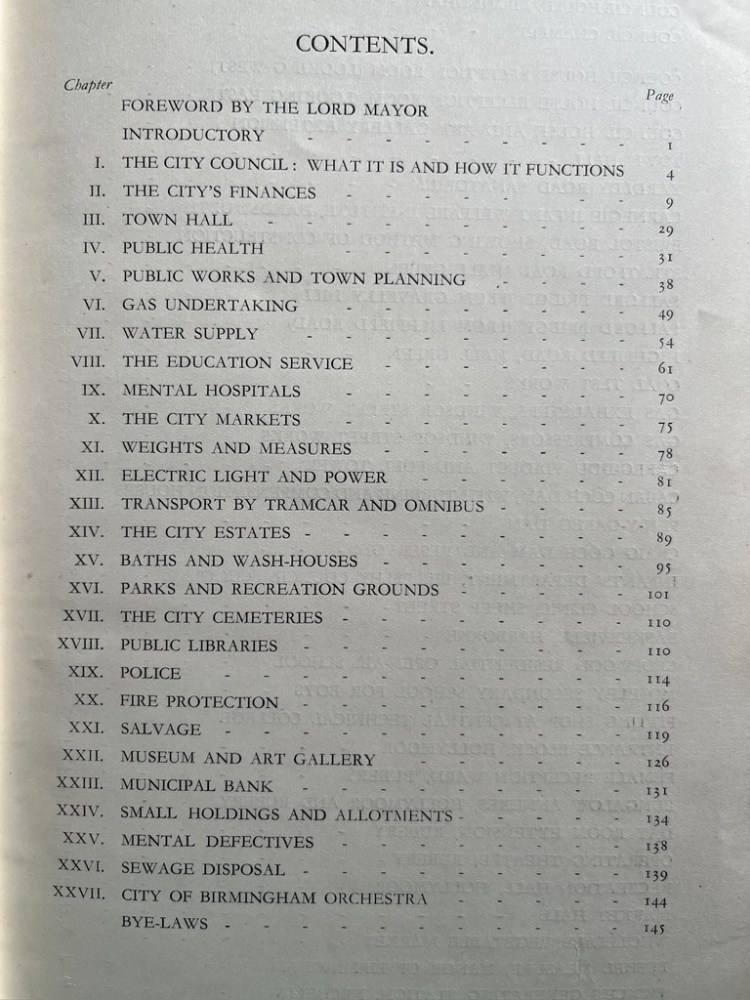
Above – the list of functions from Birmingham in 1928 – p4
How does it compare with other cities?
Let’s take the City of Leicester as another example below
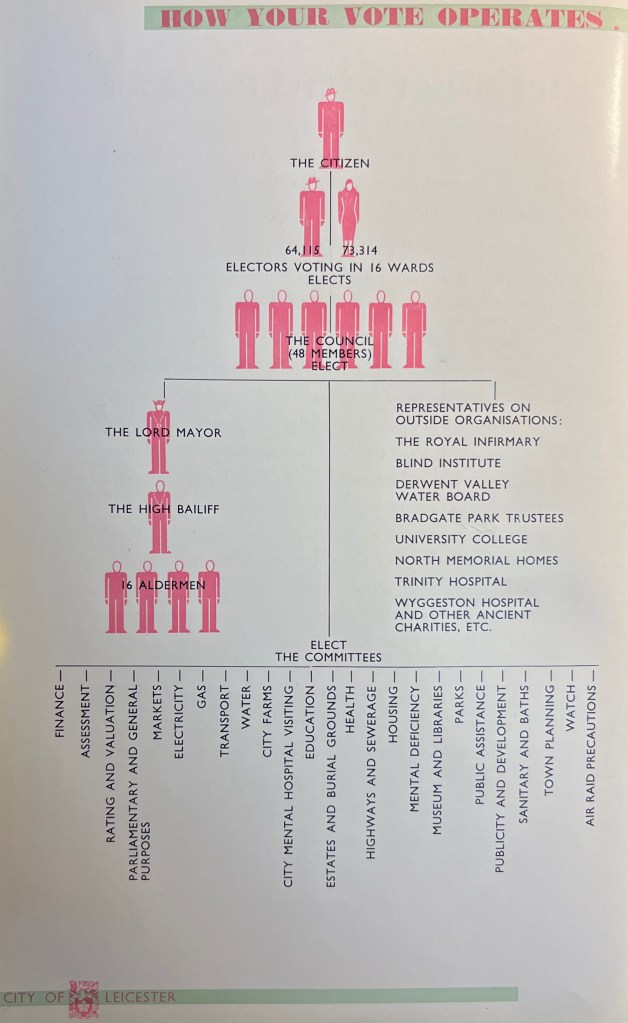
Above – Civic Affairs, the City of Leicester (1939) p5
The privatised utilities stand out
- Gas
- Electricity
- Water
- Transport
Only the Post Office – which at the time was responsible for telecommunications and telegraphy stands out as a nationally-provided-for service which in those days was run by central government, with the Postmaster General being the senior minister responsible.
Education, employment, and wellbeing of teenagers and young adults
On p75 of the Birmingham guide the authors explain the co-ordinating role of the city council regarding the wellbeing of school leavers. That’s not to pretend it was a five-star service in a pristine city.
“During a year over 94,000 visits to the department are made by young people requiring advice or assistance, and situations are found for about 7,000 each year. To ensure success it is necessary to keep in close touch with schools, social organizations, and employers, and it is essential that the officers should have a practical knowledge of industrial conditions.”
Above – City of Birmingham (1928) p76
In an era that pre-dated compulsory secondary education in the way we think of it today, and also in an era when councils did not have the resources to pay for comprehensive secondary education themselves (The inter-war governments in the politically messy decades of the 1920s & 1930s – dominated by the Conservatives even when nominally led by leaders of other parties) chose not to fund such a service. This was hotly contested by the rapidly-growing Labour Party (at the expense of the old Liberal Party) as their 1923 speakers’ handbook shows in their discussion piece on whether to spend on the military vs social and public services.
“That this Conference protests against any curtailment of any opportunities upon grounds of national economy, and demands for the mass of the workers the provision of the best possible educational facilities as an essential condition to the future well-being of the people”
Above – Labour Speakers Handbook (1923) p54
What’s striking about the above-quotation is that the demand for educational opportunities is not just restricted to children. Furthermore, the aim of education is not limited by the narrow corridor of skills policies. Instead, the policy objective is the future well-being of the people.
And yet so many of the social issues that we see in our communities, towns, and cities on a daily basis – and the sort that are discussed in well-connected public policy fields such as the RSA, don’t seem to be finding traction in senior party political circles. (i.e. with senior ministers or their shadow counterparts on the blue benches opposite). Which in our over-centralised state is where it really matters.
The issues on contemporary adult education are not new. These were raised in the Commons Education Select Committee’s report of November 2020 on lifelong learning. I wrote about it in a blogpost at the time – picking up on remarks by the then Chairman Robert Halfon.
Four Pillars of Lifelong Education
“Mr Halfon identifies:
- A community learning centre in every town
- Individual Learning accounts (ILAs)
- Nurse part time Higher Education back to health
- A skills tax credit to revitalise employer-led training”
What has been particularly depressing in this combined authority election campaign is that none of the candidates have mentioned adult education and lifelong learning outside of the very narrow skills budgets that ministers effectively set the policy for and simply use the structures of combined authorities to carry out public procurement exercises. Certainly the Cambridgeshire & Peterborough Combined Authority was not structured to be a delivery organisation – rather a contract management one it seems. Having gotten nowhere with this policy area, I had a look back to the last major overhaul that didn’t involve cuts. Which was Tony Blair’s Government and their Green Paper of the late 1990s called The Learning Age – digitised here.

“Our vision of the Learning Age is about more than employment. The development of a culture of learning will help to build a united society, assist in the creation of personal independence, and encourage, our creativity and innovation. Learning encompasses basic literacy to advanced scholarship. We learn in many different ways through formal study, reading, watching television, going on a training course, taking an evening class, at work, and from family and friends. In this consultation paper we use the word ‘learning’ to describe all of these.”
Above – The Learning Age (1998) para. 8.
At the moment, adult education policies for the age that we are living in seem to be about employment only – and a very narrow strand at that. Not surprisingly, we don’t have the organisational infrastructure, the buildings and facilities, the public transport connections to get people to where they need to be, the systems to enable more employers to contribute voluntarily, or the revenue collection powers to tax them where they will not. Which inevitably means we simply do not have the culture, let alone the collective willpower to make it happen. Something is going to have to give because too many key sectors have ageing workforces as Rail Magazine highlights in its latest issue,
Which brings me back to the key differences between then and now. Today, everything seems to be so fragmented that basic co-ordination is impossible. One of the results of this is that key pieces of information remain stuck in silos and do not get shared as well as they should be. Only relatively recently have we seen academia taken more seriously in public policy circles and some of the political barriers to policy-making acknowledged within some academic fields. The same goes for the general public and the functioning of local government – something which the Birmingham guide reminds us of.
“Adult Citizenship with Rights and Obligations.
“The citizen who has been physically and educationally “ fathered ” by the City till manhood now begins to acquire legal rights and obligations. On attaining his majority, the male citizen [remember no equal suffrage until the following year] is entitled to have his name inserted in the records of the City as a Parliamentary elector. If he becomes a householder or the occupier of a portion of a house let to him unfurnished by the direct householder, he may, because he is responsible for the payment (as rates) of a proportion of the expenses of the municipal housekeeping, vote for the election of city councillors”
Above – City of Birmingham (1928) p11
Who will be the first local election or mayoral candidate to make the case for citizenship education for resident adults who were never taught it at school or college? (You can prompt them to do so by emailing them about this – or any other local issue you might have – see https://whocanivotefor.co.uk/ )
Food for thought?
If you are interested in the longer term future of Cambridge, and on what happens at the local democracy meetings where decisions are made, feel free to:
- Follow me on BSky <- It’s much less abusive on here compared with Birdsite (in my experience)
- Like my Facebook page
- Consider a small donation to help fund my continued research and reporting on local democracy in and around Cambridge.

 The Cambridge Town Owl