
Furthermore, the collapse of social media platforms as mediums of political exchange and debate bodes ill for our democracy
TL/DR? Watch the candidates set out their public transport vision for Cambridgeshire & Peterborough here. (The full debate will follow when I’m fully recharged after the inevitable bout of Post-Exertional Malaise that follows anything I do that requires me to go outside of my front door due to CFS/ME). The organisers are still a few pennies short of meeting their costs so for those of you willing and able to support, please see Resilience Web’s page here.
Where did all of the other hustings go?
It’s not like the olden days a decade ago when community groups and organisations were organising election debates for fun. You only have to browse through my video archive here to see that we’ve lost something important in terms of the public’s ability to hear candidates in their own voices, and to know in advance where and how to put their points of view to them in public.
I was astonished to hear one of the candidates tell the audience that this was the only reasonably accessible debate between the candidates that was open to the public. Other events were either industry-delegates only, or were to an exclusive or membership-only audience. But what can you do if you are only a candidate? Because the moment you start getting involved in *organising* public events, you run the risk of having to declare them in your election expenses – expenses which have limits.
“How did the candidates do?”
I’m refraining from commenting until after the election so as not to influence people’s votes. My take is: Watch the video and hear from all of the candidates in their own voices, and judge accordingly.
If anyone has any further issues they want to press the candidates on for further responses and details, the website Who Can I Vote For? by Democracy Club shows you how to do this – and how to find your candidates for any upcoming elections with just your postcode.
Below – what you should see on the https://whocanivotefor.co.uk/ landing page.

If you don’t ask, you don’t get. And depressingly few people seem to take advantage of the ability to submit questions to candidates. One of the most effective things to do is to send a series of questions on issues that are important to you *to all of the candidates* and to compare responses. Speaking to a couple of election agents last night, they said that candidates liked receiving questions from the public because it shows that the public are both listening, and interested in democracy.
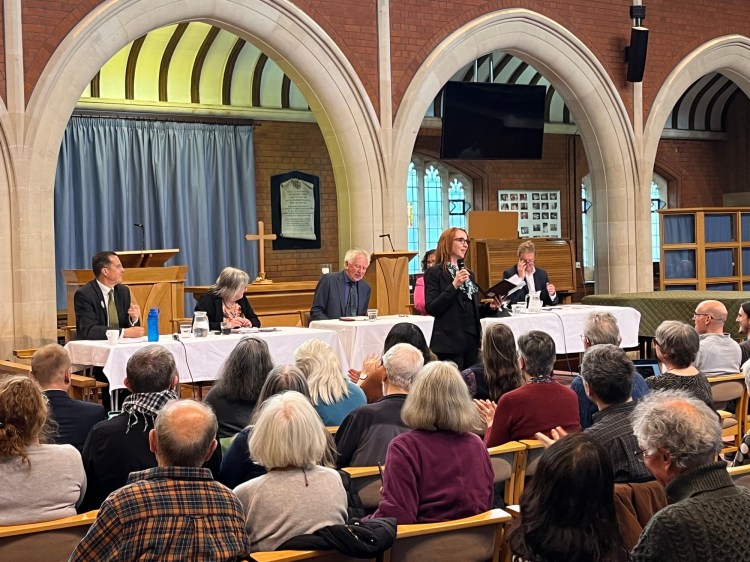
Above – at the start of the event on 23 April 2025 at the Wesley Church on Christ’s Pieces
We were never going to get the packed out audience that we got for the general election debate nearly a year ago. Furthermore, the decline of social media and the gaming of algorithms means that the vibrant exchanges that were a familiar part of campaigns a decade ago are no longer around. Look how few responses CamCycle, one of the supporting organisations, got from one of its few posts at the event.
I counted over 100 people in the main hall – only the far side of the hall had seats visibly unfilled while the seats closest to the entrance were all taken up.
This was not an easy event to organise by any means. I didn’t know it at the time but this hustings actually started off as an informal gathering of about 5 of us at a TeaCambs2 gathering several months ago, which Melinda Rigby led the way in putting something together in the face of such little publicity of the looming election and of any other public debates. (I did ask as I always do in the run up to election time!)
Institutions taking an interest in the growth of Cambridge also need to take an interest in the sound governance of Cambridge – and of the county too.
This is particularly the case when it comes to strengthening our democracy – even when that strengthening seems like it is making things difficult for those very same institutions – looking at you University of Cambridge and your colleges & member institutions.
Just because complaints and comments from residents might be annoying and disruptive does not mean they are without merit. Sound and competent leaders would very publicly not only welcome that scrutiny but also construct structures, systems and processes to take on board constructive criticism that comes from them in order to improve the proposals on the table – and perhaps bring through some even better ones.
For an example of ***how not to do this*** you only need to look at the Greater Cambridge Partnership, which squandered all of the goodwill it had in the mid-2010s because of a culture of ‘design and defend’ with controversial transport projects that when looked at today, expose not only the flaws in the concepts but also the flaws in the policies and the creation of the GCP in the first place. In my opinion as someone who has followed their meetings, papers, and deliberations for the past decade. Most of you probably had better things to do in that ten year time period! (Me being generally housebound if not restricted to being in Cambridge only, didn’t have nearly as much choice as in decades gone by!)
“So, who needs to do what to go forward?”
Ultimately it requires democratically-minded individuals within institutions to challenge decision-makers within those institutions to be part of the longer term solution. Especially as we will soon be called upon to shape the structures of the new unitary councils that ministers are lining up for England. That is something that goes far beyond elections, and into something the candidates briefly discussed at the hustings: Citizenship and democracy education. Because events of the past six months really have focussed minds on the threats to it. But if too few of us know about the essentials of democracy, how are the public meant to know what they are defending, and what the threats look like?
Food for thought?
If you are interested in the longer term future of Cambridge, and on what happens at the local democracy meetings where decisions are made, feel free to make a small donation to help fund my continued research and reporting on local democracy in and around Cambridge

 The Cambridge Town Owl