The Cambridge Room opposite Boots in the Grafton Centre will be open from 10am-5pm on 10 May 2025. I start off things with a workshop on democracy.
Have a watch of this short reel here
The timetable is as follows:
- 10.30am-12.30pm: Workshop: What Has Democracy Ever Done for Me? Led by Antony Carpen.
- 12.30-2pm: Badge-making – make your own badge with your favourite democratic saying on it. Or choose from our own selection. Then wear it proudly!
- 2-3pm: Democracy Open House. Reflect on the May 1st Local and Mayoral Elections, in an open conversation. We’ll be thinking about Voting –
- how fair and representative is the current system?
- What would make it fairer and more representative?
- Why did or didn’t you vote?
- 3-5pm: ‘Show Your Hand’ and Map-making.

Above – I can’t pose to save my life. At a previous Trials of Democracy event at The Guildhall
“Badge-making?”
Yep. I might get this one made up. But with a different logo – probably the Commons portcullis. Unless it’s an arrestable or indictable offence.
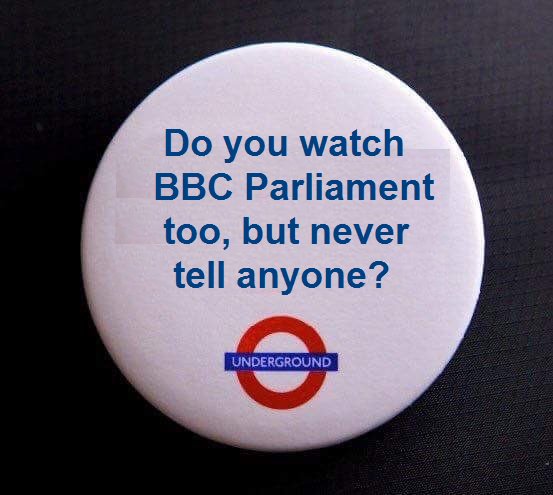
Above – anyone else in this boat?
“But what has democracy ever done for us?”
My workshop isn’t going to be like a scene out of the Monty Python sketch.
Above – “What have the Romans ever done for us?”
In one of my first seminars at university in the very late 1990s, we had a film series to watch followed by seminars where the facilitators carried out the delicate task of deprogramming us from everything that we had learnt for our A-levels.
Other takes of the sketch have been made since then, including
What previous workshops and campaigns have taught me
Our collective knowledge of democracy, politics, and current affairs is very limited – irrespective of people’s level of educational attainment

Which reminds me – bring a couple of these titles along. With so many cohorts and generations having experienced next to nothing in terms of politics and democracy education at school (i.e. civics and later citizenship), even the most highly educated individuals may never have taken part in discussions about things like the rule of law and parliamentary democracy. Which means it’s easier for threats to democracies such as this to go unchallenged.
The relationship between citizen and local government varies significantly – in particular by tenure of residence
Residents living in properties they own outright (i.e. the freeholds to, not leasehold) may have an interaction with local councils that involve little more than refuse collections and voting. People living in council houses however, have a much more interactive relationship with their local councils as service-providers – something that people in the former might be completely oblivious to. Furthermore, as owner-occupiers you have the ultimate option of selling up. and moving to another part of the city, country, or planet in search of a better life. In council and social housing, your options are much more limited – moving away eg to get away from anti-social behaviour issues is not an option.
Previous generations have already told us what we need to do to strengthen democracy – in particular those that lived and fought through the two world wars
Have a browse through some publications from the eras:
- Citizenship syllabus…for adult immigrants in evening schools (USA – 1916)
- The education of the citizen (1920)
- People and Politics (1943)
- The discussion group leader (1944)
- Democracy and Local Government (1945)
- Is Britain a Democracy? (1945)
- GCSE Citizenship (2002)
How do these read to you?
Even GCSE-level materials might be too dense content-wise for people who never had the chance to learn about and discuss the first principles.
Sometimes even materials aimed at GCSE-level readers (mid-teens/Key Stage 4) are too heavy for a general public that may have been out of education for a number of years, who may have left school at sixteen, and/or who find the intensity of some of the content off-putting. (Some people I know who have university degrees have commented how dense some of the GCSE Citizenship content is).
There is a subtle but significant difference between learning about civics & citizenship, vs learning about politics and government
With the latter, many of the educational materials are educating students to pass an exam – where they have to demonstrate both recall and understanding of specific concepts. Civics and citizenship on the other hand serve a very different purpose – as explained in the book at the top of the list from the USA in 1916 – which I featured in this blogpost.
“Purpose. It is important to emphasize that civic training does not include so much a knowledge of the machinery of government as a knowledge of its social and reciprocal relationships to its citizens.”
Citizenship Syllabus (1916) USA-DfE p8
In 21st Century UK chances are people who grew up in and/or who live in council housing have a much better day-to-day understanding of the social and reciprocal relationships between citizen and the state than anyone else. For example think of more affluent families that send their children to private schools and who, outside of emergencies are registered with private healthcare providers (from GPs to private hospitals).
‘Put on the music and they will come’ – pondering future events
Despite limited advertising, a couple of hundred people rocked up to the last couple of music in the park events at Coleridge Rec. (I counted!)

Above – from August 2021 at Coleridge Rec
I took this just after it stopped raining. Then the sun came out, and as if from nowhere lots more people arrived!
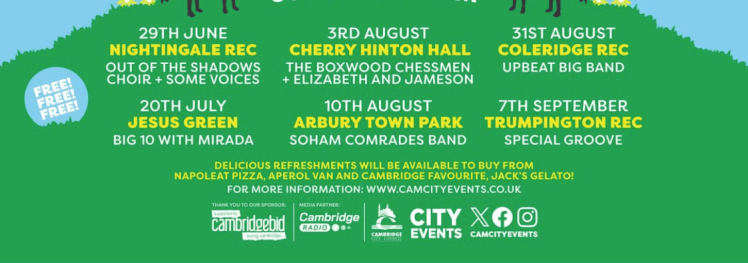
Above – the dates (which I hope will be on the city council’s website soon!)
Essentially I want to get a sense of what would work well for a Sunday afternoon in the park in terms of pop-up displays, very simple surveys, simple quizzes (this is not a politics exam!), children’s activities, and giveaways. (Eg producing a quiz sheet that gets families asking a question of each public service or community pop-up, and every person/family who completes a sheet gets a lolly or sweet from a host stall).
It’s worth noting that neither Queen Edith’s nor Coleridge wards have their own area-based free-to-access community festivals in the way that north Cambridge has with the Arbury Carnival and the Chesterton Festival. Hence the importance of the former two wards to make the most of the opportunity provided by having a critical mass of local residents turning up to the same place at the same time. The challenge inevitably is not to do a ‘hard sell’ – and respect the fact that people are turning out for the music and a nice afternoon in the park, not a citizenship lesson! (I think that applies to me more than anyone else!)
Food for thought?
If you are interested in the longer term future of Cambridge, and on what happens at the local democracy meetings where decisions are made, feel free to:
- Follow me on BSky or on LinkedIn
- Like my Facebook page
- Consider a small donation to help fund my continued research and reporting on local democracy in and around Cambridge.

 The Cambridge Town Owl