
They can’t all be taking exams – so why was a warm Saturday night in Cambridge absolutely dead at a time when it should have been buzzing?
I went to the Cambridge gig of Oysterband’s farewell tour at The Junction on Saturday night (last night) in what was a sellout gig that also, for the first time I’ve seen at the J2 had external security staff. Which made me wonder whether a gig full of middle-aged people (for I am also one of them now!) was going to kick off or whether it was one of those ongoing anti-social behaviour issues at the woefully-designed Cambridge Leisure Park (it’s still the Cattle Market for us older people as prior to the redevelopment part of the site was a longtime derelict livestock market).
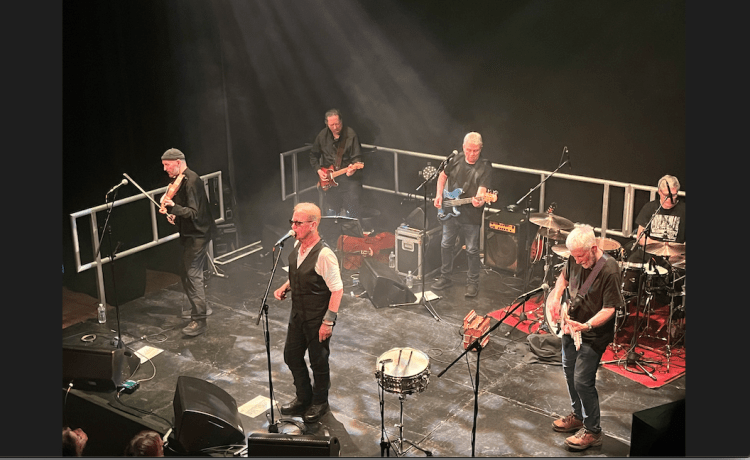
Above – Oysterband at the J2, The Junction, Cambridge 10 May 2025
It sold out due to this being one of the last dates ever in the band’s touring history that started over 40 years ago – hence the huge following of people who had seen them many times before. This was the third time I had seen them, the previous two times being at the Cambridge Folk Festival in 2004 and I think 2007.
What struck me walking back around 10:30pm was how ‘dead’ the place was. To the extent that I’m surprised the land owners, Land Securities are not worried.
“In the case of the Cambridge Leisure Park, it’s owned by Land Securities – the sort of firm inevitably more focused on the return on investment than on creating a vibrant scene of independent individuals and organisations doing their own thing and coming up with their own vision.”
The site was designed to appeal to teenagers and young adults – in particular the lucrative language school market. The problem is that as a privatised space with nominal access to the public so long as they spend money, the site has huge problems with the over-crowded Hills Road Sixth Form College across the major road junction.
“[One of the students] told me of the constant harassment of teenagers by security guards on the site who, if the former are not buying things or paying for services, then they are technically loitering and can be ejected from the site.“
Furthermore, one consultancy study noted that the site was one of the few public spaces mentioned by young people as a space for young people.
“There are limited places within Cambridge city that young people feel a sense of belonging, the only location directly mentioned by young people was Cambridge Leisure Park. No low-cost or free alternative was identified.”
Cultural Place-making Strategy, NE Cambridge, June 2020. P37
I incorporated the above into a piece about how Greater Cambridge was failing teenagers and young adults. This was in March 2021. Have things gotten better for them in the four years that have passed? I fear they have not.
Not surprisingly, some businesses are pivoting towards those 1990s teenagers in the hope that by running events similar to that era but with slightly more family-friendly and work-life-friendly hours, they can make up for the lack of teenagers and younger adults.
Fun as such events are (I’ve been to a few of them), it can never make up for being at a night where you are surrounded by lots of friends and acquaintances, and where there’s the inevitable buzz of meeting new people. (Something that as I’ve gotten older I’ve found the process of meeting new people to be emotionally exhausting).
Why is Cambridge not doing better than this?
For a city supposed to be all about young people and education, the economic and governance structures seem to be awfully effective at driving young people out of public spaces. It also struck a jarring note with a series of professional photographs taken by local photographer Ian Olsson at Eddington in Cambridge which for me capture the soulless urban design of the entire development. The vibe of the people in the photographs captures what the commissioners wanted Mr Olsson to capture: Affluent, educated, international, cosmopolitan, ‘London-by-the-Cam’ of like-minded people having a relaxing time after a hard week working on cutting-edge research.
But that’s not the life much of the rest of our city is living.
At the Trials of Democracy workshop I hosted – again far fewer people going along despite a fair amount of social media advertising (a rethink on how Cambridge advertises community events is now long overdue), the housing shortage came up. In particular the council housing waiting list which, despite significant council house-building by Cambridge City Council, has only gotten longer. Two of the participants who came along live in council housing or supported housing – which also made me wonder why so few policy advisers in the area of housing have actual limited experiences of the social problems they are trying to solve.
It wasn’t lost on us the fact that at The Cambridge Room we were sitting in a complex that until recently provided hundreds of stable jobs for people from working class backgrounds. That the site is being turned into a sci-tech sector is ultimately the result of a series of Political decisions:
- the decision not to level the playing field between high street and online retailers,
- the decision not to designate the site as a retail site and not suitable for sci-tech functions, and
- the decision not to require the privatised bus services to provide services from across Cambridge to use the purpose-built bus station.

Above – The Grafton Centre with nearly all of the old retail units closed. If you want a glimpse of what the end of consumer-retail looks like, here’s an example
Add to that the number of supermarkets and convenience stores that use self-service checkouts even though they don’t need to – thus depriving teenagers of entry-level jobs that are essential not just for work experience but for their socialisation into wider society after having spent their daytimes surrounded by people their own age all the way through their school years. But then back in April 2024 I accused politicians of not preparing younger voters from the general election, so the government not preparing and providing for other things in young people’s interests comes as no surprise.
The final thing that struck me as disturbing was the early closing of so many of the local takeaway outlets. Up until the first lockdown, most of the outlets closed around pub closing time. Clearly something has happened since then that’s made staying open until 11:30pm no longer economically viable.
Given that on the final Saturday before Christmas 2024 I noticed similar depressing scenes, Cambridge’s decision-makers really need to have a good look at the root causes of the current malaise
Because if in affluent Cambridge the night life seems to be struggling so much for ordinary residents, I dread to think what it’s like elsewhere.
And this cannot be sustainable. And as if on cue, Extinction Rebellion Cambridge returned as part of the nationwide demonstrations over the collective failure of politicians, corporations, and highly influential/wealthy people to restrict planetary temperature rises to under 1.5 degrees celcius.
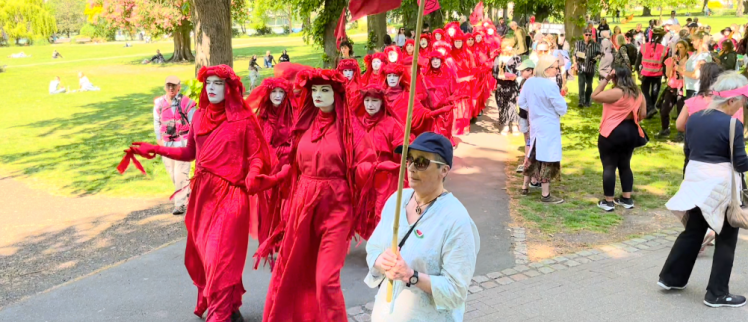
Above – the start of the XR march in Cambridge, 10 May 2025
What are the solutions? I don’t know – but in order to come up with them we cannot rely on social media to help organise and publicise events in the way we used to in the 2010s.
Food for thought?
If you are interested in the longer term future of Cambridge, and on what happens at the local democracy meetings where decisions are made, feel free to:
- Follow me on BSky or on LinkedIn
- Like my Facebook page
- Consider a small donation to help fund my continued research and reporting on local democracy in and around Cambridge.

 The Cambridge Town Owl