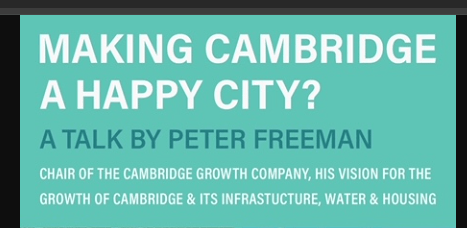
It’s still early days – and a consultation looms this summer before he makes his report that will include a recommendation on the geographical area his development corporation powers should cover
See also Phil Rodger’s live-comment feed here
I’m not going to say too much as I’ve burnt out and had to leave just as the last question from the Save Honey Hill campaign was being asked. I was a little surprised to hear the some of the audience groans at what had been nearly two hours of presentation followed by Q&A. I think I scored the rare record of asking the *shortest question* (about how the Cambridge Growth Company was going to engage schools, children, and young people) which made a nice change!
A subsequent following question from environmentalist Monica Hone asked the audience if they were for or against the principle of growth. It was a fairly equal split which was interesting to note – even though there were a number of local councillors familiar with and involved in the decisions on the recent growth of the city.
We still don’t know the geographical area
See the start of the Q&A session beginning with Terry Macalister here, summarising the huge number of issues and challenges that Mr Freeman will have to deal with.
If anything, this event did the city and county a huge favour in bringing many concerns about the future of growth into a single space. It would have been better to have had the Minister for Housing and Planning – the decision-maker, taking Qs from the audience himself. Given that the MP for Cambridge, Daniel Zeichner is a Minister of the Crown, he is bound the the Ministerial Code to support the government policy on all issues. Which inevitably disenfranchises local residents. But that’s a problem with our system and structures nationally because it requires 90 or so MPs to become government ministers. By saying Mr Zeichner should only be a backbench MP simply transfers an existing problem somewhere else rather than dealing with it at source.
There will be a future large consultation later in 2025
I asked Mr Freeman about how he will engage with schools, children, and young people. Have a listen to his answer here
I’d like to think there’s an opportunity for the CGC to commission educational materials for local schools to use as part of geography, local history, and citizenship lessons. Given that Mr Freeman said that his time frame was beyond the existing and emerging local planning periods (i.e. beyond 2040), the opportunities educating children about the decision-making processes and working on projects that all connect with both where they live, and the area’s future, is rare one and one that should be embraced.
Hold the Minister accountable for the Government’s policies
Before the event I printed out large copies of the Minister’s appointment letter to Mr Freeman (See here, scroll down). I highlighted the bullet points in that letter (second page) which were the Minister’s clear priorities for Mr Freeman. I said to the people in the queue walking past that if they had any issues with that list of priorities, they needed to hold the minister to account, and the best way to do that was to ask their MP to forward on their questions to the minister for a response. (With a big print out of https://www.writetothem.com/ to make the point). The number of people taking photos of the documents – even from a politically-aware audience, showed that there’s more work on democracy education for adults that needs doing. Because ministerial accountability to MPs, and MPs’ accountability to constituents are key pillars of our democratic system.
With thanks to FeCRA for organising the event
– which I thought went really well. (Do drop them an email if you found the event itself useful – it helps make the case for organising future events too!) The number of councillors and politicians that turned up (I spotted former CPCA mayor James Palmer in the queue – now of the Eastern Powerhouse) showed to me that there’s room for public sector organisations to support such events that enable the sharing of views and opinions with key decision-makers from outside of the city. It should not be left entirely to voluntary organisations alone to carry out those key functions of our democracy – something that has been all too common in recent years.
If you are interested in the longer term future of Cambridge, and on what happens at the local democracy meetings where decisions are made, feel free to:
- Follow me on BSky
- Spot me on LinkedIn
- Like my Facebook page
- Consider a small donation to help fund my continued research and reporting on local democracy in and around Cambridge.

 The Cambridge Town Owl