
I’m still reeling from what one youngster asked me and a fellow volunteer of the Queen Edith’s Community Forum at today’s Queen Edith Summer Fete when we asked him about current and future facilities for children and young people.
The children and teenagers of Queen Edith’s did not hold back when it came to describing what’s not functioning for them in our city – as well as talking about what they think our growing city needs to provide our residents (young and old) with.
If I didn’t have a reason to put this question to the Chair of the Cambridge Growth Company, Peter Freeman last Thursday at Great St Mary’s, the children at the Queen Edith’s Summer Fete provided me with it earlier this afternoon. (Splendidly organised by the Queen Edith Parents, Staff, and Friends Association because the entire afternoon is basically spent herding cats that have just had their fill of sugar and ice-cream!)
Talking to one of my younger relatives at the event, I mentioned to her that the first one of these I went to was 31 years ago. Same field, similar vibe, but without of the really big inflatable-type attractions that technology has enabled more recent generations to enjoy. The other thing that stood out was that the event was almost entirely cashless – people and families either buying their plastic tokens up front, or being gifted them. Important when you consider that the state schools in this part of our city serve children living in council housing as well as those living in expensive, detached houses. In that sense it was little different to the children and the neighbourhood I grew up in.
In preparation for the event, I printed out a series of A3 posters along with packs of A5 photocopied worksheets from the Developing Citizenship book published 20 years ago. The photocopiable templates still work well today. Written at the top of ‘How to contact your councillor’ was the website https://www.writetothem.com/

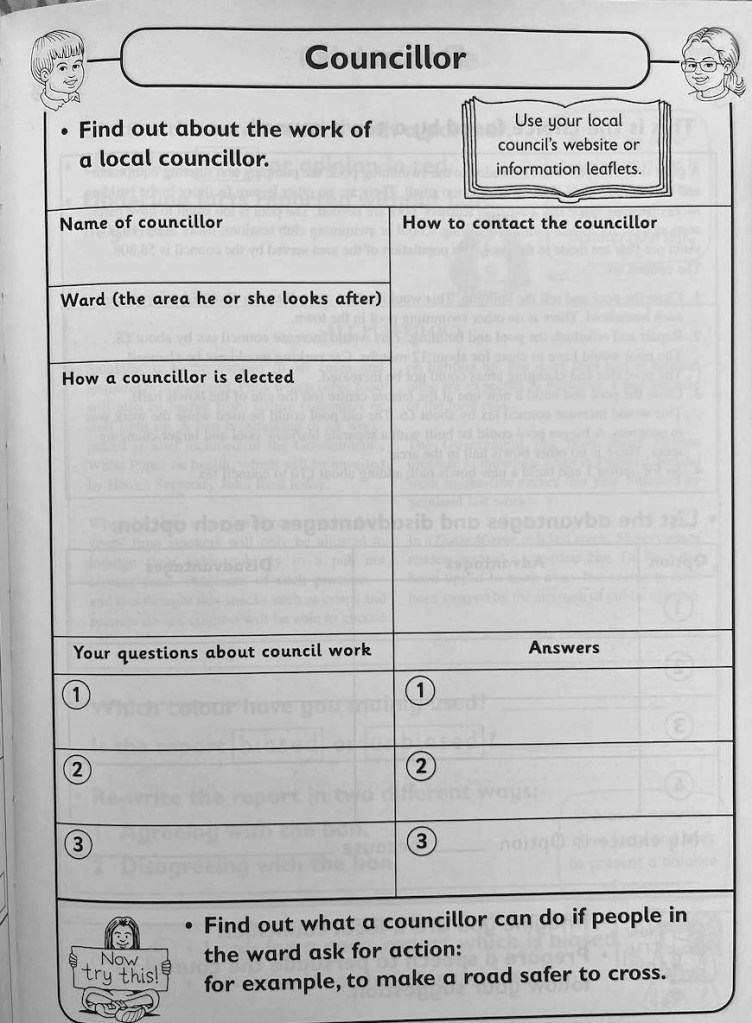
Above – prompt sheets for the children and teenagers discussing the future of our city (from Developing Citizenship – Year 6 (2005) by Moorcroft)
I was also lucky to have Cllr Immy Blackburn Horgan (LibDems – Queen Edith’s) on hand to talk to half a dozen teenage girls who were the first to get the conversation going – because until then only a couple of people had been to my stall. After that, the rest of the children seemed to follow – bringing more friends and their parents too.
Setting the picture for the children: The Government’s proposed expansion of Cambridge
As Peter Freeman told us last Thursday, he does not have a defined geographical area/definition of Cambridge. So I printed off a large copy of the emerging local plan first proposals from the Greater Cambridge Planning Service to show the children what was already being proposed.
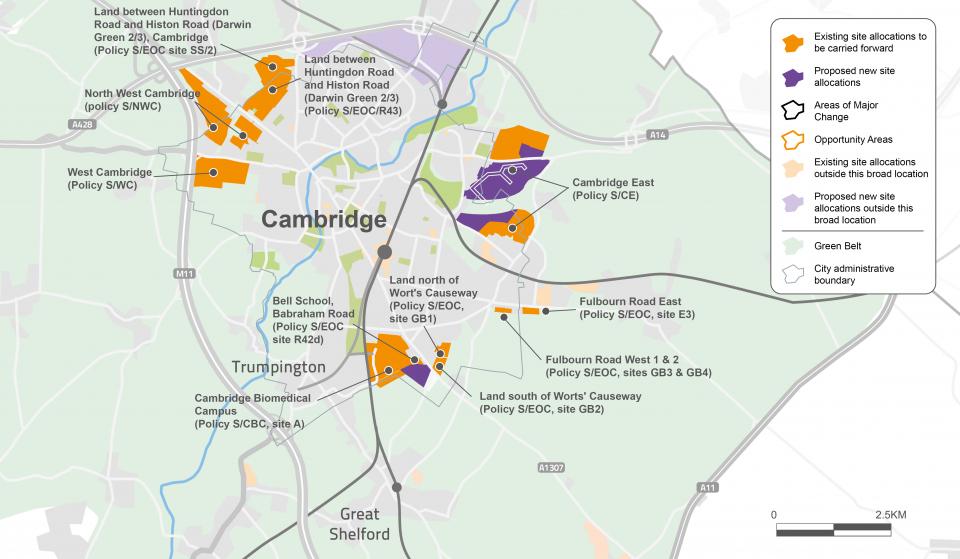
Above – from the Greater Cambridge Shared Planning Service.
Because most of the children told me they had not heard about the proposals – although a few had seen lots of building work happening in their neighbourhoods, this helped them understand what was happening and why it was happening.
Having the prompt sheet list of facilities to hand, it gave them something to discuss with each other and with Cllr Blackburn-Horgan, who ended up having extended conversations with children and teenagers who might never have met a local councillor before.
**Cambridge is not posh – it just hides behind the colleges!**
…said one teenager to me when asking if one of the former Prime Ministers was on https://www.writetothem.com/ – then saying he probably lived in a rich and posh area. I said that a lot of people think Cambridge is rich and posh. To which she replied it wasn’t – it just hid behind its university-reputation.
The quartet of girls got talking to one of the other Queen Edith’s Community Forum members and she asked them about what their schools were like. Between them they went to different schools but the four responded that both have the same issues, and both have different ways of dealing with them. One being strict, the other being less so – but neither are successful in their view at dealing with them.
The other thing the eldest of the four told us was that adults and ‘the authorities’ had absolutely no idea of the problems and challenges that teenagers face out and about in our community. Furthermore, this has an impact on the areas of the city and the public spaces that they feel comfortable in. Which struck me hard because this was a problem our city had back in the 1990s. This diary entry below reflects how 30 years ago I saw Cherry Hinton as a ‘no go zone’ because in my mind there was no one in authority around to intervene if you got ‘started on’.

Above – Diary entry 13 June 1996 – day of my final GCSE Exam
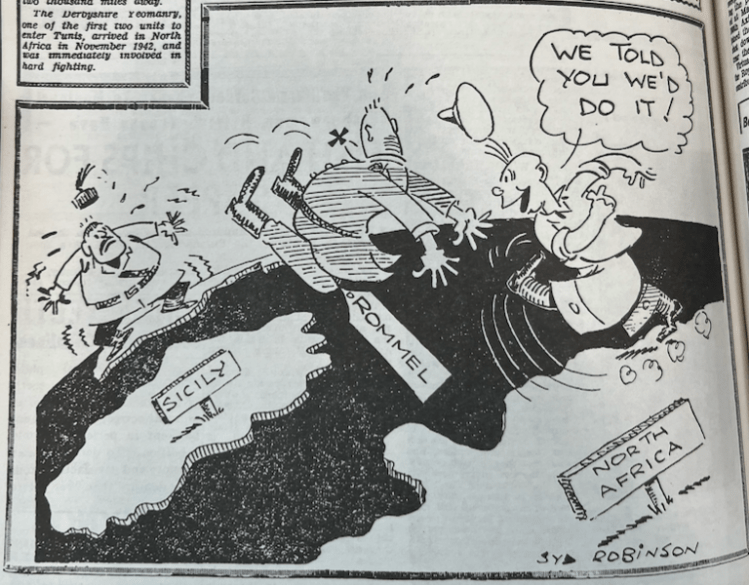
Above – what my 1996 diary sketch was based on: Syd Robinson on the allies ejecting the axis powers out of North Africa in WWII
As a result from my early teens I stopped going there. Furthermore, it shaped my overall view of Cambridge in my late teens in that as a city there was nothing left there for me. Because there was no civics or citizenship programme in schools in those days – no, I haven’t forgiven John Major and Gillian Shepherd for that policy which has had a toxic legacy, there was no one to persuade our generation that Cambridge was ‘our city’ – the future of which we could influence. So when people ask if I recalled the decisions being made under the incoming Labour Government, well…no I didn’t, because the city had spent my entire childhood that our generation was not wanted or valued. So we responded in kind. Hence being back here represents something of a passage-of-life failing on my part. (Although it was my imploding mental health that resulted in me having to come back here – I was content to stay in Brighton otherwise, where being surrounded by radical environmentalists and activists meant I developed a very healthy scepticism of large institutions – and especially those institutions that dominated my childhood in Cambridge)
The Cambridge of the 1990s didn’t have any council-run youth clubs that I can recall of
If there were, we weren’t told about them, let alone invited to them. So when one youngster asked the two of us Queen Edith’s Community Forum reps: “What is a youth club?” my heart broke. Even thinking about what he said now makes me both sad and absolutely furious. Cambridge is still failing our children a generation later after it had failed my own one.
The problem won’t be solved by me stomping furiously into the Guildhall at the annual council meeting on 22 May and shouting expletives at councillors. Nor will it be solved me doing the same at the first Combined Authority meeting on 04 June by going after the newly-elected Mayor for the failings of his political party when he was MP for Peterborough.
This is going to require a much more considered approach that involves trying to get the decision-makers of our city to take moral responsibility for the children who represent our collective future. And at the moment all I am seeing is a token response in the face of the challenges. Again, the structures of the institutions that govern our city are not fit for purpose – which is why both the consultations on the structural overhaul/creation of unitary councils, and the one announced by Peter Freeman on the Cambridge Growth Company’s remit and powers, will be ever so important going forward.
The Faculty of Education at the University of Cambridge should stand up and be counted. The should facilitate an overhaul of how schools and teachers engage with local decision-making and democratic institutions and come up with a comprehensive long term approach on how children, teenagers, and young people can influence the future of their city. That means working with teachers to come up with annual schemes of work that involve children and teenagers learning the essentials of local decision-making processes in order to influence them as they grow older. Over a decade ago I wrote up a series of ideas that I had worked on in the early 2010s in this slide set. One of them involved civics at a time I had limited knowledge of citizenship education – something that Michael Gove and colleagues were busy gutting.

Above – Ideas for making Cambridge a better city (2014) A Carpen
Some of you may even have been around long enough to remember Puffles’ manifesto from 2014 here! Two of the younger children who rocked up to our stall were more than familiar with the Coleridge Dragon Slide that resulted from that campaign!

Above: Vote dragon, get dragon! Photo by Hilary Cox Condron – currently working on the Trials of Democracy project in Cambridge.
“So, who needs to do what?”
Exactly.
And the really big barrier?
The people of Cambridge are struggling with consultation fatigue and activism burnout
The lack of social media discourse combined with the lack of local mainstream media coverage of Peter Freeman’s speech 2 days ago at Great St Mary’s (at the time of writing, none of the Cambridge News (which holds the Local Democracy Reporter post), Cambridge Independent, nor BBC Cambridgeshire have articles on this. (Although I expect one will be included in the Cambridge Independent when its next issue comes out on Wednesday next week).
Ultimately this will require a new generation of people to step forward. But that means having an offer to residents young and old that are not open-ended. Those old ‘SMART’ targets? (Specific, Measured, Achievable, Realistic, and Timely) rather than one that puts all of the burdens on too few people. It’s one of the reasons why I like the concept of Universal Basic Income – it has the potential to free up more people to do things in their communities. Until then, I’m of the view that the key roles should be paid, and funded through grants. In particular the ones that involve the sorts of non-technical roles no one wants to do – organising meetings, chairing, minuting, and publishing reports.
In the meantime, the next Queen Edith’s community event is the city-council-funded Music in the Parks event (which will be followed by similar events in other city parks)
- Sun 29 July
- Sunday 3-5pm
- Nightingale Rec, Nightingale Avenue (off Queen Edith’s way), Cambridge
I’m suggesting to the Queen Edith’s Community Forum that we invite community groups to hold stalls and also invite public organisations running consultations and/or that have an outreach function to do the same in the 2-3 hours before the music starts. Because if these show promise, it might help make the case for a Cambridge Societies Fair

Food for thought?
If you are interested in the longer term future of Cambridge, and on what happens at the local democracy meetings where decisions are made, feel free to:
- Follow me on BSky <- A critical mass of public policy people seem to have moved here (and we could do with more local Cambridge/Cambs people on there!)
- Like my Facebook page
- Consider a small donation to help fund my continued research and reporting on local democracy in and around Cambridge.

 The Cambridge Town Owl