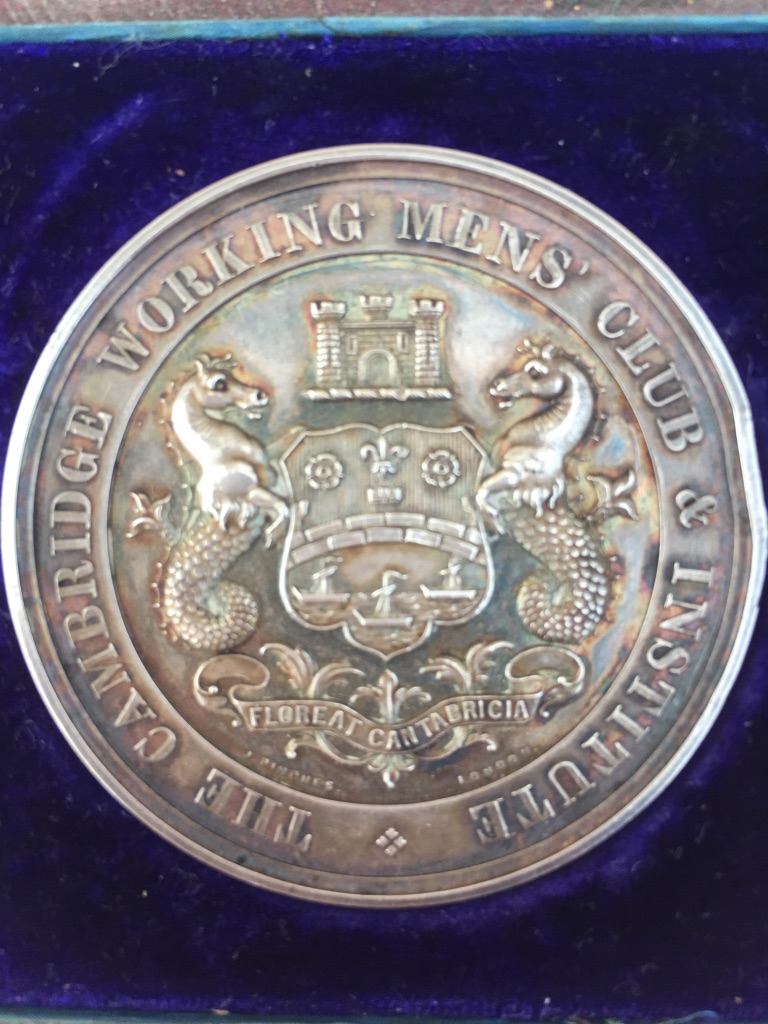
The deputy civic mayor for the previous municipal year was elevated to the mayoralty earlier today. She follows in the footsteps of previous Romsey Labour councillors Bill Briggs and Labour MP Barry Gardiner – whose daughter Cllr Beth Gardiner-Smith (also of Romsey) seconded her nomination
You can listen to the new Mayor of Cambridge’s speech here
I wanted to have the title: “Mayor says ‘Music makes us one'” but I already used the words of Sir Roger Norrington at The Proms in a previous title on a similar themed blogpost.
“I thought we already had a mayor!”
We do – and for this year it’s Cllr Dinah Pounds, who succeeds in a very long line of civic mayors dating back to when Cambridge got its first Royal Charter over 800 years ago. When Parliament passed the Municipal Corporations Act 1835 – a milestone that represents the start of modern local government in England, the proper recording of who became our mayor became more formalised. Hence many lists date back to that time.
“No – the other mayor who just got elected!”
That will be Paul Bristow who was recently elected the Mayor of the Combined Authority for Cambridgeshire and Peterborough, an office that is less than a decade old. And we’re still waiting for the Government to publish its Devolution Bill to see what powers it proposes giving to Combined Authorities.
We also met our new city council leader – Cllr Cameron Holloway (Lab – Newnham)
Think of the Mayor as “Mr Speaker” of the city council, and the council leader as a sort of ‘Prime Minister’ for the city, but with hardly any powers and even less funding. The leader determines the policies of the council with the support of a team of executive councillors. You can listen to Cllr Cameron Holloway introducing his Cabinet here, which include:
- Cllr Rachel Wade – Deputy Leader, Strategy & Equalities
- Cllr Gerri Bird – Housing
- Cllr Rosy Moore – Climate & Environment
- Cllr Martin Smart – Open Spaces & City Services
- Cllr Antoinette Nestor – Culture, Economy, Skills
- Cllr Anna Smith – Communities
- Cllr Simon Smith – Finance and Resources
- Cllr Katie Thornburrow – Planning Transport
- Cllr Mike Todd Jones
Cambridge’s first musical mayor
I think I’m correct in stating that Mayor Dinah Pounds is Cambridge’s first mayor who is also a published musician. And possibly the first East-Ender from London.
“Dinah and Adam Pounds have been giving recitals for many years both in Cambridge and London and in particular at St. Bride’s, Fleet Street where they have made regular appearances.”
From the website of Dinah’s husband, Adam Pounds – also a musician
“[As a child] music was my passion, and I was fortunate to live in an enlightened, socialist-run borough, [Waltham Forest, founded in 1965, has only once in its history has had a non-Labour leadership] that recognised the importance of the arts both in terms of social mobility and for the quality of individual and civic life that they can provide.
“The philosophy of the socialist and artist William Morris underpinned Waltham Forest’s ethos.
“I do not want art for a few, anymore than education for a few, or freedom for a few.”
“This sentiment was applied in practice in the form of free instrument loans and tuition, school and borough-wide orchestras amongst other things. For many of us growing up in the borough this access to music provided us with friendship, sanctuary, expression, self-belief, and purpose. It was at the Waltham Forest Senior Schools’ Orchestra that I met my husband Adam, and we have been incredibly lucky to have had a lifetime of music making together. From free flute lessons & school orchestras, I went onto study the flute at the London College of Music, obtaining my fellowship.”
The Romsey Music Project
Mayor Pounds spoke about the project she was a co-founder of several years ago – noting it had to overcome the lockdowns shortly after launching in 2019.
They had their last public performance a couple of weeks ago and normally have events on a monthly basis – often at St Philip’s Church on Mill Road.
“As an elected socialist council we have a mandate to intervene to ensure there is access to the arts and culture for all.”
Experiencing awe and wonder
The Mayor then spoke about more recent research on Awe and Wonder as concepts and the positive impacts experiences of these can have on our lives – and why these are such important emotions as Prof Dacher Kelter at Berkeley, California, one of the longstanding researchers in this field, explains here. More recently, he published a study based on texts from multiple languages and cultures.
“Speakers of 20 languages at UC Berkeley translated the 2,600 narratives they produced. We were surprised to learn that these rich narratives from around the world could be classified into a taxonomy of awe, the eight wonders of life, from collective rituals to sudden intellectual epiphanies.”
“Over 95% of the moral beauty that stirred awe worldwide was in actions people took on behalf of others… …others’ rare talents brought people awe around the world. For a young man from Mexico, it was the trapeze artist and contortionist in the Cirque du Soleil. For a woman in Sweden, her husband’s strength in moving large household objects around the home. For an Australian, watching swimmer Sun Yang’s last 100 meters in a 1,500-meter world-record swim. For another Australian, watching surfers ride 50-foot waves.“
Above – Kelner (Jan 2023) in Greater Good Magazine
For how many of us is it seeing an incredible goal being scored by the team or country we support? (England 4-1 Netherlands at Euro ’96 anyone?). Around 11 years ago on my old blog, I wrote about Euphoria – which in the grand scheme of things was about similar emotions to awe and wonder. It wasn’t just the highs of football matches, but very much about how I experienced the different highs – and also the lack of a connecting thread between the experiences, one of which was going to a grand ballroom ball in Vienna back in summer 2004 – the Concordia Ball in Vienna City Hall.

Above – Vienna City Hall’s festival hall (which I want Cambridge to build something similar to!) from the Concordia Ball. Photo Credit: APA/Martin Hörmandinger
Now you know why I’m obsessed with a new concert hall?!?
Actually, it’s not just that. Just over a decade ago I joined what is now We Are Sound Music (they still need more tenors and basses – hence my frustration at my continued chronic ill-health meaning I’ve not been able to return as planned this term.) While I had been to concerts and performances, I had not been in one since sixth form college in the 1990s. I had hoped to get back into it after finishing university – which to my sadness did not have the buzzing arts and music scene other places have. So when we went to rehearse for the first time in The Apex in Bury St Edmunds, that was an awe-inspiring experience as I wrote at the time here.
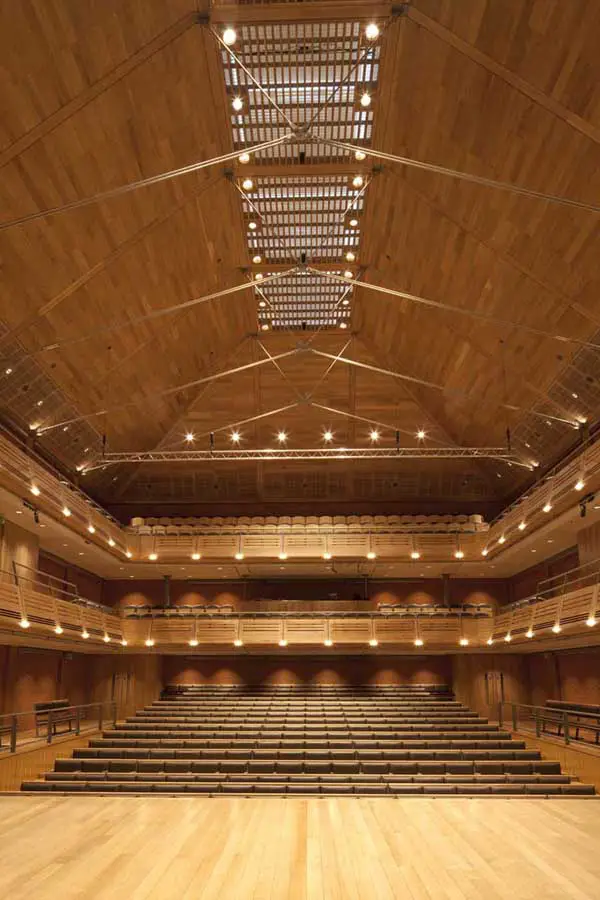
Above – the interior of The Apex in Bury St Edminds, From E-Architect
Because I had not heard an acoustic so sharp in my life. I still haven’t since.
“Cambridge does not have a public venue that gets anywhere near to the sharpness of the acoustic [at The Apex]. Following the general election [2019], I fear it will not get one in my lifetime.”
Hence noting Cambridge lacked both a concert hall with an excellent acoustic, and a large dance hall with a proper wooden sprung floor like they have at the Burgess Hall in St Ives. (Trust me, you know about it the following day if you’ve been dancing on a rock solid floor – one stint at London’s Royal Festival Hall stopped me from walking for two days afterwards, so bruised were my feet!)
The Mayor mentions architecture
Controversial topic given the latest monstrosities proposed for our city.


Above-left – a car park so ugly that RailPen doesn’t dare label it a car park, rather an acronym, and Above-Right, the sickening proposals for a southern gateway into Cambridge on Station Road Corner, from Stanhope, Bennetts Associates, and Bidwells (you can have your say here on the latter)
Can town and gown unite to come up with something genuinely awe-inspiring?
That’s my vision for a second urban centre at the southern tip of the Cambridge Airport site.
“It is my strong belief that the city and the university can and should work together to enrich the lives for everyone in Cambridge.”
The Mayor of Cambridge, 22 May 2025
The Mayor also mentioned the Academy of Great St Mary’s Orchestra which she is a member of – noting it’s a town/gown mainly secular orchestra. (Which in my view makes it far more accessible to the many).
“In an increasingly isolationist world, as Mayor I hope to use my background in arts to build bridges at home, and abroad”
The quotation from the Mayor above resonates with what the late Mayor Nigel Gawthrope told the
““What would you like me to do in your mayoralty?” Vicar of @GreatStMarys to the late @cambmayor Nigel Gawthrope. “Build bridges” he replied. Theme of Nigel’s memorial service today.”
Above – what I posted at the late Nigel Gawthrope’s memorial service at Great St Mary’s on 28 July 2019

Above – by historian Helen Weinstein who was also at the service for the late Nigel Gawthrope (pictured)
Question: Can Cambridge achieve the Mayor’s vision?
It’s not just the Mayor’s vision – it was also the vision of the former Vice Chancellor Sir Ivor Jennings.

Sir Ivor Jennings said as follows:
“In the Exhibition you will see our suggestions for its use mainly as an extension of the civic arena, and I would stress the point that the University has already offered to meet half the cost of a new public hall in the Lion Yard for joint city and University use. Such a hall would, I believe make a great contribution to the life of Cambridge.”
Above – Lost Cambridge 06 Oct 2021 Featuring the Cambridgeshire Collection
On their own, the University of Cambridge and Cambridge City Council cannot achieve those awe-inspiring visions that the Mayors and Sir Ivor spoke of.
The attitude from too many of the existing senior decision-makers towards the people who are not part of the University community is one of contempt. That’s not to insult individuals personally – it’s an institutional culture, one that I am glad to say more and more people within the colleges’ walls (students, staff, academics) are much more willing to challenge compared with previous generations.
As for Cambridge City Council, it has never had the resources this side of the Millennium to undertake anything like this sort of undertaking. Enfeebled by a decade-and-a-half of Conservative austerity, the electorate showed their utter disgust at a once proud and mighty local institution by ejecting the two MPs for the constituencies surrounding our city, and replacing them with Liberal Democrat MPs – three of them reflecting the rapid population growth outside of the city.
In anycase ministers have taken the future of our city and county into their own hands
Despite the understandable concerns and protests from environmentalists (concerns I share – especially over water, very hot summers, the capacity of the industry to build all of the things ministers want built both on time and to a high enough standard while keeping it affordable!), I saw some shoots of hope from Peter Freeman’s talk at Great St Mary’s (again!) where I got the sense he was not going to tolerate bog-standard buildings of low design quality that will make those willing to provide conditional support for growth reconsider their views.
Note central and local government have got form – the Cambridge City Deal starting off with conditional support and critical friends back in late 2014, only for transport officers and a succession of board and assembly members of all three main parties to completely squander it – resulting in the election of Paul Bristow as Combined Authority Mayor ready to go into next month’s GCP meeting to call for its abolition as per his mayoral mandate. (Unfortunately for Mr Bristow, the powers reside with ministers – can he persuade them?)
“What difference can the new civic mayor of our city make?”
A huge one – and she already has with that speech that sets a very clear vision and direction of what she wants to achieve. Furthermore, a whole host of things are already falling into place for her.
- There is a critical mass of people already in, or wanting to join music/singing groups
- There is a critical mass of individuals and businesses aware that if Cambridge does not resolve its chronic problems, their work and businesses will be it. We rise and fall together. The challenge for future municipal/local government is whether it can manage competing interests (and whether ministers will give it the powers to do so)
- The success or otherwise of Cambridge over the next decade or two is of national Political importance – ministers are more than willing to intervene locally if things are breaking down. (Furthermore, with Cllr Anna Smith (Lab – Coleridge) back on the city council executive, the Labour-run city council still has in principle the direct line to half of the Cabinet given that so many of them took part in campaigning in her ultimately unsuccessful campaign to become Mayor (where the electorate in Peterborough, where much of their campaigning was done, would have told them some hard truths about central government policies).
I hope the new mayor will be able to break the barriers that have held our city back on arts and music for so long. I’m more than happy to support her in achieving that awe-inspiring vision – and hope that the people of our city can do so as well.
If you are interested in the longer term future of Cambridge, and on what happens at the local democracy meetings where decisions are made, feel free to:
- Follow me on BSky
- Spot me on LinkedIn
- Like my Facebook page
- Consider a small donation to help fund my continued research and reporting on local democracy in and around Cambridge.

 The Cambridge Town Owl