
How will Cambridge’s sci-tech community and affluent business interests respond to this very visible sign of discontent outside The Guildhall?
Image – from the Trials of Democracy project in Cambridge
The saying goes that businesses need economic stability and predictability if they are to invest in a manner that results in jobs and growth – what Labour has tied its political and policy flagships to. At the same time, the appearance of protesters and activists from 20th Century-era political extremes is a symptom that all is not well in the economy or society.
So when Cambridge’s Guildhall had stalls from both beyond TeamNigel’s extreme, and another from a reconstituted communist group *at the same time* (only separated by a religious outreach stall!) it becomes hard to ignore. (Noting that both Christian and Muslim religious groups had stalls in front of the Guildhall that day – along separately with The Green Party, a couple of pro-welfare state/social security campaigns, trade unions, and another far left grouping advertising a London conference).
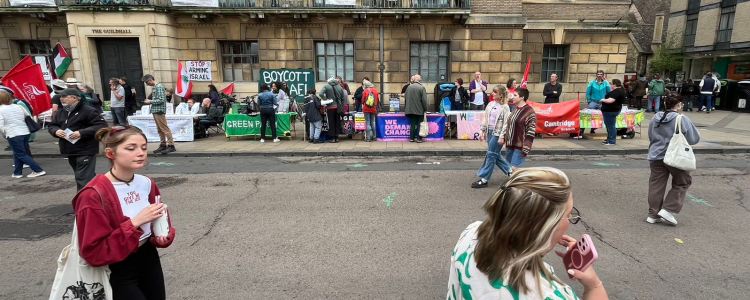
Above – a completely jam-packed row of stalls outside The Guildhall, 24 May 2025
To the left of the photo was where TeamNigel sympathisers and outriders were gathered (it turned out according to other locals that were there that few of them were local to Cambridge/Cambs) around the Snowy Farr statue, watched and outnumbered by a variety of political and community activists from the causes in the photo and more. You can view the footage from Andrew Osborne’s videos here, and from Green Party activists and councillors who were also there too.
At first there was no police presence and the two groups stayed apart. It was only later on that a handful of officers turned up. After a couple of hours chanting and verbal slogan-exchanging, the TeamNigel side dispersed – having seemingly expected a speech by someone but none came. In the meantime their opponents ‘had a megaphone and knew how to use it’. It turned out that the former side were mobilised by a press release with a list of cities and town centre spots – as happened in Colchester.
‘Why didn’t we know about this?’ asked a number of local activists
The big picture is that we can no longer rely on social media to share information about events and actions in the way we did 15 years ago. The way that social media giants game the algorithms means that going back to email-trees of the early 2000s or even phone-trees pre-2000, will return as tactical campaigning tools where actions are needed at short notice. Because as others posted online, they only found out about what was going on after it had all ended – peacefully and without incident fortunately.
That they were there with big banners as Elliot’s photo shows is worrying enough – something that also won’t be resolved by a one-off A-to-B march. Instead, to deal with the chronic inequalities not only requires big moves from national politicians, but also, as Michael Sheen said at the end of his Raymond Williams Lecture in Nov 2017, a lot of hard work – and then some. It’s worth watching Mr Sheen’s extended lecture in full (all 90 mins) because although concentrated on Wales (The writer Raymond Williams was from Wales, and spent three years round here at Cambridge too), there are lessons for the rest of the UK too. Including Cambridge.
“You have to learn how to listen.
It’s not just a question of standing there with a clipboard and asking questions with the right look on your face.
You have to show up.
And stay around.
You have to let go of your assumptions and your biases and your agendas and your prejudices.
It’s really hard.
Speak to the people who are on the frontline of working in communities.
The ones doing the really tough work of giving support where it is desperately needed.
Where their resources are getting smaller all the time but the need for what they’re doing is getting greater every day.
Ask them about listening.
Because they’re really good at it.
But they’re also the ones who’ll say that they’re not being listened to.“
Michael Sheen, Raymond Williams Lecture, November 2017
In a city with a high population turnover due to changing terms of employment in key sectors (away from permanent contracts to shorter, fixed term contracts especially in science and academia) showing up and staying around is *really hard to do* – especially if you have the means and the motive to move elsewhere having been stonewalled by large decision-making institutions that Cambridge historically has had too many of.
Which is why I agree with Grace Blakeley in her speech here where she says powerless is one of the defining emotions of our current age. Because powerlessness in the face of contemporary political decision-making was one of the threads that linked almost all of the protest groups and factions outside The Guildhall on Saturday. Just don’t ask me what the collective response should be!
 The Cambridge Town Owl