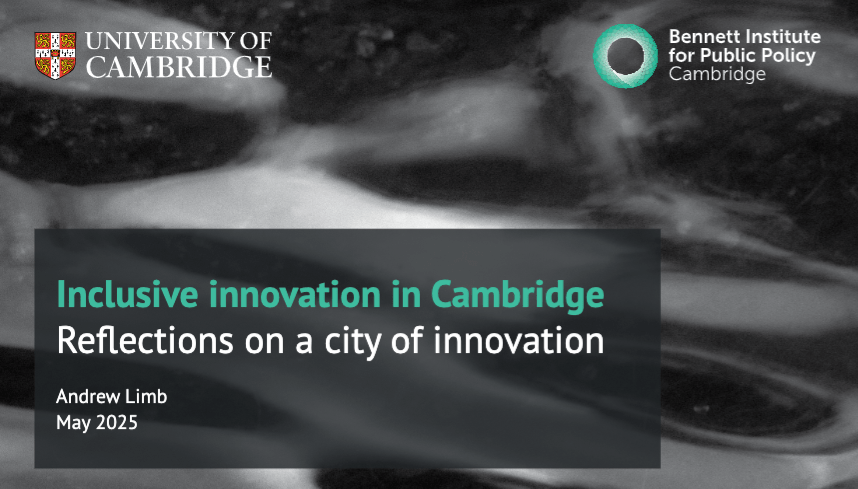
The former Assistant Chief Executive of Cambridge City Council, Andrew Limb, authored a recent study for Cambridge Ahead having spent several decades both in the civil service (where he was burdened with me in my 20s in the bank of desks opposite – poor fellow) and in local government following the 2010 General Election
I think the summary in the link above understates what I think are hard-hitting observations by Mr Limb.
One of the most significant statements is at the end on p34:
“Those who have gained wealth, power, and valuable skills through the success of the innovation economy must be willing not just to donate, but to actively transfer those skills and capabilities. This shift would move less advantaged communities away from reliance on handouts and toward real agency over their own futures.”
The reason why this is significant is because it demands the affluent and influential step far outside of their comfort zones and meet those with the least in our city on equal terms.
Sound familiar? It should do.
“I’m not interested in the organising and financing of events as being acts of charity where you hand over the cash and take a step back and watch from a ‘safe distance’ in a paternalist, patronising manner about the nice thing you did for the poor people.”
I’m not going to claim that my words were an original concept either – in my case they were inspired by Save the Children UK Founder Eglantyne Jebb during her Cambridge years before she became famous in the 1920s.
“I was a long time realising that the social reform on the part of the Conservatives is like charity in the hands of a Lady Bountiful – everything to be made nice and pleasant, but the ‘upper class’ is to be respected and obeyed.“
Eglantyne Jebb on 08 July 1910 in the Cambridge Independent Press – a decade or so later she founded Save The Children.
A generation before Eglantyne, the co-founder of the Cambridge Workingmen’s Club, Ellice Hopkins concluded with what began as missionary work in one of the worst slums of Cambridge along East Road. (See Lost Cambridge here). So what Mr Limb is doing in this report is carrying on a longstanding Cambridge town tradition of calling out the affluent and influential over their collective failure to deal with rising inequality in our city.
That’s not to say he thought: “Oh – Eglantyne, I remember her from Antony’s blogposts! I’ll use her words!” That’s not how it works. Mr Limb was one of the supporters in his city council role of a host of community projects over the past decade or so reminding our city of the work that the great generation of women who modernised our city 100 years ago undertook – in particular the CamVote100 project led by Hilary Cox Condron and colleagues.

Above – what this work built on was the initial discoveries I had made in the county archives, the Cambridgeshire Collection, and the British Newspaper Archive online, where an initial meeting of around 20 of us that year at Hobbs Pavilion sketched out what those far more creative and artistically-talented than me could do with these re-discovered herstories.
My point being that things like this influence the cultures and workings of organisations – and give them much-needed civic grounding. This is particularly important for a place like Cambridge given how high our population turnover has become.
Eglantyne Jebb set the example to the affluent of her time – along with Margaret Keynes (later Margaret Hill CBE), and Gwen Darwin (later Raverat, Grand-daughter of Charles the Botanist) who between the three of them carried out a rent survey of the entire borough as part of Miss Jebb’s first and epic study of poverty and multiple deprivation in Cambridge’s history published in 1906 and digitised here.

Above: Eglantyne’s rental map (right-click & open in new tab) which was produced for her by Gwen Darwin (later Raverat)
How many of our top executives or investors would be willing to go door-to-door in some of Cambridge’s most economically-deprived areas to carry out such face-to-face surveys? Ditto the rest of us – even if someone paid us? Approaching the general public to talk about anything political is a fiendishly difficult thing to do for most of us. And as Michael Sheen said in his Raymond Williams Lecture of 2017, it’s not just about rocking up with a survey.
“You have to learn how to listen.
It’s not just a question of standing there with a clipboard and asking questions with the right look on your face.
You have to show up.
And stay around.
You have to let go of your assumptions and your biases and your agendas and your prejudices.
It’s really hard.“
Above – CTO – Michael Sheen’s masterclass to politicians – 13 Sept 2022
For anyone who has never done community action before, it’s worth listening to Mr Sheen’s extended lecture in full. Not just for its content but for the actor’s superb delivery of it. It takes a very special talent and a lot of hard work to hold an audience spellbound for that length of time.
On being challenged, on being opposed, and on being told: ‘You’ve got it wrong’
Looking at the list of people Mr Limb interviewed on p35, at first glance it appears to be just a bunch of faceless corporate types from middle-class to affluent backgrounds. I can think of one or two that I have clashed with on that list, along with one or two on that same list who have encouraged me to keep persisting with those lines of questioning!
Which makes me wonder about both the relative freedom and the responsibility I have in being able to write about the past, present, and future of Cambridge without having to worry about impacts on things like job security or accommodation tied to it. That said, I’d rather be in much better health, have full mobility and be in full time employment than in poor health, not able to leave the city under my own steam, and not able to function full time let alone work full time. When you can’t go anywhere or do anything useful because chronic fatigue symptoms kick in as soon as you get on the bus, what little political and civic work I do has to be local. A culture shock following seven years in central government in what I sort of hoped would have been a career for life.
Shared purpose
One of the biggest challenges for the institutions represented by the interviewees is negotiating a shared purpose with the rest of our city who are all-too-often excluded (whether by accident or design) from decisions about the future of our city.
“The different communities and sectors across Cambridge should find new, innovative and genuinely inclusive ways of coming together with a clear shared purpose.”
Yet the case study of the Hobson Street Cinema shows that the developer’s ambition for the site is at odds with the desires and needs of the wider community. As a result, he has chosen to appeal to ministers to get an historic building demolished even though he rebuffed attempts to get the building put into community use while he decided what to do with it. (I’ve got the videos dating back to 2016 showing the various attempts to engage, which are in the links). It’s not just Hobson Street. It’s the proposals for Kett House on Station Road Corner, and also from RailPen proposing two new multistorey car parks which are hardly the sort of architecture and building design millions of tourists come to see our city for. Kett House’s redesign is even worse than the existing building yet will be the new ‘southern gate’ along Hills Road into Cambridge, which if built will probably become one of the most hated and loathed buildings in the city. But hey, it will make some people a lot of money even though as one of Cambridge University’s own researchers is showing, poor quality architecture and urban design can have a negative impact on the health of the people who have to live in its shadow.
I remain to be convinced that a critical mass of corporate Cambridge is willing, let alone able, to make the sorts of changes to its cultures, structures, systems, and processes needed to achieve the aim that Mr Limb concludes in his report.
“The challenge then, is to bring these and other strands and initiatives together into a coherent, ambitious and inclusive whole that is more than the sum of its parts.”
I don’t think there is a man in our city capable of making Cambridge greater than the sum of our parts.
Why?
Because the people who have been the most resistant to anything seeking to improve our city that has come from the grassroots have been older White Men in influential or decision-making positions.
The people most likely in my opinion to succeed in making Cambridge become greater than the sum of our parts are women. Not just because they have been the ones more often than not (of diverse ages, social backgrounds, and life experiences) who have been at the forefront of better alternatives, many have also supported me in challenging Cambridge’s institutions to become better than it is, Furthermore, I am seeing more of them – especially the generation of students who were protesting on the streets a decade or so ago now moving up the ladder inside institutions and changing their cultures from within.
Sadly I’m sort of reconciled to the idea that I might not live long enough to see that city greater than the sum of our parts ever being achieved, nor the architectural embodiment of it in a new second urban centre for our growing city. Furthermore, there is a risk that things are going to get much worse before they get better – the menacing appearance of one group of extremists waving large offensive banners outside of the Guildhall being particularly disturbing from my perspective. And if that wasn’t a wake-up call for corporate Cambridge, I don’t know what else is.
To conclude?
The Combined Authority Mayoral Election result provides the warning to institutions.
Institutions can do what the Greater Cambridge Partnership senior executives did in how they treated opponents to their flawed busway plans. They can retreat into the ‘Design and Defend’ culture of their transport engineering profession and hope the politicians will make the people go away. Ten years of this resulted in ‘The People’ electing a Combined Authority Mayor that has in his manifesto both the scrapping of the proposed busways (still going through an application process after over a decade in the works!) along with the abolition of the institution that employs them.
or…
…they can work meaningfully with the people who make up our city (not just those that live within our 1935-era boundaries either!) from the very start in order to come up with shared solutions. Had councillors and officers chosen to work with Cambridge Connect light rail from the start back in 2016, or even worked with their counterparts at Suffolk and Essex County Councils as I had suggested ***over a decade ago*** (see the video here) then we might be in a better position than we are in today.
As it is, the new Mayor of the Combined Authority is already working with those of us opposed to the busways such as Cambridge Past Present and Future in this photo from the CPCA Mayor Mr Bristow yesterday (below).

Above – (L to R) James Littlewood of Cambridge Past, Present, & Future, with Mayor Paul Bristow of the Cambridgeshire & Peterborough Combined Authority
I hope they succeed in getting the busway plans cancelled and replaced with a light rail solution using the Cambridge Connect Light Rail proposals as a starting point.
Because far from being the ‘Don’t build anything!’ response from communities affected by the busway, this was very much in the spirit of ‘We want something far better’. And given ministerial plans for the massive growth of Cambridge, as Mr Bristow said at the Cambridge hustings, it is inconceivable that The Government would embark on such a huge urban expansion of over 100,000 new homes without a new metro system to serve it.
I look forward to the first GCP board meeting that the Mayor is due to attend in around six weeks time.
Food for thought?
If you are interested in the longer term future of Cambridge, and on what happens at the local democracy meetings where decisions are made, feel free to:
- Follow me on BSky
- Spot me on LinkedIn
- Like my Facebook page
- Consider a small donation to help fund my continued research and reporting on local democracy in and around Cambridge.

 The Cambridge Town Owl