
Will it be a ground-breaking splendidly beautiful visionary design, or will it be carbuncle-tastic and enrage His Majesty? Also, the Combined Authority publish videos of some of its events at the big UKREIIF property industry jamboree in Leeds.
TL/DR? – See the consultation event on Wed 04 June 2025 in North Cambridge, and see the Combined Authority’s YT Video page for the property events including one on how to create strong & successful communities for the rest of us in Cambridgeshire and Peterborough!
Will the Crown Estate build something wonderful, or a row of carbuncles?
Some of you may be old enough to recall the former Prince of Wales outraging the built environment industry and the architectural establishment when he tore into the selected design for the National Gallery in Trafalgar Square
Above – the Prince of Wales in the speech that coined the word ‘Carbuncle’
“The public generally sided with the Prince, not the architects.”
Above – IanVisits.co.uk on the 30th anniversary of that speech – where he also spotted the beneficial impact of the speech
Crown Estate’s Cambridge Business Park plan for Cowley Road
I wrote about their initial announcement in late 2024 here
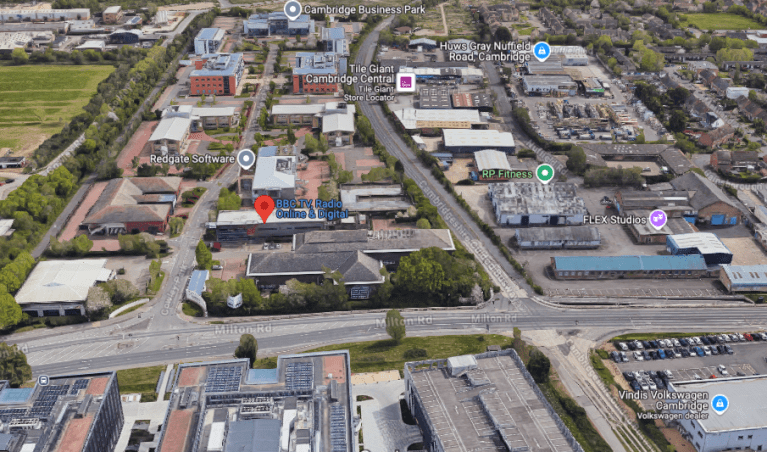
Above – from G-Maps – it’s the site to the left of the guided busway. I’m old enough to remember when that path that curves to the right at the top of the photo was an overgrown strip of wasteland, forgotten and abandoned!
You can also see why the site also presents a huge opportunity for the land owner to make an absolute fortune from a redevelopment – the site as it is containing mainly low-rise business premises. Zoom out a little here on G-Maps and, using Redgate Software’s building as a reference point you can see Hartree’s site to the left, and to the top, the Cambridge North district by our favourite controversial firm, Brookgate.
“What about the swimming pool idea?”
I wrote about this back in January 2022 and asked the developer’s London-based consultants about this. Their response was:
“The Crown Estate are not in possession of the Milton Road Garage site and so it is not within their remit to construct a swimming pool there. However, your suggestion of a new sports facility has been noted and will be considered as part of the feedback from the public consultation.
I can confirm that the project team are working closely with the team for Hartree to better coordinate our plans, and are in regular contact with representatives from the Greater Cambridge Shared Planning Service. We closely monitor the plans and strategies put forward by the Local Authority to ensure that our proposals align with local priorities.
Our previous stage of consultation highlighted the need to prioritise social inclusion in Cambridge and we are currently working on a skills education programme for young people in the local area.”
Above – Kanda Consulting to me, 10 March 2025
Which is about the best you can expect from a consultancy firm hired to be the fire-shield for the main developer. (Cynical? Moi?!?!)
The Wider Context – North East Cambridge Area Action Plan
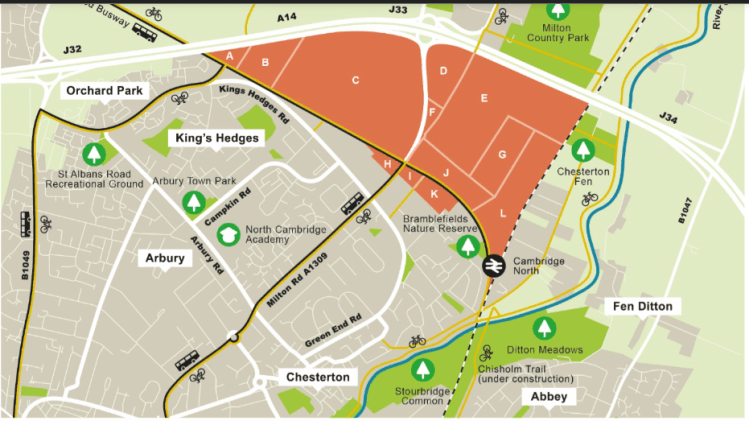
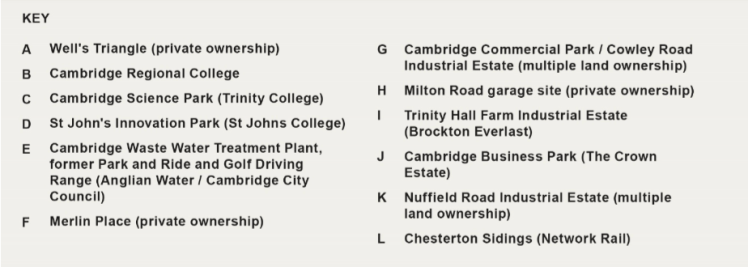
The NECAAP document shows the Milton Road garage site (H on the map) as being under private ownership, and also says that it has room for 75 houses. Hence why little has been said about a very small plot of land that isn’t owned by any of the partners. Why does this site matter?
“Kings Hedges ward had the highest number of benefit claimant households,
Mapping Poverty – Cambridge City Council (2023) p1
King’s Hedges also has:
- 34% of children living in households dependent on benefits – p9
- the highest number of working-age people [897 – around 11% of residents] living in a household in receipt of benefits [an indicator of work-place poverty/poverty pay]
Imagine what impact a new large leisure centre a short walk from King’s Hedges Road could have for residents in the area in terms of jobs, access to new health and leisure facilities, and the inward spending brought in from all of the villages along the busway and from the Cambridge Science Park. (Could the Cambridge Science Park’s infrastructure be used to heat the water for such a pool and thus save on costs needed to keep their buildings, computers and IT infrastructure cool?)
Is Peter Freeman the game-changer?
Potentially – because the development corporation that he’s putting together (i.e. the Cambridge Growth Company) will have the sort of funding and powers that local councils can otherwise only dream of. One of the big barriers to the construction of really high quality developments that at the same time are popular with residents has been land assembly. Basically if you are a small land owner you can hold out for the highest possible bid, which then makes things like affordable housing ‘unviable’. (I’m speaking generally as I’m not aware that this is happening in this particular case). The changes to the law going through Parliament in the Planning and Infrastructure Bill potentially make things easier for development corporations to assemble such sites.
“Moving swiftly on, can rich people make a good job of ‘Creating Strong, Successful Communities in Cambridgeshire and Peterborough’?”
I should be more careful about some of the words I choose because I know more than a few people who were at UKREIIF this year. Also, having been on similar panels in my previous life, you don’t get to put your personal views on whatever the issue is – you’re not paid to do that. You’re there to represent the institution that employs you.
That said…
There are huge problems institutional structures, processes, and systems when it comes to deciding the future of our settlements (villages, towns, and cities) and communities (the groups of people however you choose to define them) that live within them. We can see that by the huge range of complaints that so many different interest groups make about what is inherently a Political issue.
There is no such thing as ‘taking the politics out of it’ because politics is the only peaceful method we have of deciding large collective issues that affect the many with the consent of as many people within those communities as is possible
Things like:
- the methods of construction,
- the materials used,
- the places where those materials are sourced,
- the pay/remuneration for the people who are involved in the design and building of the buildings wider urban environment
- the qualifications and training needed in the different professions – and who meets the costs & does the accreditation…
…It’s not simply a case of ‘Oh leave it to the Market’ because markets by their very nature require complex legal systems and information systems in place in order to function efficiently. (Ranging from institutions to enforce contract law through to the publication of factually accurate information whether on prices to components that do what the manufacturers say they will do!)
Beth Dugdale of the Cambridge Growth Company indicates that the ‘growth agenda’ for Cambridge must address its chronic inequalities
“Cambridge as a city is one of the most unequal in the country with severe pockets of deprivation – and a 12 year gap in life expectancy between its most economically deprived and most affluent areas”
Beth Dugdale to UKREIIF Cambridgeshire & Peterborough, May 2025
I’m reading between the lines here because she phrased it in much more ‘corporate-friendly’ terms (“Opportunities to address some of the challenges faced by a number of communities in the area…”). Yet she’s consistent with what Peter Freeman told us in Cambridge about his approach to the task that the Minister for Housing and Planning has set him and his team.
‘How could we involve communities more?’
Asked Michelle Sacks, the Chief Executive of Huntingdonshire District Council to Rebecca Britton of Urban and Civic – the latter saying that Newtowns are the most frightening for local people because of the scale, citing:
- Fear of more cars
- GP surgeries already overrun
- Over-stretched public services vs phasing of public services with new homes
The real tension in Ms Britton’s response is on the factors that are outside of the control both of the developers and of local councils.
- We’re still waiting for ministers to publish their substantive light rail policy (because the Department for Transport’s response to my question on this does not indicate that a full-on comprehensive and well-thought-through plan that has been out to consultation actually exists)
- No one seems to have a clue about who decides which areas get how much funding for how many GPs, so no one really knows who to hold accountable…while in the meantime those houses keep getting built…
- The headlines on Northstowe back in 2023 stung ministers and the construction industry badly. The one positive to come out of it is that it concentrated minds (progress update nearly two years later?) resulting in the new Labour Government intervening and directing Homes England to take control and appoint a new master planner.
Why is it this way? In part it’s due to fragmentation of our public services that went into overdrive in the 1980s. Margaret Thatcher’s Government brought in a programme of austerity, centralisation, privatisation, and compulsory outsourcing that in the grand scheme of things broke the back of co-ordinated local public services.
You only have to compare the current public services provided by city councils in unitary authorities and compare them with say Birmingham City Council back in the late 1920s which I have digitised here for you to read.
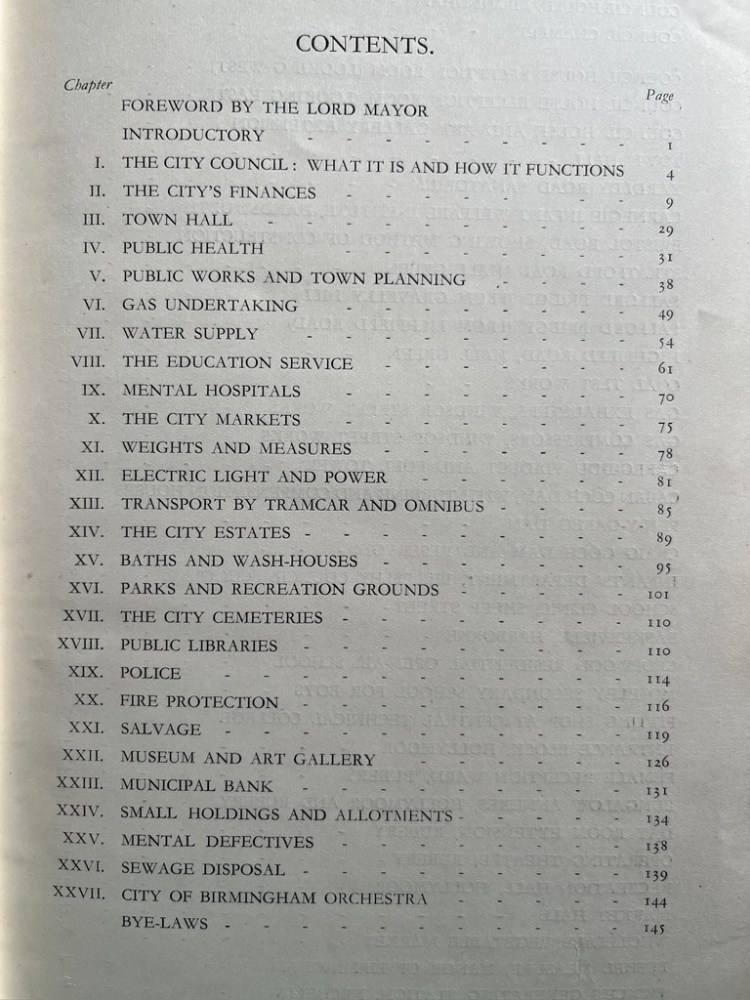
Above – Birmingham and its civic managers – the departmental doings of the city council (1928)
Alternatively, have a look at Leicester 1939/40 with its Air Raid Precautions function
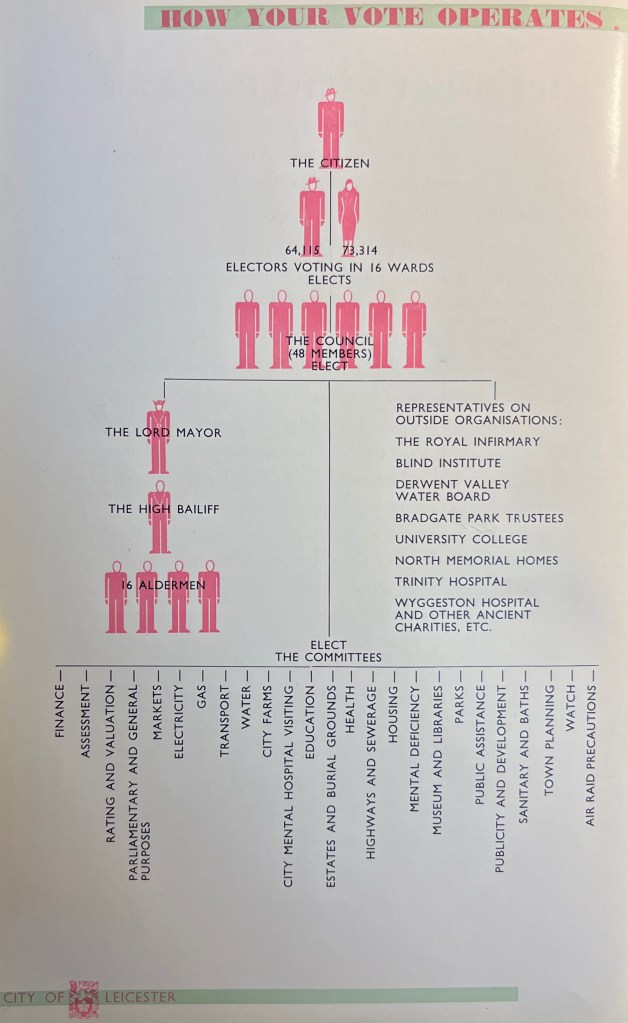
Above – Civic Affairs of Leicester (1939) p4
Note both of those books were published at a time when voting was a relatively new phenomenon – hence the civic need to ensure an informed and educated public were able to make democracy work.
Given the threats to democracy, that need is even more important to today.
The big challenges on communicating with the public highlighted by Ms Britton and Ms Dugdale have their roots in the policy failures on democracy education.
If we are going to talk about opportunities, then one huge one is on civic and democracy education for adults (as well as children). See Lifelong learning in the UK: the need for adult citizenship education by Qasir Shah (2020)
At the moment, consultations in/around Cambridge that I have been to more often than not involve developers hiring a London-based consultancy to act as a fire-shield, commissioning consultants who know next to nothing about the city, its people, its civic history, or its issues. With so much money to be made, the strong financial incentives combined with weak public institutions hollowed out by successive Conservative governments make the minimal cost, maximum profit designs all the more prevalent. The best democracy money can buy? (Hence the funding of political parties is another indirect issue that needs resolving).
So much for Cambridge being a place for outstanding and awe-inspiring urban design.
Which is why I find some of the new research on ‘Awe-inspiring’ designs and its impact on human welfare to be an interesting new field – and how it aligns with nature.
“The emergence of neuroarchitecture – which studies how the built environment affects brain function – deepens our understanding of how design influences occupant health and wellbeing.”
Above – Cleo Valentine and Heather Mitcheltree on Neuroarchitecture, 09 Dec 2024
When ministers approve bland designs like they did with Brookgate’s proposal for North Cambridge described by Cambridge Past, Present, and Future as ‘The Great Wall of North East Cambridge, what makes a profit for the few risks being at the expense of the many due to the negative health impacts on those who live and work within the new developments. One of the future challenges for urban designers and construction workers for the rest of the century is how to retrofit so much poor urban design and bland buildings that have already been built – and having to do so in increasingly hostile weather conditions as the climate emergency makes itself known. The latest offerings from RailPen and the Station Road developers (Aviva and Bennett Associates) don’t fill me with hope.
If you are interested in the longer term future of Cambridge, and on what happens at the local democracy meetings where decisions are made, feel free to:
- Follow me on BSky
- Spot me on LinkedIn
- Like my Facebook page
- Consider a small donation to help fund my continued research and reporting on local democracy in and around Cambridge.
Below: Other visions for the future of Cambridge are – or were available! Have a look on Lost Cambridge – and visit the Cambridgeshire Collection in Cambridge Central Library! (When it reopens hopefully later this month!)
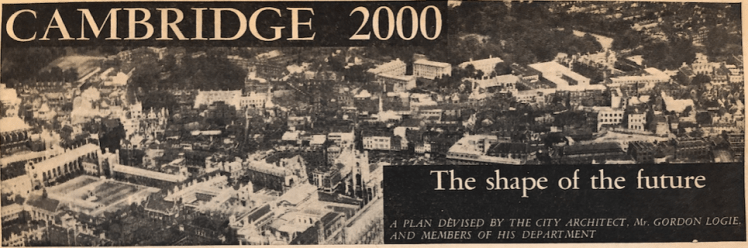
 The Cambridge Town Owl