
And not just because I want to apply for one to try out civics pop-up stalls
Basically the city council’s small grant scheme excludes individuals and unless you are a fully-functioning, established constituted organisation with a history of successful delivery, the barriers to applying for anything are prohibitive.
“What are micro-grants?”
“A ‘micro-grant’ means a small grant which can be awarded by a Community Council or other community-based group to a local community group, charity or individuals for an activity which benefits their community.”
Foundation Scotland – Running a micro-grants scheme
“First things first, how much £££ are we talking about?”
“Micro-grants are awards of normally up to £400 to individuals and up to £1,000 to groups for ‘charitable purposes to the general benefit of local residents, including individuals and non-constituted groups’ in line with the aims or purposes of the main Community Benefit Fund. In some cases, these upper limits may differ, depending on the agreement relating to the overall Community Benefit Fund in question.”
Foundation Scotland – Running a micro-grants scheme
“Terms and conditions?”
See Foundation Scotland’s Ts & Cs here. One important consideration is to work out how best to evaluate the impact of the micro-grants. Which itself depends on how you define success, as well as the level of detail you want recipients to go into.
Pop-up civics stalls
Now in my case, I wouldn’t need £400 to run a pop-up civics stall. That said, had I had more time to prepare and that amount of funding behind me, my pop-up stall at the Queen Edith’s Summer Fete last month (which I wrote about here) would have been a little more substantial than what I had below!
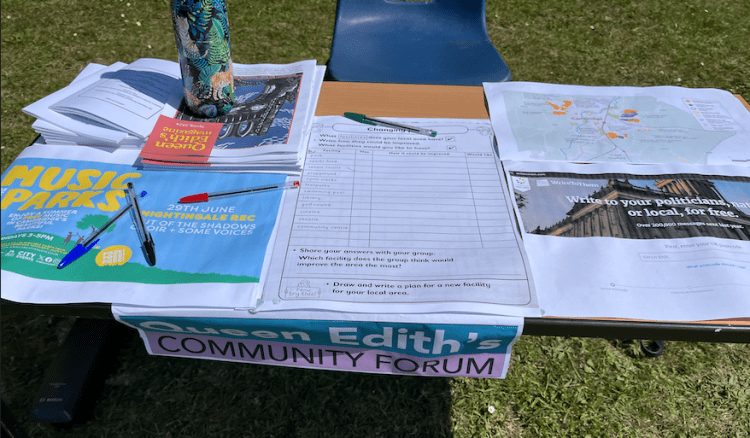
Above: Have A3 colour printer, will have fun with it!
And if you have a big map, even better!
Never underestimate the power of a big colourful map to draw people to your stall! (As I found out at the Stourbridge Fair back in September 2022)

Above – me with the map of Holford & Wright’s proposals for Cambridge published in 1950
What difference would a micro-grant have made? Transport for a start. I moved everything *by bus* too/from the site ( – the first and last time given the chest pains I felt.) Possibly hiring a small gazebo with another. And then there’s the awkward issue of trying to work out what my time is worth financially given that DWP’s rules limit the ‘voluntary work’ you can do.
Micro-grants can be for stand-alone activities, or they can help support individuals wanting to put something on for an existing council-supported event
Such as the Music in the Parks events being run by Cambridge City Council
What sort of applications would the city council get if for each Music in the Park event they said there was say four lots of £100 micro-grants for any individual or unconstituted group to run a stall or activity for a couple of hours before the musicians started playing? (Which is normally from 3pm – heat of the summer sun you see!) The criteria can be similar to what the city council already has: i.e.
- activities that help people be more active
- activities improve access to arts and culture
- activities that bring communities together
- activities that reduce poverty
- activities that reduce loneliness and social isolation
Above – Cambridge City Council Community Grants
With pre-existing event, the presence of council staff and councillors provides an extra level of assurance that the people receiving the micro-grants actually show up. It doesn’t need the micro-management/monitoring of their activities. Simply seeing local residents interacting with the stalls/activities put on by the grant recipients, and informally asking the residents what they thought, could be enough alongside a basic report from the recipients.
In Queen Edith’s ward we’re looking to go ahead with inviting community groups to hold stalls anyway at the Music in the Parks event on 29th June.
Our forum took the view that we wanted to go ahead with it anyway given that the Pavilion was going to be open for the event. (Think access to refreshments etc). Having caught up with one of the local council officers they were happy for local groups to be there too. Personally I would like to see someone either from the Greater Cambridge Shared Planning Service or a city councillor who is on or who has served on the Planning Committee to run a stall with maps introducing residents to the future plans for city and county.
“If we can make the Music in the Parks community stalls a success, might the council allow us to have a city-wide societies fair?”
Sounds like wishful thinking but we’ll throw that in given the change of council leader and the announcements from ministers on the future of our city. With Music in the Parks it’s neighbourhood-based with a few hundred people showing up to see live music – often a brass band, sometimes something more funked up (I recall the Brass Funkeys) with the stalls in the background.
A Cambridge Societies Fair simply expands on the numbers of stalls and groups – sort of like a Freshers’ Fair that the students have. Think that but for town and village societies in and around our city. My preference is to have it at The Junction in Cambridge because of the large numbers of bus routes that stop near it. It also has sufficient space both inside and out to host displays. But this is something the city council should lead on. Not me.
South Cambridgeshire’s Active Grants – subsidising the fixed costs to enable activities to take place
Their latest round has just opened and, with a maximum of £500 per grant, it’s aimed at freelance sports and fitness professionals to cover the costs of things that don’t change irrespective of the number of people who turn up. Eg hall hire, marketing, one-off equipment purchases are still the same irrespective of whether a few people turn up or whether you have a full hall. Which means in rural areas with poor transport links, individuals (especially on low incomes in a high-cost-of-living area) can take substantial financial risks just to try and establish regular classes/sessions in a place with a small population.
Universal Basic Income – possibly the greatest of all micro-grant schemes?
This is something that Greater Manchester is currently working on, having identified four sources of funding:
- Existing Greater Manchester Combined Authority un-ringfenced budgets
- Central Government funding (which they’ve put in a bid to HMT for)
- Philanthropic support from wealthy donors/institutions
- Charitable fundraising from the general public
- Research funding grants to pay for academic studies/evaluations of any pilot
Above – from UBI Labs Manchester, Feb 2025
Now combine that with the work that Loneliness Awareness Week is trying to respond to.
A combination of more individuals with the means to try out new things combined with the greater ability of people to pay for the transport needed to cross greater distances, pay for the course fees, and pay for the equipment?
Germany has already completed a substantial basic income pilot
“A groundbreaking three-year study in Germany has delivered compelling evidence challenging common criticisms of Universal Basic Income (UBI), showing no reduction in work effort while significantly improving mental health and wellbeing.“
Above – Basic Income Earth Network, April 2025
Which is why I hope Greater Manchester gets the go-ahead for theirs – especially given some of the huge problems of poverty and multiple deprivation their city and region faces.
Food for thought?
If you are interested in the longer term future of Cambridge, and on what happens at the local democracy meetings where decisions are made, feel free to:
- Follow me on BSky
- Spot me on LinkedIn
- Like my Facebook page
- Consider a small donation to help fund my continued research and reporting on local democracy in and around Cambridge.

 The Cambridge Town Owl