I rocked up to the afternoon session of a pair of workshops at the recently-opened Cherry Hinton Hub in South-East Cambridge. While I was the youngest person participating (the morning workshop had a more diverse group age-wise), the united call for the University of Cambridge to bring back a civic lifelong learning function was something I didn’t see coming – in particular for science lectures and workshops
“We are keen to hear from local communities. If you would like to find out more email us…”
See https://www.cam.ac.uk/about-the-university/civic-engagement to find the email address.
Want to take their survey?
You’ll need to scan the QR code below, or email the University’s civic engagement team for paper copies of their survey.

Civic engagement workshops
The University of Cambridge has commissioned a number of external consultants to run these workshops across our city to get a sense of what the University could be doing better in terms of community engagement. Given the age of a couple of the participants in our workshop, it’s easy to forget that for some of them they recall an age when:
- Women were banned from enrolling/matriculating from most of Cambridge’s colleges
- The University of Cambridge had its own council seats on Cambridge City Council (See here and scroll to the foot of the table)
- All of the motor traffic had to go through the city centre, for there was no M11, no A11, and no A45 (today A14) motorways or dual carriageways
Which is why their memories and recollection are civic gold dust – not just for local historians but for today’s local policy-makers
A previous generation of Cambridge University bosses priced out many local residents from what was once a more symbiotic relationship between the university and local organisations – from local government to branches of the Workers’ Educational Association.
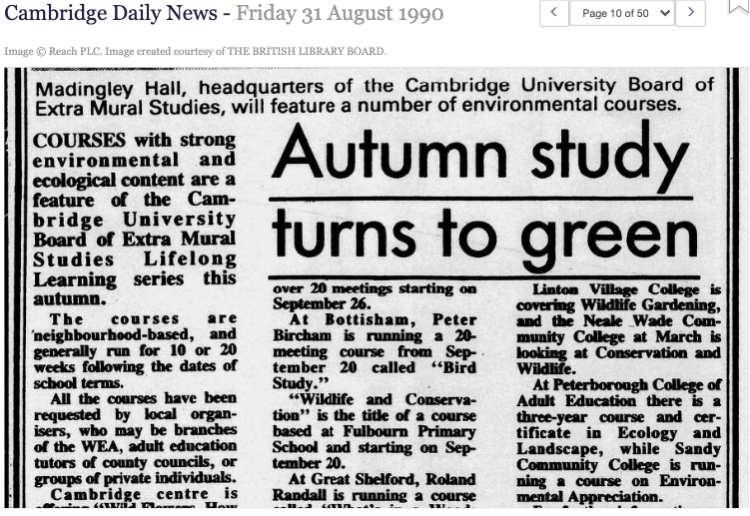
Above – Cambridge Evening News 31 Aug 1990 in the British Newspaper Archive
This was a year after the Green breakthrough in the European elections, resulting in politicians from the main political parties talking about climate change and protecting the environment in a manner not seen before.
“Courses with a strong environmental and ecological content are a feature of the Cambridge University Board of Extra Mural Studies Lifelong Learning Series this autumn. The courses are neighbourhood-based and generally run for 10 or 20 weeks following the dates of school terms. All the courses have been requested by local organisers, who may be branches of the WEA, adult education tutors of county councils, or groups of private individuals”
I have no idea what happened to that relationship but it doesn’t seem to exist today. The long-since rebranded Institute for Continuing Education at Madingley Hall has reoriented itself away from local communities and more towards an affluent ‘footloose’ market that can do work and research by distance learning combined with a series of intense learning weeks or weekends. And the prices are set to match those too – taking the history short courses as an example. Even with the short online/video conference-based courses you are looking at 5 sessions at 2-3 hours each for around £400.
This is very different to the set up as per the types of adverts below:
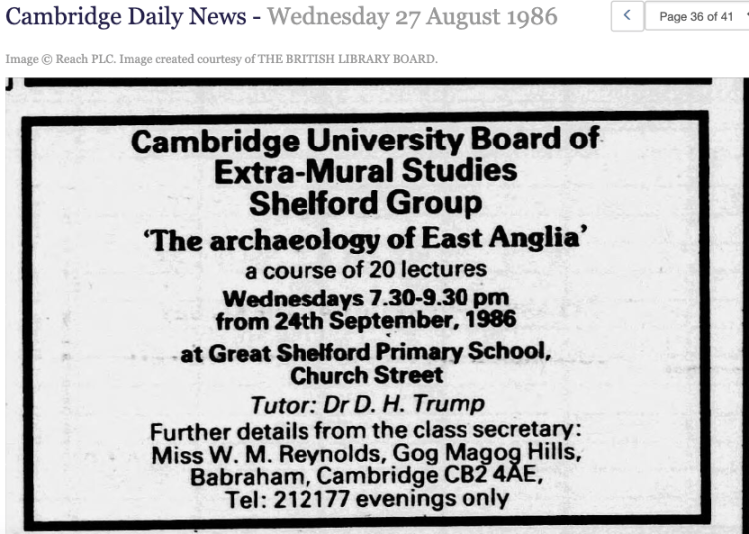
Above – Cambridge Evening News 27 Aug 1986 in the British Newspaper Archive
I had to do a double-take on the tutor’s name. Note the venue of the classes – a local primary school just outside Cambridge. And note the address of the organiser – possibly today’s Cambridge Past, Present, & Future.
Back in the 1990s, even what is now Anglia Ruskin University (at the time it was known as APU locally) had part-time classes

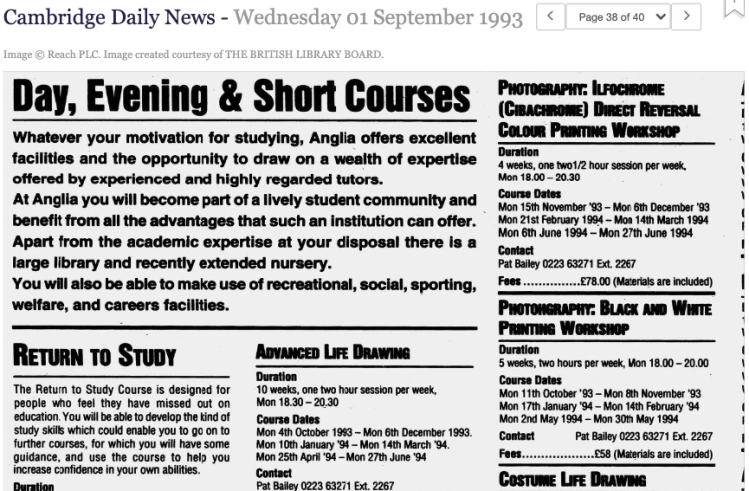
Above – Cambridge Evening News 01 Sept 1993 in the British Newspaper Archive
Furthermore, in the then high-selling and regularly-read Cambridge Evening News (my late grandparents got this delivered daily) there were adverts from APU very clearly inviting local residents onto their premises for concerts.
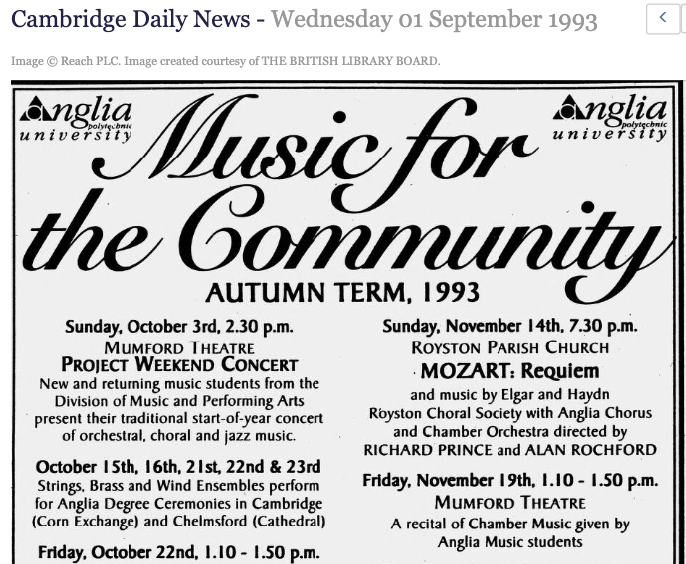
Above – Cambridge Evening News 01 Sept 1993 in the British Newspaper Archive
Can the new civic Mayor of Cambridge Cllr Dinah Pounds call on the two universities to bring back that sense of civic pride and community engagement with its older residents in the suburbs?
If you missed our new mayor’s speech, have a look here
Following the barrage of calls for more science lectures and workshops in residential communities run by the University of Cambridge, there were also calls for the arts as well. The one big problem we crashed into and had no answers for was on communicating with the entire city.
It was interesting to see two of the participants debating on whether people in their generation were comfortable with using computers, phones and social media. (They agreed to disagree). But the point remains that since the demise of the local print press across the UK (and beyond?) combined with the implosion of the popular social media platforms, there is no local ‘catch-all’ means of communicating with residents (or rather one that can alert a critical mass who then inform others). Furthermore, participants also raised the challenge of a high population turnover in the academic sector – saying that too many academics on short/fixed term contracts have no incentive to get involved in the life of the city. They stay within their bubble for the few years they are here, and off they go. Which inevitably has a knock on impact on stability of communities.
Furthermore, there were calls for lifelong learning to be used as a means of integrating new arrivals into our city with existing residents. Given the impact of the University’s employment practices and those of its spin-off sectors, perhaps there’s a growing number of civic responsibilities that its senior decision-makers are unaware of because their attention is focused either on Westminster, or abroad. This is not a new phenomenon – it’s the Papua vs Pampisford challenge.
“When renowned archaeologist Sir Cyril Fox officially opened the Cambridge & County Folk Museum in November 1936 he noted in his opening address, “I am inclined to think that in the University of Cambridge there is more exact knowledge of the social anthropology of, let us say, Papua, than of Pampisford.”“
Museum of Cambridge 03 Nov 2022
Was Sir Cyril correct back in 1936? Do his words ring true nearly 89 years later?
A reminder of why science learning for the general public is important
Carl Sagan reminded us in 1996.
The problem is even back in the early 1980s not many places had the specialist lab facilities for the teaching of science to adults.
“A very few local authorities have adult education colleges with purpose built science facilities and specialist staff; here, provision of basic science courses for adults is likely to be at its greatest.”
Above – NIACE 1981 pp15
This is where I think senior ministers, local councillors, the Mayor of the Combined Authority, and the big investors and firms in and around Cambridge should get together and thrash out a deal to construct a new generation of lifelong learning centres as the Commons Education Select Committee recommended back in Nov 2020, enabling local government to levy new taxes on those gaining the most financially from Cambridge’s growth – alongside things like land value taxes to replace council tax and business rates, and land value uplift levies to pay for new infrastructure. We should not be in a position where central government is seen to be throwing money at Cambridge while high streets across the rest of the country crumble. Because the consequences not least for the main political parties, could be catastrophic.
If you are interested in the longer term future of Cambridge, and on what happens at the local democracy meetings where decisions are made, feel free to:
- Follow me on BSky
- Spot me on LinkedIn
- Like my Facebook page
- Consider a small donation to help fund my continued research and reporting on local democracy in and around Cambridge.

 The Cambridge Town Owl