
With three major developments next to each other, it will be interesting to see how the final designs compare, contrast, and interact, when they are finally built
TL/DR? See the Crown Estates consultation here – you have until 02 July 2025 to send in your views.
I went along to the Cambridge Business Park consultation yesterday (04 June 2025) arriving in a miserable mood because it took over 90 minutes to cross town by bus. Which is why accessibility matters when selecting a venue.

Above – Cambridge’s chronic traffic problems normally means bus journeys take 50% longer than scheduled.
Which reminds me, anyone who wants to get involved in campaigning for better bus services, get in touch with Richard at the Cambridge Area Bus Users Group.
Getting off to a bad start
I think it’s important I mention this – ultimately because of the ending. And if local history is anything, it’s about a story rather than a list of facts or statements. When I got in, my early conversation with Vicky, one of the urban planners, began awkwardly mainly because long public transport journeys are utterly draining when you have CFS/ME. And I challenge anyone to be in a good mood when you are absolutely drained and exhausted knowing you are about to go into a public consultation on the back of over a decades-worth of disappointment where large/wealthy developers have raised, then dashed the hopes of local residents. (This blog and my previous one, A Dragon’s Best Friend which I began the month after I left the civil service, are littered with articles of me and others going to consultations and public meetings over the past 15 or so years with hopes continually raised and dashed).
‘Are you yet another London-based consultancy coming up to Cambridge to tell us what is going to happen to our city and completely ignoring the concerns of residents?’
This was my assumption when I looked up the office details of the consultancy running the consultation – Kanda Consulting whose email regarding a possible North Cambridge Swimming pool I mentioned in this recent blogpost.
After the initial sparring Vicky pulled me up and said:
“Look, what is it that you are really looking for?”
To which I said something along the lines of:
“You see Brookgate’s development over there? Not that.”
Let’s look at the land ownership map again
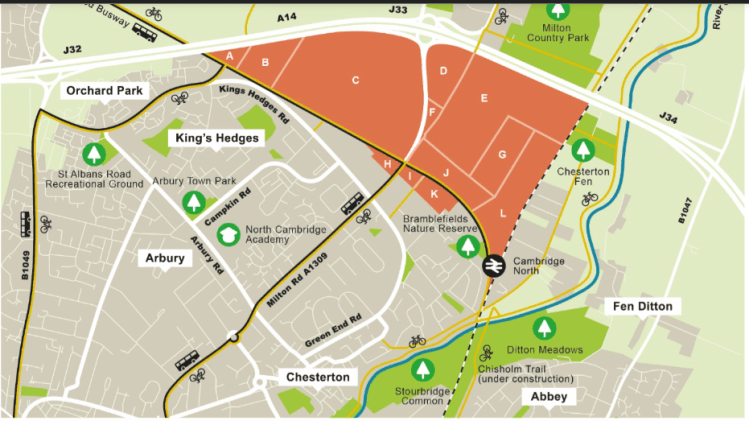
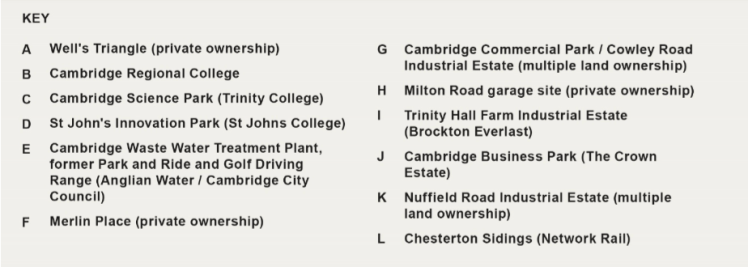
Above – Cambridge Business Park (at box J) is owned by Crown Estates. The Chesterton Sidings (at box L) is Brookgate’s development for Network Rail and others. The Anglian Water Works site (at box E) is the Hartree redevelopment. Furthermore, Trinity Hall Farm is being redeveloped (at box I) by Brockton Everlast.

Above – Brockton Everlast for Trinity Hall Farm from their July 2024 consultation (clashing with the general election so we all missed it!)
First impression of the above? ***OMG I hate it already!!!***
Which is why the first thing that stood out on looking at the large boards the Crown Estate and team had were the colours.
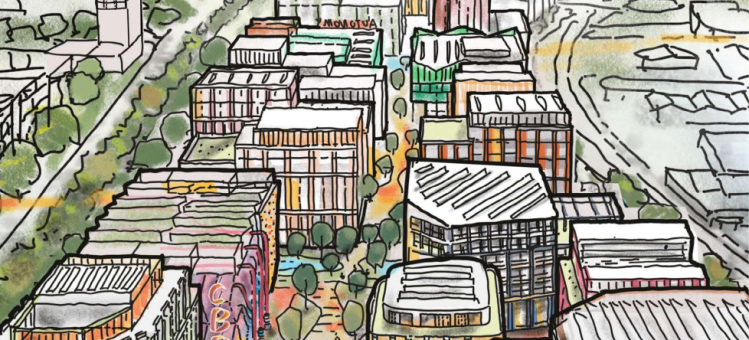
Above – from the display boards here, in comparison to their neighbours, there’s far more colour on the buildings in this illustration, although it remains to be seen how the concept transposes into the computer-generated simulations/images, and then the real buildings.
Getting into the local social history of the nearby neighbourhoods
When we looked at the context of the local area, we started talking about things like transport infrastructure and the over-complicated governance structures of Cambridge. One of the things they told me was that the guided busway was a huge constraint and barrier regarding pedestrian access to the site.

Looks like a straight forward walk from the Science Park busway stop…

…until you look up and realise that someone has put a barrier or three in the way
It’s not pleasant – and neither is the underpass that floods regularly. Combine that with a high-motor-traffic road and some of the ugliest buildings in the city on the Cambridge Science Park which in this bit are an ugly wall of grey, make for a depressing sight. Even on a warm sunny evening.

Above – I love a good hexagon but even these cannot save this monstrousity from being anything other than horrible
And if you want to borrow and browse the online version of Hideous Cambridge to see some more carbuncles, have a look here. I think I gave my last copy of the book to Peter Freeman of the Cambridge Growth Company at a conference earlier this year, asking him to browse through these and tell all of the developers here’s what not to build!
Taking the consultants through some of the local social history, and then asking how they would apply their technical expertise to some of the problems highlighted on the existing map
When the council estates in Arbury and King’s Hedges were built, residents and councillors quickly discovered that low density housing made it much harder to sustain a new generation of public services in the era of the post-war welfare state.

This then brought us onto conversations as to why the estates were designed as they were – to which we have Eglantyne Jebb and friends to thank for their work in the early 1900s flagging up poor housing conditions and low quality urban design creating demands for a new generation of housing that was much better ventilated and also had back gardens for allotments given the country’s experience of the U-Boat blockade during the First and Second World Wars. I’m old enough to remember my late Grandparents’ house in the 1980s where all of the occupants in their row were pensioners, nearly all of whom had fought in WWII, who had allotments in their back gardens with only two lines of wire held up by short posts separating their gardens. Thus as a child you got the impression that the back garden was a much wider open space. Today, all of the gardens have been fenced up.
Competing over design styles over who can create the best development with the most imaginative, distinctive, and awe-inspiring building designs and urban environments
This is not the first public consultation I’ve been to where property professionals have mentioned their familiarity with the reputation of Brookgate and their consultants. What’s been interesting is how so many have been at pains to state how and why they are different – not least those representing very long term institutional investors who were looking to hold onto the properties they were investing in for periods spanning many decades.
Looking at some of their emerging concepts
I mentioned that James Littlewood of Cambridge Past, Present, and Future, had described Brookgate’s development at Cambridge North as The Great Wall of North East Cambridge‘. which opposed Brookgate’s Cambridge North development that was only approved on appeal to the Conservative Minister Matt Rowley who also overturned the Environment Agency’s objection over water supply.
Hence we discussed their emerging proposals below, and looking at opportunities to break the skyline which Brookgate is inevitably filling up with big box blandness.
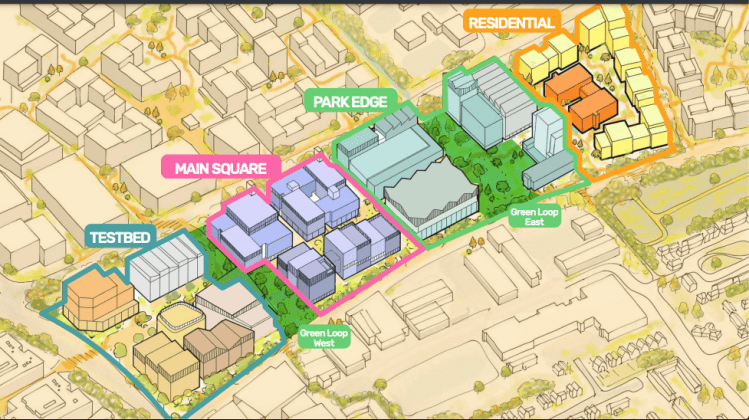
Above – emerging concepts from Crown Estates
Given Cambridge’s main roads are filled with dull, bland, boring, and/or ugly buildings, can Crown Estates come up with something that is the opposite?
Bennetts Associates now want to make Hills Road even worse with their monstrosity on Hills Road
It turned out that several people have already highlighted the potential of using decorative features at the tops of some of the buildings to break the skyline. Hence showing them some of the print outs of old unexecuted designs for which their designers and architects may want to take inspiration from.

Above – what Peck and Stephens proposed for Cambridge back in the late 1850s – published in The Builder on 14 Jan 1860.
The concept of the twin towers is something I’d like to see brought back for a new second major urban centre for Cambridge with a quartet of civic buildings each having their own twin towers.
- A new city hall for the unitary council
- A new very large concert hall
- A new large lifelong learning centre
- A new railway station at Cambridge East.
“And on the swimming pool?”
This is where I updated them on the Combined Authority meeting earlier in the day where the new CPCA Mayor Paul Bristow set out the likely next steps for the Cambridge Light Rail manifesto commitment, and also set out the way he wanted to work mindful of:
- Labour’s majority on Cambridge City Council,
- The Liberal Democrats majorities on both Cambridgeshire County, and South Cambridgeshire District councils, and
- The three new Green Party county councillors in central and east Cambridge!
His line was: “I want us to hunt in a pack for Cambridgeshire & Peterborough” – i.e. presenting shared and united bids for Government support for new infrastructure. Which was also my plea for support on my idea for a new swimming pool on the Milton Road Garage diagonally opposite their site. We discussed the poverty and multiple deprivation indicators for King’s Hedges in Cambridge (see Cambridge City Council’s ‘Mapping Poverty’ report for 2023 here) and how a new leisure centre within walking distance would make a huge difference to local residents in terms of jobs and health – as well as providing an amenity for their tenants and the Cambridge Science Park – which two years ago I wrote has a moral duty to respond to the poverty on its doorstep.
This was also where I urged them to use their lobbying power with local and national politicians to help come up with a solution that will benefit local residents, local students at Cambridge Regional College, and the tenants and visitors to the science and business parks near by. With a guided busway stop close by, it would also be accessible to the villages along the line. Finally, with Mr Freeman working on proposals for a new development corporation, his future powers on land assembly make it potentially easier to acquire that site for such a purpose.
Finally – on engaging children, teenagers, and also working class parents at design stage
I mentioned the question I put to Peter Freeman last month regarding young people not being listened to. Have a watch here.
I also listed:
- Cambridge Women’s Resources Centre
- Make Space For Girls
- Indie Cambridge
- Form the Future
- Together Culture
- Living Streets Cambridge
…as groups to get in touch with. Finally, with the Arbury Carnival in under ten days time, there is still time to book a stall and engage with/listen to hundreds of local residents who don’t normally get to have their say on future developments.
Furthermore, the Chesterton Festival is the following weekend – another chance for a stall that involves going where the people are, rather than waiting for them to come to you. Because otherwise you end up with the same old suspects (i.e. me) turning up. And even I wouldn’t want to wish that on anyone!
Food for thought?
If you are interested in the longer term future of Cambridge, and on what happens at the local democracy meetings where decisions are made, feel free to:
- Follow me on BSky
- Spot me on LinkedIn
- Like my Facebook page
- Consider a small donation to help fund my continued research and reporting on local democracy in and around Cambridge.

 The Cambridge Town Owl