
The multiple symptoms are now impossible to avoid. So long as Ministers and in particular The Treasury insist on holding onto the levers of power that might lead to improvements, little will change
Image: “Cambridge& – Impossible Stories”. Part of me is like: **I’ll give you an impossible story! ‘Ordinary resident on minimum wage working full-time hours buys family house with a mortgage valued at 3x their annual income’ **
Where were the adults in their 20s and 30s at these recent local events?
I’ve been to at least three music events in the past couple of weeks. Two at The Junction, and one just now at St John’s Church opposite Homerton College. If there was one thing all of them had in common, it was this: The lack of young adults in the audience.
“Children are the canary in the coalmine for what is happening to our cities”
…as I quoted from Dr Anna Minton’s work in an earlier blogpost headline. Has anyone tried asking the teenagers and young adults why their presence in our nightlife has shrunk back compared with 20-30 years ago in Cambridge? I wonder what a series of extensive, in-depth surveys would reveal. Cambridge Ahead’s Young [under 35s] Advisory Group wrote a report about the challenges our city faces, illustrating what young people at different stages of their careers and with different preferences and dispositions are facing. But inevitably it has limited insights into the lives of working class young adults.
“…in a nutshell our teenagers and young adults are being ill-served by our city’s economy.”
…as I wrote in a call for a single events portal for Cambridge. Because even that won’t fill the pubs, bars, and night clubs. My locals used to be packed on Friday and Saturday nights. I walked past one of them earlier. Yes there were drinkers inside, but it was hardly packed.
The catastrophic combination of reduced part-time jobs for young people (combined with another toxic culture – exams culture) means that even fewer have the ability to earn even a small amount of disposable income to go out and enjoy themselves. And given the high profile inability of the entertainments sector to deal with the toxic masculinity so many such institutions, it’s hardly surprising that young people are voting with their feet.
Combine that too with the higher costs of student rent, the very high repayment rates on tuition fees brought in by the Coalition (which in my view has become an unsustainable financial bubble in part created by the reluctance of the private sector’s graduate recruiters to pay for the costs of the education of their graduate recruits – combined with a powerful lobbying capacity to get their way) has contributed towards the crisis higher education now finds itself in. Even more so perhaps because students started behaving ‘like customers’ – trying to work out how much in fees each lecture cost. (I still remember discussing it with fee-paying international students in my own uni days in the early 2000s – one of them saying it was the equivalent of over £200 per hour!)
The hollowing out of communities through the conversion of residential properties for short-term accommodation.
This is particularly noticeable in South Cambridge because there are a number of different markets competing with new home buyers who want to settle down.
- Second/multiple home owners
- Air BnB ‘investors’
- Landlords targeting the student market (which don’t pay council tax)
- Landlords targeting the ‘affordable housing’ sector plus Registered Social Landlords
- Landlords buying to let for medium-term renters (eg for a few years)
- Overseas property buyers
As the buyers of most of these are more likely to be able to pay cash up front – i.e. not relying on mortgage approvals, they are in a much better position than the rest
All of these types of tenure mean that population turnover is inevitably higher than long term ‘buy-to-live’ accommodation, especially those that want to settle down and start families. Not surprisingly as people pass away and move on, it can feel destabilising for those left behind. Combine that with the decline and closure of social institutions, the rising costs of socialising, and the inevitable processes of ageing which means many of us become less mobile than we were in our younger years. (For someone who used to commute to London daily, I cannot imagine going on a train journey to the capital today (CFS/ME amongst other things). Want to know why I’ve made such a big deal about trams and light rail for Cambridge over the past decade? Exactly.
High prices for poor quality new builds
I remain to be convinced that much has improved. (Some of you may be interested in Cambridge’s house building statistics here). And so long as ministers refuse to fund a new generation of lifelong learning/adult education colleges across the country *and* fund the retraining and costs of living grants needed to enable people to switch into those careers with major skills shortages (to the extent it impacts the Government’s ability to meet its promises), then as I’ve said repeatedly, little will change.
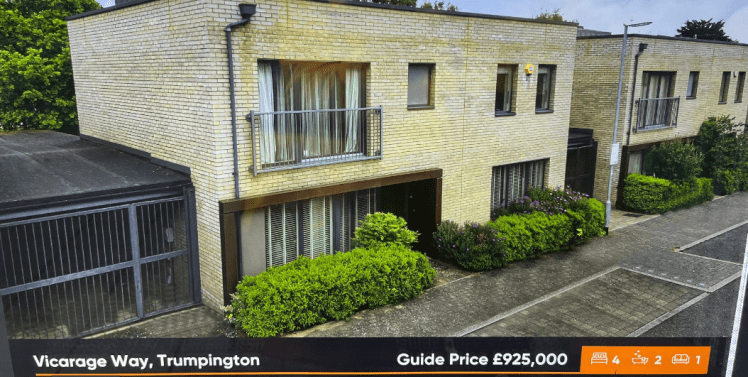
Above – I took this photo last night walking back from The Junction in Cambridge where there’s a nearby estate agency. £925k for a newbuild box-style flat-roofed detached house that is already going mouldy.
Note the top left of the property as you look at it – and look at the piping. The evidence of leaking water is more than visible. (Don’t get me started on ‘faux-balconies’!!)
Because Cambridge does not, and cannot function as a city greater than the sum of its parts, the symptoms of loneliness inevitably crop up – and there’s little local government can do about it
Take this example from one community page in Cambridge on FB.

This is not the only example I’ve seen – just the latest from earlier this evening.
Cambridge University’s colleges don’t care – it’s not in their royal charters and furthermore, culturally their only interest is with their own collegiate communities. It’s how they were designed both as institutions and as built environments. Which will be the first college to send a request to the Privy Council for a change to its royal charter so that its investment decisions as well as its wider activities have to account for the interests of the people of Cambridge – in particular those with the least?
“Shouldn’t local government be doing more to integrate new arrivals into communities, and providing more things for residents to do?”
The answer in part depends on where you stand – noting the traditional philosophical and intellectual divide between Conservatives and Labour was that the former saw it as the role for charities and community groups – ‘Big Society’ if you will, to do those things. The latter saw it as the role for the state – hence in the New Labour years many of the regeneration schemes funded from the centre (such as the New Deal for Communities programmes that covered 39 communities across England between 2000-2010) employed community development workers to work out of newly-established community centres. Sadly these were some of the first posts to go when austerity kicked in – resulting in the farcical situations of community centres being built but councils not having the staff to run them – such as with Nightingale Pavilion in South Cambridge. Again, if ministers want things like that staffed in Cambridge, they should let the local council tax more of the wealth being generated here. But successive Chancellors of the Exchequer have shown no interest.
“So, what’s the policy solution?”
Go to Heffers Bookshop in Cambridge (where I was earlier) and head downstairs to the politics section. There are ****lots of books**** there that have the answers – some of them even have the same ones!
The above-two are some of the more-familiar titles, but in the grand scheme of things it’s probably best to get a group friends together to go and have a collective browse, buy what interests you, and talk amongst yourselves about who wrote what.
One thing to add – there are a number of niche subject books that deserve a much wider audience but a combination of price, (lack of) advertising budget, and target audiences mean few get to find them – such as ‘Applied Security Studies’ edited by Norma Rossi (2024). Because in this age of ours the topic headings alone make for sobering reading. The authors of each chapter cover:
- Migration
- Race
- Gender
- Organised crime
- Cybersecurity/online
- Financial security
- Climate Security
- Health Security
- Resource Security
…and more. It ranges from the hyperlocal (Eg street crime) through to the international and global
And even a place like Cambridge cannot avoid the challenges for all of the above. Given that social resilience and social capital are becoming public policy issues, at some stage ministers and their advisers will have to face down the powerful interests whose lobbying is blocking the strengthening of our communities.
As Mr Freedman alluded to in his book, how many powers (and how much power) are ministers prepared to relinquish? The same question could be put to the powerful private institutions: How much power and wealth are they willing to relinquish in the interests of the greater collective good? Because when the very powerful try to hold onto it at all costs, history has more than a few case studies of what can happen. As dramatised in Doctor Zhivago returning home from the Eastern Front late in WWI.
If you are interested in the longer term future of Cambridge, and on what happens at the local democracy meetings where decisions are made, feel free to:
- Follow me on BSky
- Spot me on LinkedIn
- Like my Facebook page
- Consider a small donation to help fund my continued research and reporting on local democracy in and around Cambridge.

 The Cambridge Town Owl