
With the consultations on the Cambridge Growth Company and the new unitary council looming, now is the time for civic-minded residents to speak up. Town, gown, and county.
TL/DR? Look at the charter here – and specifically at the commitments from Section 7.
Image – The Trials of Democracy, which has more events coming up over the summer
This post emerged from a series of posts by Alex Blandford here, and former councillor Sam Davies MBE here, the latter being in response to my blogpost stating that Chronically high land and property prices are poisoning our city
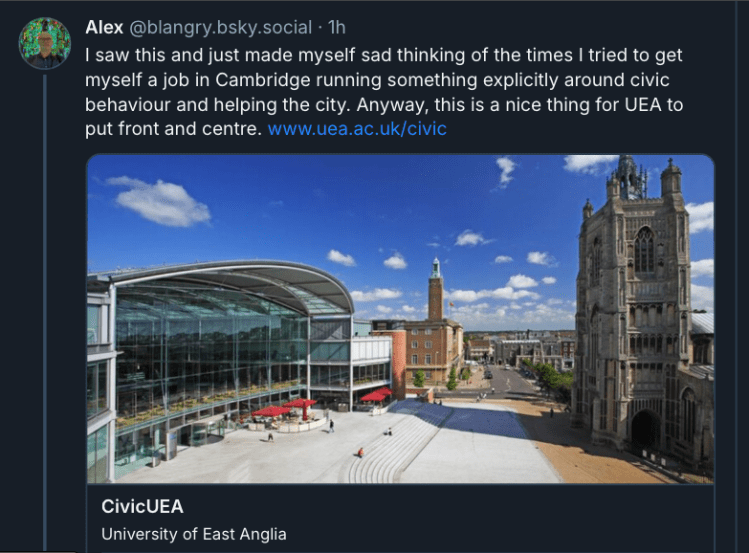
Above from Alex here, which got me looking at the University of East Anglia’s civic charter here. (Note the superb civic urban design of The Forum on the left, the city council’s 1930s building with the clock tower, and the ancient St Peter Mancroft church building which dates back to 1430.)
The UEA Civic Charter as proposed
It has not been approved by UEA’s governing authorities. Like so many other institutions there are various subject areas fighting for their existence in a crisis that seems to be engulfing higher education but one being curiously ignored by the mainstream media. Hence the list of signatories here and the call for people to sign it.
The civic charter states [amongst other things] :
7. COMMITMENTS:
“a) UNIVERSITY: we will…
i. Listen to the voices of the people of East Anglia so that we can fully understand our evolving purpose in this region;
ii. Nurture our whole community: students, staff, alumni and regional citizens;
iii. Build bridges that connect the life of the University with wider society: opening our campus to all; “
“Are they out of their minds?!?!”
Why would they be out of their minds?
“Because once they commit to opening up the ivory towers to town people, it won’t stop there!”
Well…it is our city.
“And what will happen to the colleges?!?”
Much less…influence?
“Do you know what happens if the right people don’t have influence? The wrong people get it! Local councillors! Ordinary voters!“
But aren’t the people supposed to have influence in a democracy?
“This is a British Democracy Bernard!!!” (If you’ve not seen the Yes Prime Minister clip on Regional Government!)
In the case of Cambridge’s older colleges, it’s not simply a case of opening up the old courts – not least because:
- students live there
- the buildings are ***really old*** and maintenance does not come cheaply – and it also creates a huge amount of paperwork for the city council as the local planning authority with so many listed building consent applications needed for small things like replacing a window frame.
- Cambridge gets 10 million tourists per year – most of whom come to see the old buildings (rather than the new ones) – so much so that in recent decades the city centre becomes unmanagable. Especially in the summer.
Furthermore, UEA’s charter calls for the university to,,,”
“Convene world-leading teams to meet complex challenges, offering our expertise to address common problems in the region and beyond”
One thing the University of Cambridge could have done (but hasn’t) is put its expertise towards solving Cambridge’s chronic transport problems. One of the reasons why it has failed to do so ***as an institution*** is because it has a huge conflict of interest. What do you do when your researchers come up with recommendations that state that the University and its colleges need to take a series of actions that will reduce its wealth, power, and influence in return for contributing towards the greater good of the city? (For example massively reducing health inequalities and increasing biodiversity creating new nature reserves and urban parklands on land that they otherwise might want to realise development gains from?)
- I’m more than aware of some of the excellent and ground-breaking research a number of research students are undertaking on our city’s challenges – not least because as a local historian several have interviewed me as part of their research!
- What do you do as a researcher if your conclusion comes up with actions or policy recommendations that the institutions concerned have no interest in carrying out, and/or can point to legal restrictions that ‘prevent’ them from doing so – such as compromising a clause in a royal charter or an Act of Parliament? (As a civil service policy adviser, one of the first things you are told is that unlike almost any other job in the country, if there is a public policy issue that is insurmountable within the existing legal system, you have the ability to recommend a change in the law to your superiors up the chain – including ministers, knowing that there is more than a small chance your recommendation will be acted upon.)
The irresponsibility of ministers and senior Cambridge University decision-makers to expand our city…
…without ensuring the structures, systems, and processes to provide for the needs of our city and surrounding towns and villages.
This was the point former city councillor Sam Davies MBE made
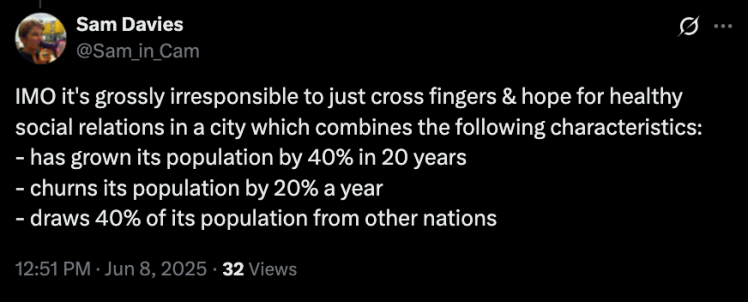
In criticising the decision-makers past-and-present, Ms Davies stated
“IMO it’s grossly irresponsible to just cross fingers & hope for healthy social relations in a city which combines the following characteristics:
- has grown its population by 40% in 20 years
- churns its population by 20% a year
- draws 40% of its population from other nations
In these circumstances you have to work hard and invest in creating the spaces where people can come together. The last two decades have seen the city move in the opposite direction. No wonder it leaves people feeling disappointed and disconnected”
The G-Search Engine’s new AI-pop-up thingy that hardly anyone asked for, stated:
“The University of Cambridge has a diverse international student body, with over 9,000 international students representing over 140 different countries. Approximately 25% of undergraduate students and over 50% of postgraduate students are from outside the UK.”
…in response to my search for data on the makeup of the Cambridge University student population – which you can see here.
The. Students. Are. Not. To. Blame.
Furthermore, Ms Davies points readers to the https://www.reddit.com/r/cambridge/ threads and the number of people/posts citing or hinting at loneliness – highlighting this case in particular.
Cambridge’s fragmented institutions have given rise to the piecemeal attempts at civic problem-solving.
It’s even worse for newcomer residents because continued austerity and the enfeeblement of local government in the UK since the 1980s has meant that the civic role of elected local councils has been scaled back dramatically to such an extent that they feel like little more than service commissioning institutions and contract managers. (How many agenda items in this recent county council meeting have the word ‘recommissioning’ in them?)
The University of Cambridge’s opaque and confusing decision-making processes have been long documented. Shouldn’t the University get its own structures and systems in order before publishing articles lecturing others on corporate governance? (What would it be like if this network sunk their teeth into a high profile analysis of the University and Colleges structures? What would their recommendations be? Furthermore, what would it be like if the University of Cambridge had to secure the approval of a governance committee that met in public before its representatives took part in meetings as part of local, regional, and national government structures affecting the future of our city?)
You can’t blame the council for decisions college landowners make in who to rent out their town centre commercial properties to
Hence this post noting the rise of various new shop types that don’t seem to contribute much to the life of the city – aimed at a mass tourist market more than anything else. But then if colleges choose to set rents as high as they are, the only stores that can make ends meet are either ones with a high turnover of stock, or those that sell expensive items to a very wealthy clientele.
“What might a civic charter for Cambridge look like?”
It’s not so much the final result as the journey undertaken to produce it. I could write a civic charter basically copying, pasting, and tweaking the UEA charter and shout: ***Done it!!!*** But it would be meaningless. A small group of academics could do the same thing, but without the co-operation of the institutions (or the threat of a big stick from central government – the willingness to legislate), that would not have much impact either.
‘If a civic charter is the answer, what’s the problem?‘
So to speak. Which is why I don’t think a civic charter alone provides the responses to our collective challenges any more than the Climate and Nature Bill will deal with our own environmental challenges.
Ultimately the roots of the problems are in municipal government and governance: how people and institutions in a given settlement or defined geographical area live with each other and distributed limited resources within a society that not only has basic needs, but one that also has unlimited wants.
And if you want to get interested people together in one place to attempt such a thing, the best way to start it is not with a mass meeting/conference somewhere, but rather something that can spark our city’s community and campaign groups into life. Hence my repeated calls for an annual Cambridge Societies’ Fair – like what students have, but for town and county groups.
Food for thought?
If you are interested in the longer term future of Cambridge, and on what happens at the local democracy meetings where decisions are made, feel free to:
- Follow me on BSky
- Spot me on LinkedIn
- Like my Facebook page
- Consider a small donation to help fund my continued research and reporting on local democracy in and around Cambridge.

 The Cambridge Town Owl