
The author of ‘Human Transit’ (in the metro public transport sense) has invited any interested groups to organise a speaking event and/or a 2-day transit design course both in and for our city
TL/DR? See JW & Associates’ transit network design course here.
Image – from Cambridge Connect Light Rail
Given a number of Cambridge Ahead representatives have spoken highly of Dr Walker’s publication Human Transit, and given that the recently-elected Mayor of the Combined Authority is making preparations for a feasibility study for a light rail for Cambridge, now seems like an ideal time to invite Dr Walker to address not just an audience of specialists, but also the wider general public, hundreds of whom have been following and commenting on many transport plans over the past quarter of a century!
Dr Walker was also in Cambridge (UK!) in the run up to the general election in 2024, after which he posed this question:
“Reading up on guided buses after yesterday’s day trip to Cambridge, UK. Intrigued that the long Wikipedia article on the topic doesn’t answer the question: “What problem does this solve?””
Above – @HumanTransit on the birdsite in June 2024
This is why local history is important! Let’s go to the first county council newsletter from over 20 years ago.

Above – where is the guided bus link from St Ives to Hinchingbrooke Hospital?!?
There was a significant opposition campaign against the original guided bus campaign. Fortunately the websites are still up.
The first leaflet from Nov 2003 stated:
“As you may know, Guided Bus is an innovative new transport system which uses a dedicated guideway to take buses along a fixed route with small guidewheels keeping the bus within the guideway. The buses operate as normal on the road when they leave the guideway.
For much of the route this means that the buses will not need to run on crowded roads providing a much more reliable alternative to congested and unreliable routes such as the A14. The buses can join the guideway at either end or at several entry points along it.”
On the same page, former councillor Shona Johnstone (Cons – Willingham) stated:
“You may have seen proposals advocating re-opening the line as a railway. We don’t think this is the best option for this route. The rail option is not supported by the rail industry or the Government which means Government money is not available for it. We don’t think it is deliverable either in the timescale or in a form that offers the benefits of Guided Bus which we talk about in more detail later.”
Above – Guided Busway Newsletter No.1, Nov 2003

Above – the NoGuidedBus campaign has uploaded all of the newsletters to its website here,
Follow the link above, scroll to the foot and enjoy over a decade’s-worth of newsletters! (There’s a postgraduate research study waiting for an early career researcher to undertake with all of this material!)
Additionally, members of Cambridgeshire Sustainable Travel Alliance, Rail Future, and the Cambridge Connect Light Rail Project may also be interested alongside the Combined Authority Mayor
And if you’ve not seen the Cambridge Connect Light Rail video, see it below.
Above – Cambridge Light Rail by Cambridge Connect
Also, if you missed it at the time, see Cambridge Connect’s press release following the recent Mayoral elections last month.
“Was the guided busway a success?”
That depends on your definition of success.
Edward Leigh of the now closed Smarter Cambridge Transport Campaign gave his assessment here.
In terms of passenger numbers it’s harder to tell with the impact of the lockdowns

Above – from Cambridgeshire Insight’s Traffic Monitoring Report 2023 – p111
The big unexpected/unplanned success was the doubling up the access road into a footpath and cycleway. This was in part due to the successful campaigning of CamCycle, who objected to the lack of a properly-surfaced maintenance track and also the lack of a cycleway underneath Hills Road Bridge. (See their formal objection letter in 2004).
While the extra costs incurred due to the work on Hills Road Bridge (including massive traffic delays while this was happening – I lived through it!), in the longer term it has made a huge positive difference to pedestrians and cyclists.

Above – from Cambridgeshire Insight’s Traffic Monitoring Report 2023 – p107
I’ll leave you to compare the turnout with the predictions, projections, and expectations of the late 2000s. Ultimately the two biggest failures were:
- The huge cost overruns that cost both the county council and BAM Nuttall, the main contractor £millions in legal fees, finally settling out of court before the the cans of worms were made public in open court hearings.
- The avoidable deaths of Jennifer Taylor, Steve Moir, and Kathleen Pitts – which rightly resulted in a prosecution by the Health and Safety Executive, and fining of the county council
The decade-long debate – busways vs light rail
Dr Walker had a look at the different reasons for choosing one over the other in his blogpost here.
The emerging development plan for Greater Cambridge 2031-40 more than made the case for light rail in my view. Hence supporting the Cambridge Connect proposals from the very start. What swayed most of the politicians was the continued and sustained opposition to the proposed new busways that had none of the supposed benefits of the concrete guide-rails – essentially being roads with additional signs telling motorists to keep off the busways. Yet as many people from the business communities were telling me anecdotally at events and conferences over the past decade, ‘wealthy people will use light rail, but they won’t use buses’.
It remains to be seen whether the new Mayor of the Combined Authority has secured ministerial support for light rail.
The looming spending review on Wednesday should tell us what possible funding and powers Mr Bristow might get. At the same time, Peter Freeman, the Chair of the Cambridge Growth Company has also indicated his preference for light rail over busways given the scale of the Housing Minister’s ambitions for growing Cambridge. I agree with Mr Bristow in that I believe it’s inconceivable that ministers would want Cambridge to expand by over 100,000 homes (thus over 250,000 people on top of a population already over 300,000 people in Cambridge City and South Cambridgeshire District Councils’ boundaries) without constructing a light rail metro to serve it – along with a clear set of options for new unitary council for Greater Cambridge. (I think Dr Walker would be horrified if he saw how a globally-recognised city like Cambridge had the governance structures of a market town!)
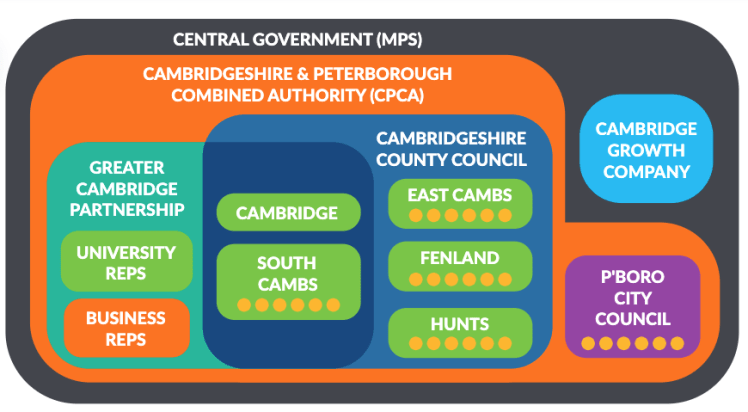
Above – how Cambridge has been governed for the past decade or so – now with added Development Corporation! (Accountable to ministers, in the form of the Cambridge Growth Company) In CamCycle Magazine Summer 2025
We should have substantial amounts of additional information published by the time Dr Walker arrives in Cambridge in September 2025, including:
- Information on a light rail feasibility study by Mayor Paul Bristow
- A live consultation from Peter Freeman and the Cambridge Growth Company (including its proposed powers and geographical area of those powers)
- A live consultation on the boundaries of a new unitary council for Greater Cambridge
- More information from the Newtowns Taskforce on where any additional newtowns for Cambridgeshire should be built.
For anyone interested in the future of Cambridge, you’ve got a lot of heavy reading ahead over the summer!
If you are interested in the longer term future of Cambridge, and on what happens at the local democracy meetings where decisions are made, feel free to:
- Follow me on BSky
- Spot me on LinkedIn
- Like my Facebook page
- Consider a small donation to help fund my continued research and reporting on local democracy in and around Cambridge.

 The Cambridge Town Owl