
On how people on low incomes and face two sets of barriers when it comes to trying to influence decisions made about where they live – and also has wider impacts on policies trying to deal with loneliness in society
This is my second attempt at trying to write this post because I got side-tracked on all things neurodiversity on the last one.
My LinkedIn feed is currently full of photographs of people from middle-class-to-affluent backgrounds enjoying themselves at corporate events – ones where the refreshments are free. In times gone by I used to go to such things both during and after my civil service days, so I’m not about to start throwing brickbats around.
Also, I won’t get started on the formal dinners hosted by Cambridge Colleges other than to acknowledge their existence and the ability to have informal off-the-record conversations at them. There’s a much-wider issue of how the University and its colleges formulate and decide their corporate policies – and how they are held accountable to their students and members.
There’s lots of stuff happening in the daytime – when most people are at work
For example Cambridge Wide Open Week was hardly going to be accessible to the general public – which then makes me wonder who it was actually ‘wide open’ to.
The context of this post isn’t: “Why didn’t I get an invite to XYZ – don’t you know who I am?!?” (because with CFS/ME amongst other chronic health conditions I rarely get to go to anything these days – and the things that I do get to go to inevitably involve spending 2 days bed-bound with Post-Exertional Malaise trying to recharge my internal batteries. Which is one of the reasons I make a big deal of getting a new generation of people educated and active because the generation of the 2010s has long since burnt out).
How do we get a new, younger generation of people active and involved?
Because unless adults in their 20s and 30s are paid to be at events on behalf of their employers, all too often their generations are conspicuous by their absence – as I last noted in this recent blogpost. In the PR photos of the corporate events, the rooms are full of people younger than me in suits and shirts. But they are there to represent their employer rather than in any personal capacity. I also found out the hard way in the 2000s that I simply did not have any spare mental capacity to engage in debates on the future of Cambridge – not that I noticed any of the institutions making a concerted effort to reach out to young adults at the time. Remember mine was a generation not educated in politics and democracy.
Multiple shared interests
Shortly after graduating over 20 years ago, I figured out that I needed to find a small stable group of close friends with whom I had multiple shared interests. Fast forward a couple of decades and I concluded that I had failed unspectacularly in that endeavour to the extent I no longer had the capacity to continue chasing that dream. What I didn’t know until a couple of years ago was how my neurodiversity influenced my experience of this – and how so many other people were experiencing similar symptoms and struggles – so much so that loneliness in society has since become a public policy issue. (See the research briefings on loneliness by the Commons Library here)
How can decision-makers in powerful posts hope to solve the challenges the rest of us face if their structures block out the very people they are meant to be helping?
One classic case in point is Cambridge University’s U-bus service and their press release of 19 May 2025.
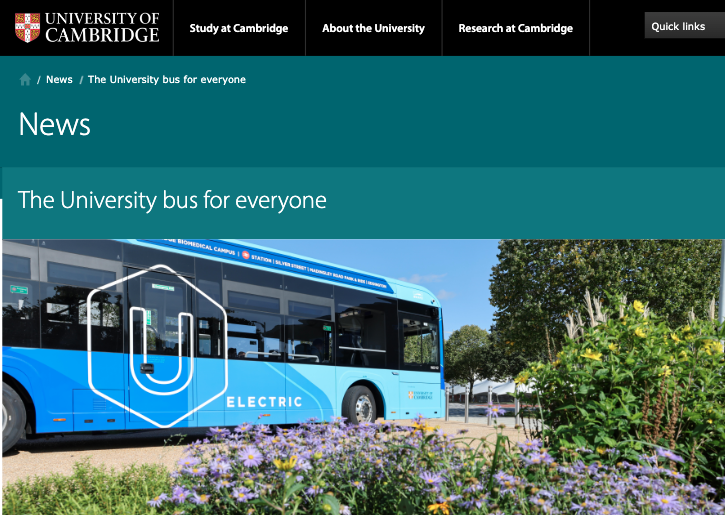
Above – The University bus for everyone. But is it?
On paper, it is. Anyone can buy a ticket to get on it and go to whichever stop they want. But there are two major design problems:
- The bus routes for the service don’t serve any major residential area where the majority of the population are earning below the median wage and/or living in homes valued at or whose rents are below the median. (See the route map here and note that South Cambridge along Hills Road is one of the most sought-after places in the country to live in)
- The bus service is run by Whippet, which means that because of the refusals of successive governments to impose universal ticketing for public transport, people living in most of the city and beyond will have to buy two sets of bus tickets in order to get to places like the West Cambridge site, West Road Concert Hall, or Storey’s Field Centre – designing in additional financial and geographical barriers to people who might want to see a show at the latter two sites
If the people doing the planning and designing at the very start had adopted ‘inclusivity by design’ into their principles, then things like universal ticketing, bus routes from town residential areas, and council housing on Eddington would have been built in.
But they are not.
What this reflects is a lack of awareness in the institutions concerned, and a lack of diversity of life experiences in their cohorts of decision-makers past and present. Recall how the lack of diversity in Downing Street led to the avoidable deaths of women during the pandemic – something the University of Cambridge and most of its colleges should be *extremely sensitive about* given their histories of institutionalised sexism. (If you haven’t read The Spinning House by Caroline Biggs, it’s well worth doing so).
“How can Cambridge design in inclusivity into the decision-making processes for the future of our city and county?”
“Whether forged in neighbourhoods, clubs or universities, cross-class links can boost social mobility and break down divides”
Editorial by The Guardian, 24 March 2025
Is the newspaper (and are media organisations generally) living what they are preaching? The same goes for the academic output for the likes of the Judge Institute at Cambridge – what would the results be if a critical mass of their researchers on management and corporate governance researched and analysed the institutions, structures, systems and processes of the University of Cambridge, and their impact on the wellbeing of the people of Cambridge (in particular those earning below the median wage, and those in council or social housing)?
“Feeling poorer than your friends in early adolescence is associated with worse mental health”
“Poverty can mean children going without basics, and it can mean missing out on everyday fun and activities that other kids take for granted. Poverty harms children’s health, social and emotional wellbeing, and education. It harms their childhoods and their futures.”
Outreach at existing community events as a first step
I’m glad to say we’re starting to see more of this. i.e. institutions now making an effort to go to where the people are, rather than setting up events at places that are hard to get to, and even harder to find out about.
One of the big game-changers for me would be seeing events where those gaining the most financially were engaging in conversations with the people of our city on a routine basis. Not through consultants or professional PR people, but the senior executives in the big institutions of whichever sectors. Furthermore, those conversations need to begin at the very start of the processes and also involve sharing the problems. And yes, some of those can be informal – even social events. Because otherwise Cambridge will remain a cash cow whose wealth can be extracted and exported for the benefit of the very few, not the many.
Food for thought?
If you are interested in the longer term future of Cambridge, and on what happens at the local democracy meetings where decisions are made, feel free to:
- Follow me on BSky
- Spot me on LinkedIn
- Like my Facebook page
- Consider a small donation to help fund my continued research and reporting on local democracy in and around Cambridge.

 The Cambridge Town Owl