Reading through some of the social media write-ups on Cambridge-Wide Open Day, the democratic and Political issues were conspicuous by their absence. At some stage these events will need to grapple with them and figure out what accountability means.
I went along to a couple of events back in 2023 (see my write-up here) but being in a chronic fatigue/PEM trough has meant that I’ve hardly done anything this week.
Two architects of the future of Cambridge
To paraphrase one trusted source who I won’t name, one event started off with:
“”Two architects of Cambridge” That’s how [Andy Neely and Peter Freeman were] introduced [as] this morning’s Cambridge Wide Open Day speakers.”
“Well I didn’t vote for them!”
You don’t vote for architects of Cambridge!
“Well ‘ow d’you become one then?!?”
Neither of the two men mentioned have any accountability to local government-level democratically-elected institutions.
Prof Neely, until recently the Pro-Vice-Chancellor for Enterprise and Business Relations, was accountable to the members of his own institution via the much-criticised governance structures of the University of Cambridge.
Mr Freeman is directly accountable to the Minister of State for Housing and Planning, Matthew Pennycook MP, who appointed him as Chair of the Cambridge Growth Company
I’ve had my disagreements in the past with Prof Neely, but my criticisms are primarily at the institutions – and their systems, structures, and processes. (Mainly on the grounds that if the person speaking was replaced by someone else, the message would still be the same).
“The Pro Vice-Chancellor Prof Andy Neely of the University of Cambridge caused a little disquiet (to put it mildly) with the picture he painted of the institution he represented, and its relationship with the local councils and ‘town’.”
Above – from an event by the Academy of Urbanism at The Cambridge Union, 22 June 2023, which I blogged about here
In the above-mentioned blogpost I challenged him in the Q&A session about his framing of town/gown relations.
“I put a question to Prof Neely on why his university had de-prioritised a major leisure infrastructure project (the proposed large swimming pool for the University’s sports centre) despite its huge wealth and income. I also reminded him of the commitment Sir Ivor Jennings, a former Vice-Chancellor made in 1962 about the University’s responsibility for our city. “
At the time he said the University of Cambridge was ‘just about breaking even. At the end of that financial year the University of Cambridge reported a deficit of £53million. Yet only a couple of years earlier in 2022 it was telling the world of how it had raised over £2billion in philanthropic donations.
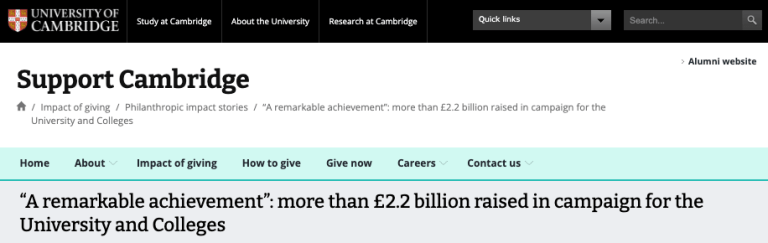
Above – from the University of Cambridge’s philanthropy pages
Prof Neely summarised the institutional structures of the University in a blogpost in 2021.
“One of the challenges of working with Cambridge is our breadth and scale. With more than 150 Faculties and Departments, nearly 12,000 staff and more than 22,000 students not to mention 31 independent Colleges, the opportunities for businesses to engage with us are plentiful.”
Above – Impact through collaboration: the importance of strategic partnerships – Nov 2020
He followed that with:
“Sometimes, we are told, too plentiful. We know the University is complicated – but it’s not just us. Almost all large companies also have labyrinthine organisational structures. Trying to bring the right people together at the right time can take patience and persistence.” [My emphasis]
Surely the responsibility is on the University of Cambridge to demonstrate institutional leadership by simplifying those ‘labyrinthine organisational structures’ and using its influence to make those large corporations much more transparent and accountable – both to customers and shareholders/investors. After all, isn’t improving corporate governance of large institutions one of the key selling points of the courses offered by the Judge Institute opposite the Fitzwilliam Museum?
In the process of establishing new unitary councils, ministers should consider bringing in stronger transparency and corporate governance systems for universities and higher education institutions that sit on local public service committees that shape the futures of places
Some of the issues about transparency and accountability were asked by former councillor and Cambridge Alumnus Sam Davies MBE here. See also her blogpost on the continued growth giving no benefits to too many of the residents of the city.
At the very least, shouldn’t the University of Cambridge have mandating meetings which are publicly and proactively advertised to enable its own members to shape the corporate positions of the University and its member colleges? Especially for decisions that affect the lives of the people they share a city with? (There’s a separate debate that has been ongoing for decades about college investments that affect those living beyond our city and county).
I think there’s something to be said for the Pro-VCs to be cross-examined by local councillors on a routine basis – perhaps similar to the Commons Liaison Committee scrutinising the Prime Minister. Eg once every 4-6 months. Which reminds me of the proposals for local public accounts committees.
“On 26 January 2023 Lisa Nandy MP announced that the establishment of local Public Accounts Committees would form part of a new approach that the Labour Party would take towards English devolution, if they form the next Government.”
Above – Centre for Governance Studies, 26 Jan 2023
This was included in the English Devolution White Paper 2024, although I imagine every higher education institution will be trying to lobby for a way out of being hauled before them!
“Will the new generation of councillors be able to stand up to the huge institutional power of the University of Cambridge and Central Government?”
The thing is, democracy isn’t a spectator sport. Cllr Holloway has got no more of a chance than any of his predecessors if the rest of us sit back and assume ‘it’s the councillors’ job to do that’.
In a recent interview, state senator Mallory McMorrow in an interview on The Daily Show explained how constituents can support their councillors and MPs in their work.
“She’s advocated with me, we’ve built up a relationship over six years, and [they got the law changed on domestic violence]. And every time there’s legislation, she reaches out. Because I know this is now her area of expertise, *I call her for advice*”
Mallory McMorrow, The Daily Show, 09 April 2025 (from 11m in)
In the early days of Birdsite, Cambridge MP Dr Julian Huppert (Liberal Democrats, 2010-15) became something of a thorn in the side of Coalition Ministers because he used his social media accounts to crowdsource public questions to ministers. Imagine having a city like Cambridge and being able to tap into so much expertise to fire laser-guided questions to ministers on a daily basis.
“Julian Huppert MP is one of several MPs that now crowd-sources questions for ministers prior to departmental questions in the Commons. People can see him putting questions to ministers and hear the responses back. Furthermore, social and digital media allow for a more continuous/conversational relationship between elected representative and constituent.”
ADBF – 09 Aug 2013 – “How can parliament embrace digital democracy?” – A response
That was over a decade ago. It’s soul-destroying to know how this opportunity for proper crowd-sourced methods of ministerial accountability to Parliament with MPs supported by a critical mass of their constituents has been lost.
If you are interested in the longer term future of Cambridge, and on what happens at the local democracy meetings where decisions are made, feel free to:
- Follow me on BSky
- Spot me on LinkedIn
- Like my Facebook page
- Consider a small donation to help fund my continued research and reporting on local democracy in and around Cambridge.

 The Cambridge Town Owl