
Probably not, but you never know what funding could come from where to overhaul an appallingly-designed site owned by LandSec with some of the worst examples of early 21st Century corporate civic architecture and urban design.
Last month I was at The Junction to see ageing folk-rockers Oysterband in their farewell tour after over 40 years worth of gigging and touring. (I first saw them at the Cambridge Folk Festival back in 2004). The emptiness of the square, seemingly purpose-built for crowds of young people, was hard to ignore for a Saturday night in May.
According to the site’s owners, the market value ranges between £15million – £50million

Above – from the properties page of the owners as of 14 June 2025
With the proposed development corporation having far greater powers of land assembly amongst other things, this is where Mr Freeman could make a huge difference to a part of town that is a case study for developers gaming the planning system for their own enrichment – as I wrote nearly nine years ago here.
There were proposals to redevelop The Junction but ongoing austerity meant there was no money to proceed.

Above – Levitt & Bernstein’s proposals from 2019 which I wrote about here
…even though it was Cambridge firm 5th Studio that started the ball rolling
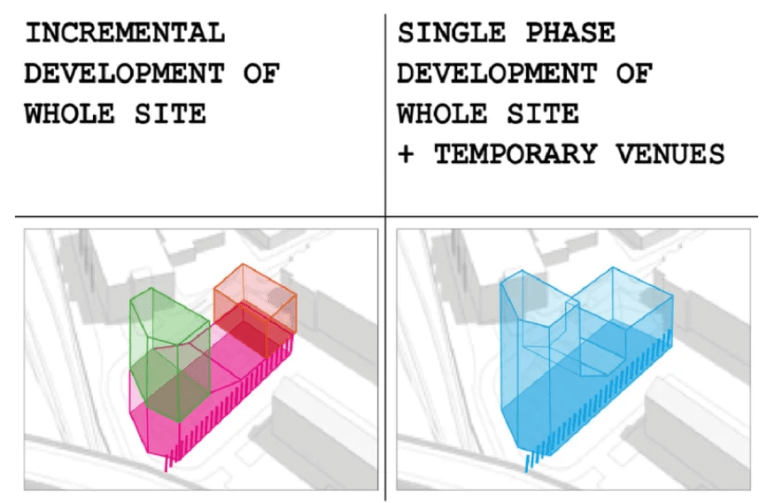
Above – concepts from 5th Studio from ***ages ago*** (but still relevant)
This post started from some local historical research after another local school summer fete in Queen Edith’s, South Cambridge
Below – me with some local democracy things and big print outs from this month’s CamCycle Magazine. Spot the colour that ran out in my printer!

Above – the print outs on the table with lots of pink in are from CamCycle’s 30th Anniversary Edition which provides the most clearest depiction of how our over-complicated local government institutions in Cambridgeshire is currently structured.
Talking to a couple of the parents, one of them mentioned trying to put together a new alumni society. (Sadly a few years too late for Dame Olivia Newton John who spent a few months at the school before her family emigrated to Australia).
Two other names that came up were Peter Hall (Sir Peter Hall) the former director of the National Theatre (only its second in its history)
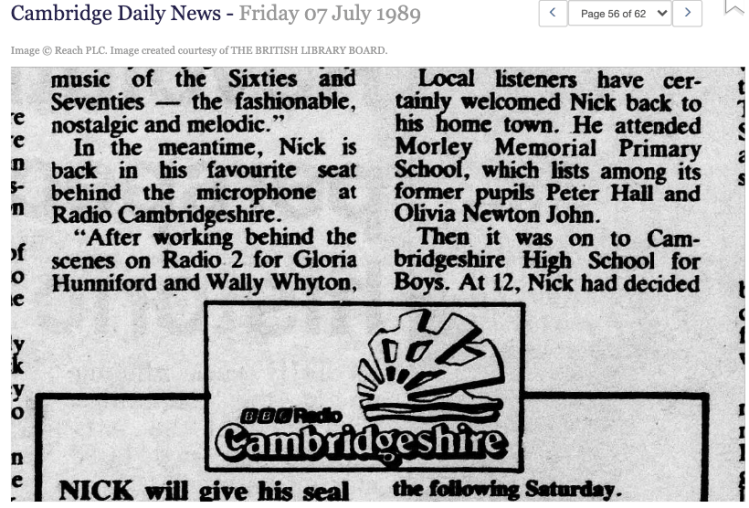
It turned out that Sir Peter didn’t like the place! (It was during the inter-war era, Sir Peter was born in 1930)
“We moved to Cambridge and I went to Morley Memorial Junior School, which seemed very rough. Being an only child, and a loner from the wilds of Suffolk, I was mocked by brawling boys and giggling girls. It was bearable because it was just round the corner from home so, if the worst happened, I knew it would take only two minutes to reach the safety of my mother.”
Above – Sir Peter Hall in The Independent, 15 May 2008
The reason for picking up on this was that Hall won a scholarship to The Perse – which just before the pandemic named their new performing arts centre after him. The private schools in Cambridge tend to be better at listing their past students – not least because they have a commercial incentive as well as the resources to do so. Under-funded primary schools on the other hand. But what do you do if your famous former pupils go on public record as not liking their time at said school, as former Pink Floyd musician Dave Gilmour did during his time at The Perse? ( <– See the school’s account in the Performing Arts & Culture Tab).
In competition with The Perse is The Leys Great Hall theatre which sometimes does public events. I’ll leave you to be the judges of who has the best technical specs – the J2 vs The Perse vs The Leys, but note this: The J2, which is broadly comparable with the two private schools, has a seated capacity of 220 people, while the two private schools cater for over 330 people each. The J1 – the original Junction building opened in 1990, five years after the riots on East Road that persuaded local politicians to provide something for teenagers and young adults, remains a cheap-as-chips breeze-block quad with a roof plonked on top. Hence it being long past its use-by date and in this city of supposed wealth, long overdue being replaced by something far more grand.
“Why spend all that money on state-of-the-art fully-equipped theatres for private schools which their children learn to use…
…only to find that out in the real world many of the local public theatres that might need said skills could never hope to afford such equipment?“
It’s not for me to tell individual parents how to spend their money or which institutions they should be volunteering their hours for. Interestingly the first Conservative Woman Mayor of Cambridge, Baroness Trumpington (yes, that one) – then known as Cllr Mrs Barker, was a school governor at both state and private schools in Cambridge during her time as a councillor in Trumpington. In that sense she got to see a cross-section of the city – then as now, Trumpington Village being one of the areas of council house-building at the time.
“Do we have the institutional structures for civic fundraising for big new amenities?”
For example Cllr Kelsey Kerridge was the civic titan behind the huge sports centre that we named after him.

“Kelsey Kerridge, vice-chairman of the Cambridge Sports Hall appeal fund, represented Cambridgeshire at no less than 10 sports in his day.”
(Look at the size of the fists of the former county-level boxer!)
“How about a Mayoral Capital Fund?”
I asked about that in June 2018…have a read here
“And the result?”
The city council leader at the time, Cllr Lewis Herbert said: ‘No’. See the minutes of Thurs 19 July 2018 at Cambridge City Council’s full council
“Mr Carpen asked the following: “What thoughts had the Mayor of Cambridge and councillors given to the idea of a Mayor’s Permanent Fund to act as a central ‘collecting pot’ for donations from wealthy and affluent donors to help fund large civic projects that cannot be paid for through existing council funds or developer contributions?””
“The Leader provided the following response:
- In each Mayoral year, the Mayor nominated the charities that they would like to raise money for. In this mayoral year Councillor Gawthrope had nominated the Alzheimer’s Society and the Red Hen project.
- It was not appropriate for the council to become the sponsor of major charities.
- The Council contributed £900,000 to voluntary organisations. He commented that the council could look at how financial contributions to the Mayor’s charities were made simpler.
“Mr Carpen made the following supplementary points:
- The fund he was trying to describe was for larger capital projects that the council should be funding in any event.
- There were a lot of homes being built but not the civic infrastructure to support it.
- The number of community venues had got smaller.
“The Leader made the following supplementary points:
- He did not think that the council should seek individual contributions to infrastructure projects.
- He suggested that the council would continue to focus on the charities nominated by the Mayor and community grants awarded by the council.
Above – from the minutes of Cambridge City Council’s Full Council Public Questions 18 July 2018
Textbook example of how to shut down an issue that could easily come back at another meeting – whether from me or someone else.
Also – I still haven’t forgotten about the Societies Fair for town people!
“The context of today – nearly seven years later, is very, very different”
The inequalities are not, as is the under-provision of civic and leisure infrastructure. The potential solutions available to us however, are. Because:
- The restructure of local government nationally gives the public the opportunity to make the case for a local council that is greater than the existing components of previous councils clumped together. (If all we get is the equivalent of an institution with the powers of Peterborough City Council, it will fail)
- Legislation going through on changes to the planning system, along with new policies from Central Government make it potentially easier to raise more funds from new developments
- There’s a much greater awareness from the wealthier sectors within the business communities of our city’s chronic inequalities, and that the current levels are utterly unsustainable. (Hence things like The Cambridge Pledge)
- The Cambridge Growth Company’s establishment and the very clear steer from ministers not just on the levels of growth (which personally I think are utterly unsustainable in their current form) but also on the conditions that ministers say they want tied to any growth that happens, means that the people of our city need to start getting organised to present a clear set of requests/demands/requirements.
Hence continuing my outreach at local community events that I started last month, with one trio of youngsters telling me that they wanted Cambridge to get a new water park. So if any councillors get such a request for one…good! Which reminds me, the Cambridge Sports Lakes Trust has long standing proposals for one (see below), but anecdotally has had a few challenges in recent years (as have many others). You can see their governance documents and returns on the Charity Commission’s Register here.

Above – the proposed/long delayed Cambridge Sports Lakes near Milton Country Park
I’ll leave it here for now, but keep an eye out for the looming consultations and publications on the future of Cambridge in the next month or so – as confirmed in the Spending Review last week.
If you are interested in the longer term future of Cambridge, and on what happens at the local democracy meetings where decisions are made, feel free to:
- Follow me on BSky or on LinkedIn (where I pick up a lot of town planning content)
- Like my Facebook page
- Consider a small donation to help fund my continued research and reporting on local democracy in and around Cambridge.

 The Cambridge Town Owl