Please don’t ask me to do anything sensible for the next few days as the Post-Exertional Malaise (due to CFS/ME) following Sustainable Futures: Delivering a Regional Sustainability Vision at ARU in Cambridge today will be brutal. Yet the learning and influencing was invaluable to more than a few of us.
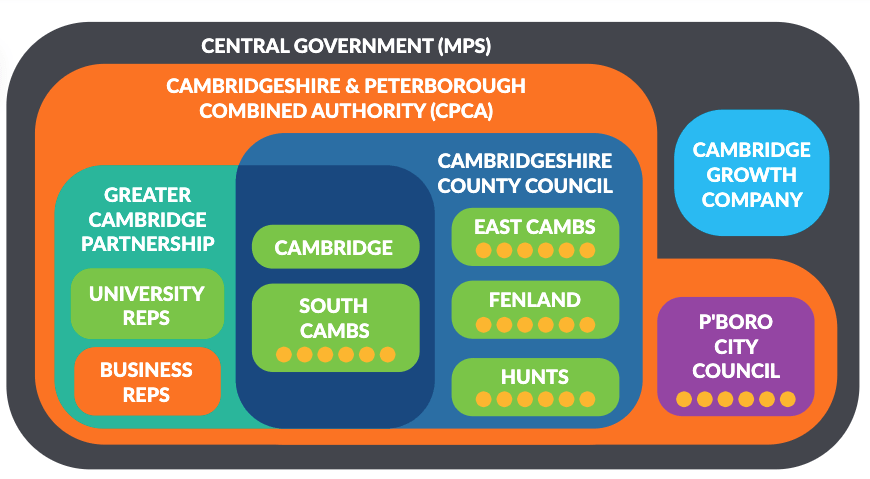
Image – CamCycle’s latest diagram on how our city and county are governed
It was an inevitably Cambridge-centric event – which is why I think ARU should co-host similar events elsewhere in the county and beyond – mindful of its Chelmsford Campus that also has its town planning department!
ARU has hosted such civic events before.
Remember the series of talks in the Imagine 2027 series? Time has flown by, has it not? How do the speeches by the eminent speakers of 2017 compare with where we are today?
Also, back in September 2024 I asked:
“Can Anglia Ruskin create the public, democratic spaces for people to shape the future of Cambridge?”
…and I’d like to think I got a positive response at the conference!
Alternative and contested visions for the future of Cambridge
Just before heading out, I picked up my recently-acquired copy of Cambridgeshire County Council’s monster plan for traffic and roads in Cambridge published in 1963, which left a few jaws on the floor at the event.

Above – imagine Cambridge’s historic centre having the roar of motor traffic from all of the dual carriageways proposed – anyone students/early career researchers want to find out who the individuals and groups were who stopped this from happening?
Twenty years later, Cambridgeshire County Council tried to extend a partially-completed East Road Dual Carriageway over twenty years later. This was strongly opposed by the children of St Matthew’s School – next door to ARU because the prospect of having four lanes of traffic roaring past their playground
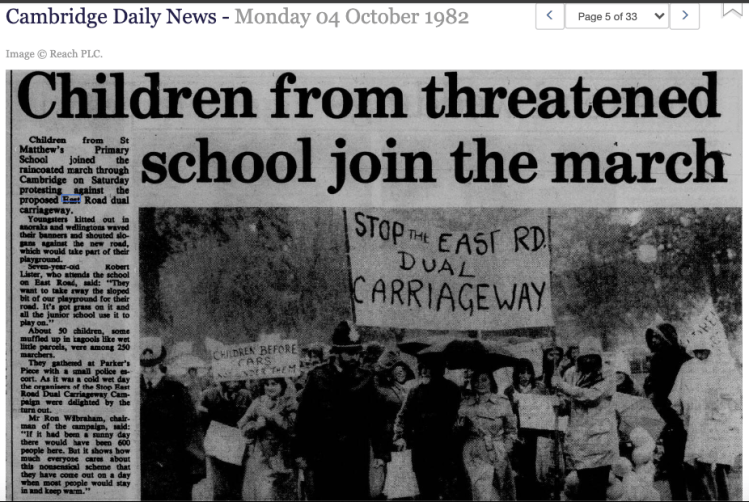
The other historical impact it had was to mobilise a statistics lecturer at ARU’s predecessor institution, the Cambridgeshire College of Art and Technology – or CCAT. This was Anne Campbell. She stood as Labour’s county council candidate in 1985, winning the seat along with the campaign – as can be seen by the dual carriageway ending abruptly just before Norfolk Street/Burleigh Street. The slum clearances of a previous generation enabling the widening towards Elizabeth Way Bridge. In the long term it created the momentum by which Mrs Campbell would later win the Cambridge parliamentary seat in 1992, becoming the first woman to represent our city, and ultimately deprive the Conservatives from what was a previously safe-as-military-fortresses blue seat. (Fast forward to 2024 and the Tories polled their lowest share of the vote in Cambridge in their party’s history. How the mighty fall).
“What’s that got to do with a sustainable region?”
Politics
One of the things that was challenging for many of the speakers to engage in were the Political issues related to the future of Cambridge. This was a challenge for those representing institutions which by law have to be party-politically neutral. (Eg charities). But the Q&A sessions brought the spotlight onto the split between the four political parties represented at The Guildhall (i.e. Cambridge City Council). This was when the concept of ‘Degrowth’ – something that The Green Party are openly talking about, if not making the case for. Recall that Sarah Nicmanis polled over 6,800 votes in Cambridge at the 2024 General Election (a party record by some distance), and the following year won three county council seats in the city, winning two off of Labour, and one off of the Liberal Democrats.
My point? The pro-fast-growth forces cannot take for granted the support of the general public – as the parties supporting the Greater Cambridge Partnership found out the hard way back in 2023 over congestion charging and busways
On skills – why are older adults being ignored by policy-makers?
I made (or rather ‘pleaded’!!!) the case for a new large lifelong learning centre to both Prof Claire Pike of Anglia Ruskin University and also Melissa Collins of the recently-formed Skills England. (Here’s a case study on an ideal adult education centre from the 1960s by the WEA in Derby – what would a 21st Century one for Cambridge be like? (And could a new institution – whether ARU-branded or otherwise, be an anchor institution for a second urban centre for our rapidly-expanding city?)
As insightful as Prof Pike’s presentation was, I couldn’t help but feel that for the people in my part of Cambridge of a similar age (late 30s-50s) who needed something more than something so narrowly skills-focused, and targeted at either a younger cohort or those without basic level qualifications, there was very little for us. As someone I went to school with who I saw for the first time in over 25 years not so long ago said, if you don’t have a redundancy payout or family support, there’s no way you can afford to retrain. Don’t get me started on ‘more loans’ as a sustainable policy in one of the most unaffordable cities in the country. And yet still the voices of employers complaining about skills shortages continues year-on-year.
Ministerial initiativitis
Prof Pike put it onto a single slide
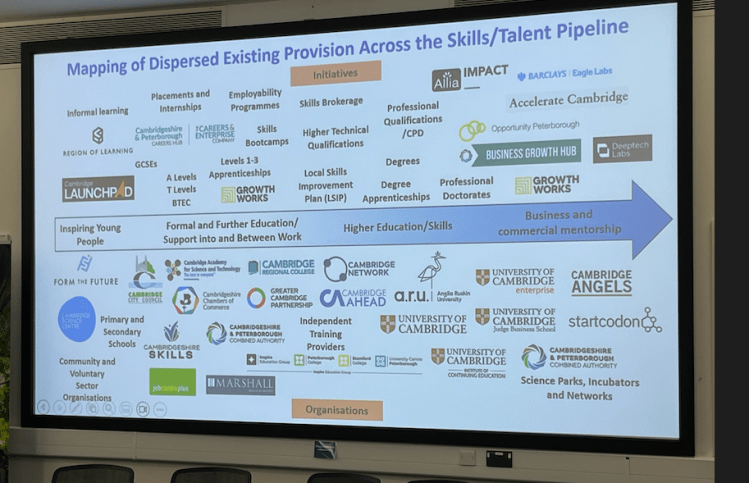
Above – Prof Claire Pike for ARU (17 June 2025)
Researchers in other fields have found similar phenomena. Dr Dolly van Tulleken [previously Theis] examined this in the context of obesity policy in her 2021 paper with Martin White here.The number of policies between 1992-2020 is jaw-dropping.
Above – Dr Dolly van Tulleken stated in her video summary of 11 May 2021 that in her research for her Ph.D at Cambridge University, she found 14 major government obesity strategies between 1992-2020, and *over 700 different policies*
In the meantime, researchers Michael Gibson, Felix-Anselm van Lier, and Eleanor Carter examined attempts to join up local public services in Policy Press in 2023
“Over the last 25 years, central government has attempted to join up local public services in England on at least 55 occasions, illustrating the ‘initiativitis’ inflicted upon local governments by the large volume and variety of coordination programmes.”
Above – Gibson, van Lier, Carter (2023) in Policy Press Vol 51 Issue 4, and online here
At the very end of the ARU event when the audience picked up on successive failures of over-complicated ‘partnership working’ (in the context of environmental protection, lack of new reservoirs, and water companies), I handed out a few fliers illustrating what councillors in interwar Leicester did , that were left over from one of the recent primary school fetes I ran some outreach stalls at.
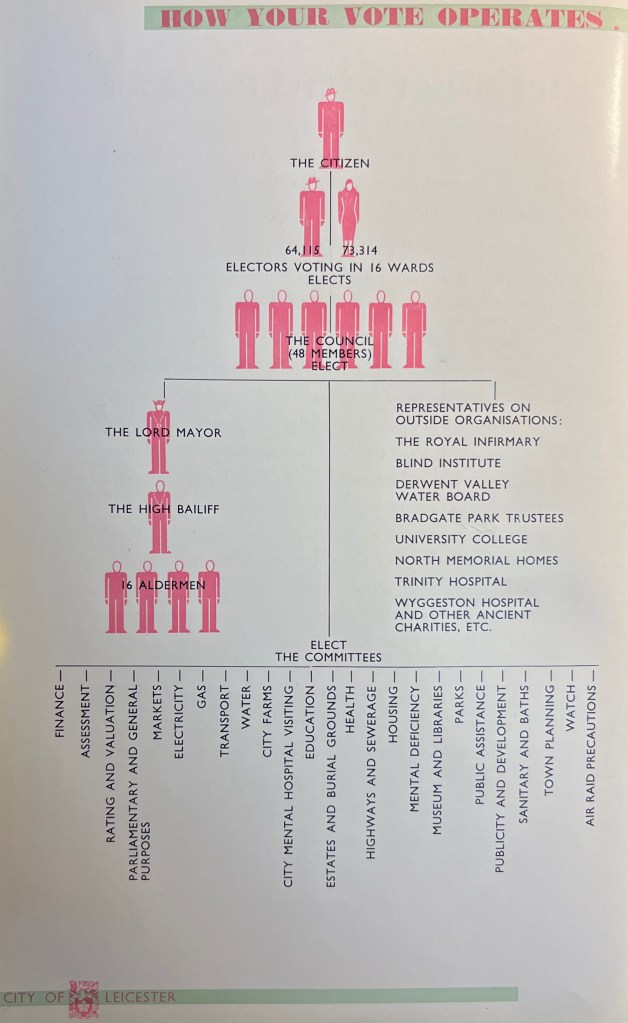
Above – note the huge range of public services that the City of Leicester under the oversight of its councillors were responsible for. Furthermore note the Board presence of the council on the old University College – now the University of Leicester
Anglia Ruskin as a Civic University
This is mainly covered in the essay written by Prof Ross Renton of ARU Peterborough – recently established and by the sounds of things doing very well. You can read his essay as part of the Kerslake Collection here. In hindsight, why it took successive governments so long to establish a new university in Peterborough following the completion of the housing growth in its 3rd generation newtown programme (1968-88) I don’t know. But the level of education deprivation is striking in its geographical polarisation. If you want to know how that is reflected on the life chances of women in Fenland District, have a read of Mary Chamberlain’s Fenwoman, originally published in 1975. (One for researchers: How do the life chances of young women in 2025 in Fenland District compare with those of over half a century ago?)
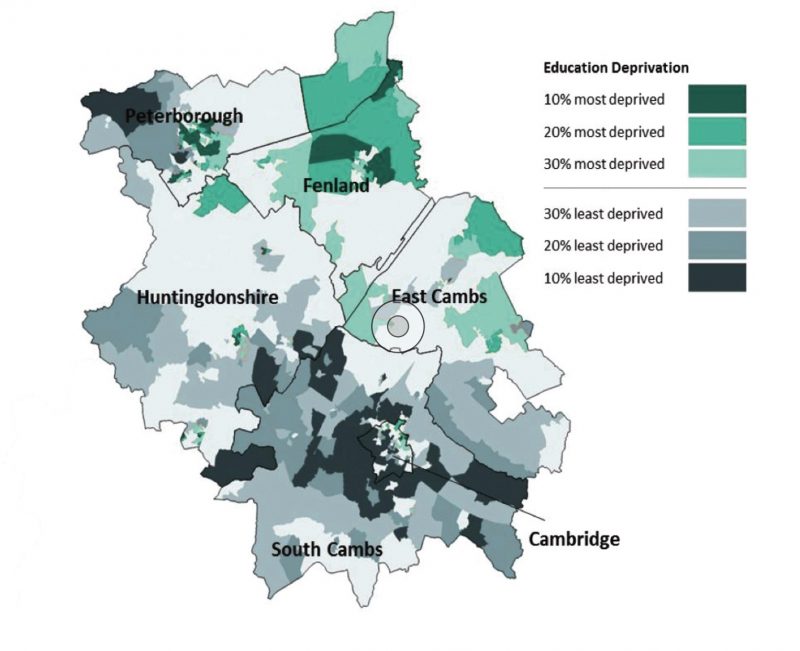
Now compare the above diagram with the recent county council election results.
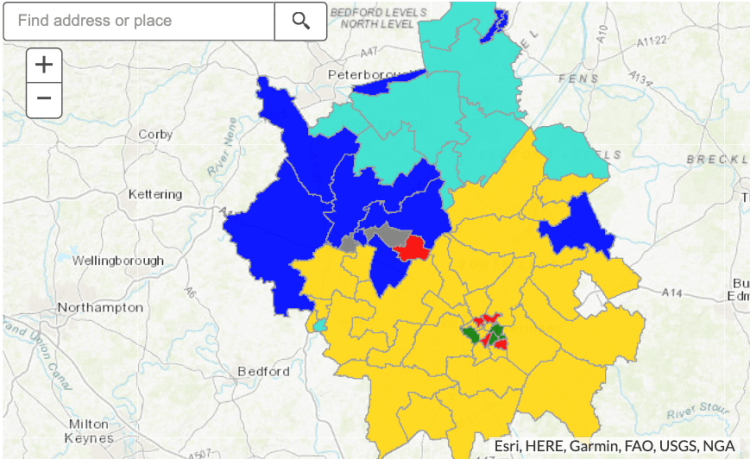
Above – from Cambridgeshire County Council as five-party politics arrives in Cambridgeshire
To quote from Charlotte Pickles of the Re:State Think Tank at the Reimagining Whitehall Conference also earlier today:
“𝘵𝘩𝘦 𝘨𝘢𝘱 𝘣𝘦𝘵𝘸𝘦𝘦𝘯 𝘱𝘰𝘭𝘪𝘤𝘺 𝘢𝘯𝘥 𝘥𝘦𝘭𝘪𝘷𝘦𝘳𝘺 𝘪𝘴 𝘸𝘩𝘦𝘳𝘦 𝘱𝘰𝘱𝘶𝘭𝘪𝘴𝘮 𝘨𝘳𝘰𝘸𝘴”
If Anglia Ruskin University (I was a post-graduate student there 2002-04 for my PG-Dip in Historical Studies: Contemporary Europe) doesn’t step forward to help educate and inform the residents of our city not just on democracy, politics and basic policy making, then who else will? There’s only so much that well-meaning amateurs such Cllr Clara Rackham (a governor of one of ARU’s predecessor institutions when she was a county councillor) with her civics courses just after WWII through to my own (see some of the very early findings from my first pilot back in 2023) can achieve.

Above – civic hero: Clara Rackham (Circa 1925, from the Palmer Clark Archive in the Cambridgeshire Collection, colourised by Nick Harris of Photo Restoration Services, commissioned by Antony Carpen)
Can ARU host/co-organise/run some events that help inform the residents of our city and county about the looming consultations coming up about our collective futures?
That was my final awkward question on a hot day inside a conference room – at which point one of the organisers thanked me for making more work for him! (Sorry!)
Yet it’s as Ellie Breeze of Together Culture told me recently, the best way for institutions to get people involved in what they are doing is to invite them into your premises – especially if it’s unfamiliar or unknown to them. And as several local councils are finding out this summer, an action that is just as effective is to go where the people are. So it’s ***really good to see*** councillors and council officers going that extra mile to run outreach stalls at community events (such as here at the Arbury Carnival – an annual event in one of the most economically-deprived wards in the county) where you get to meet lots and lots of people who many who work in office-based policy roles rarely get to meet.
ARU as an institution doesn’t need to reinvent the wheel on this.
One of the principals of a predecessor institution, Dorothy Enright did it 100 years ago.

Above – Dorothy Enright from Anthony Kirby’s history of Anglia Ruskin University.
Despite her untimely death, her legacy as the first woman to become a principal of a further education college in England is this incredible course prospectus from the mid-1950s. From a civics perspective these included:
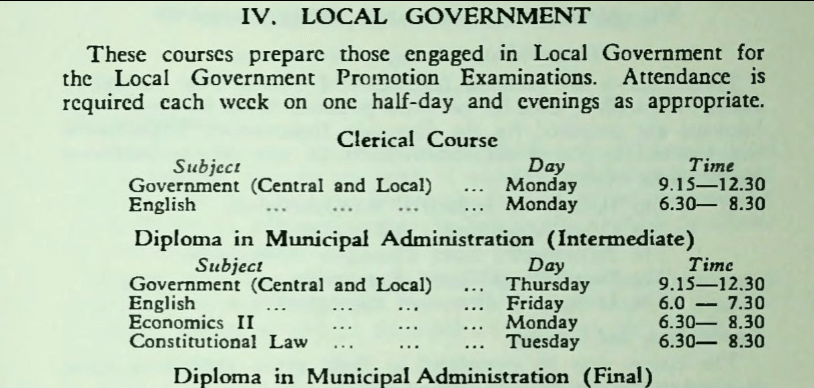
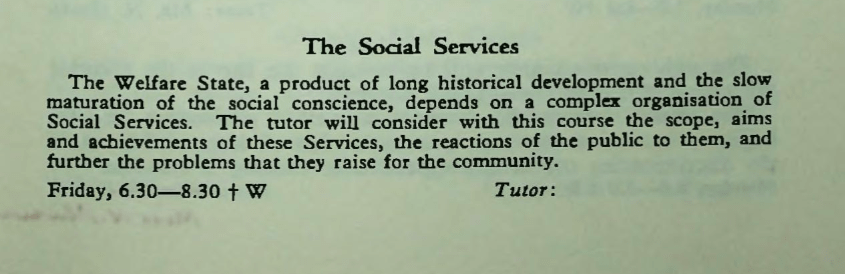

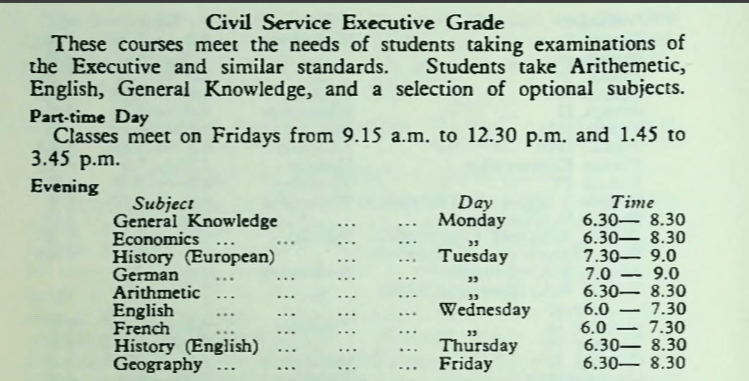
Above – some of the courses available for local residents who wanted to go and work in local government, the civil service, or to simply learn about how public services were organised.
I’m not asking for carbon-copy repeats of course content from the 1950s – rather, I think we should take inspiration from previous generations so as to inform and inspire current and future ones. In this case passing on the traditions of civic education that the likes of Dorothy Enright and Clara Rackham valued so much.
Food for thought?
If you are interested in the longer term future of Cambridge, and on what happens at the local democracy meetings where decisions are made, feel free to:
- Follow me on BSky <- A critical mass of public policy people seem to have moved here
- Like my Facebook page
- Consider a small donation to help fund my continued research and reporting on local democracy in and around Cambridge.

 The Cambridge Town Owl