
At the Sustainable Region event I went to earlier this week (see here) I noted that ARU is delivering one of the six National Civic Impact Accelerator projects – one of which is working in one of our city’s most economically-deprived wards: Abbey. There is also an opportunity to build a new urban centre for Cambridge within the vicinity of the south-eastern end of the ward as well.
TL/DR and want to skip to the module catalogue bit? Scroll down towards the end
“Anglia Ruskin University: Developing employment opportunities on their Cambridge campus, providing local people with work experience and access to university resources for career development.”
Above – from the Civic University Network
***Well why didn’t anyone say so?***
They did – and it was picked up by BBC Cambridgeshire on 04 Feb 2025 here
But as we all know, good news seldom picks up attention.
“[The scheme] is led by ARU’s Students at the Heart of Knowledge Exchange (SHoKE) programme, which empowers pupils to develop ideas that solve real issues in local communities.”
George King for BBC Cambridgeshire, 04 Feb 2025
ARU’s press release goes further.
“As a part of ARU’s strategic and civic responsibilities in nurturing vibrant university communities, this Research England funding will transform an idea into reality by helping long-term unemployed individuals re-enter the workforce.
“We look forward to collaborating with Abbey People, a community charity, and engaging enthusiastic ARU staff volunteers to provide mentoring and employability support.””
Above – ARU Press Release 03 Feb 2025
Hence it being picked up at this week’s conference.

**Shiny Abbey People…**
…should the Abbey Voices community choir ever want to rewrite the lyrics to REM’s (with the B52s) hit from 1991 and sing it like The Pub Choir did recently here.
Abbey Ward in Cambridge matters because it is one of the most economically deprived in the whole of Cambridgeshire – i.e. not just our city. You can browse through the statistics through the custom profile option for Abbey Ward on Cambridgeshire Insight here.
The CEO of Abbey People, Nicky Sheppard has built up Abbey People from an institution that in its first year to March 2020 had an income of £35,000, to one that is closer to £300,000. (See its Charity Commission summary page here). See her team of staff here, and see their local events listings here.
When you look at the mosaic of logos of supporters when you scroll down on Abbey People’s landing page, it’s easy to get the impression that corporate Cambridge is falling over itself to help out. What the picture doesn’t tell are things like:
- Amount of funding or support contributed
- Percentage of funding/support as a proportions of either total available funding allocated for CSR, total expenditure, or even profits/bonuses/dividends by the institution (i.e. you can’t compare ARM, the chip giant with say Together Culture, or whatever contributions were made by Grosvenor Estates owned by the Duke of Westminster).

Above – the number, range, and the profiles of contributions are diverse and wide, but when you look at the funding coming into Abbey People vs the scale of the problem, it’s hard not to come to the conclusion that charity support can only go so far. Ultimately, the state has to step in.
The struggle between ideologies since the banking crisis in the face of climate catastrophe and extreme international wealth inequalities
Whether it’s ARU hosting discussions on what a future sustainable region might be like through to former Bank of England Chief Economist Andy Haldane – now at The RSA talking about measuring social capital and calling for a new generation of investment into it, a critical mass of individuals seems to be shifting things inside UK institutions across the sectors. Perhaps it’s not surprising when the symptoms of broken economies and broken societies are visible on our streets.
What was interesting about the ARU event was that participants were beginning to talk about things that were otherwise taboo subjects in public policy fields – in particular those things framed outside the current Overton Window.

Above – from Mark E. Thomas for Compass, 09 April 2021
It took until the afternoon before someone mentioned the problems of capitalism and of our extractive economic systems and structures. There were also exchanges about degrowth in the face of the continued damage to the environment and the time it is taking for ‘solutions’ to Cambridge’s water crisis to materialise.
“What’s all this got to do with a module catalogue from a quarter of a century ago?”
First of all, you have to go back *over 20 years* to find out what it was. Thank you to the people who invented the Wayback Machine!
Back in the olden days before the big social media firms were invented, Anglia Polytechnic University – which was a popular local brand and the last to ditch the ‘polytechnic’ name, had a wonderfully-accessible module catalogue that enabled students to pick and choose any modules that they liked. Once they gained enough credits, they could qualify for an award in ‘Combined Studies’ or similar. Furthermore, the tuition fees were much, much cheaper than their equivalent today, and far cheaper than their equivalents at the Institute for Continuing Education at Cambridge University. When I started what was meant to be a Masters in Historical Studies: Contemporary Europe, the Cambridge University equivalent course cost over ten times the amount, even though the course content was similar. (And as it turned out, the institutions shared supervisors for post-grad theses as ARU had subject experts that Cambridge University did not have at the time).
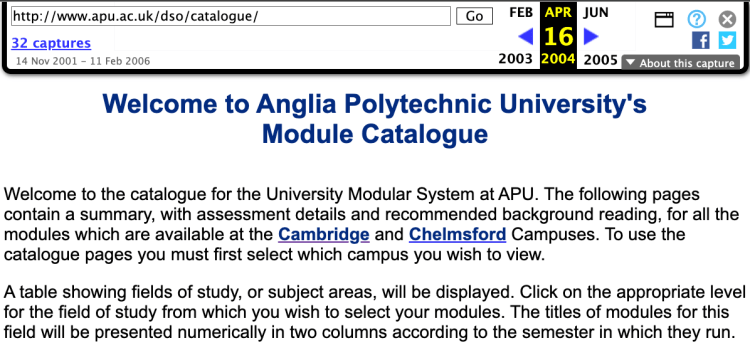
Above – have a browse through what we once had via the Wayback Machine here
The Cambridge module catalogue was extensive.

Above – detail from the Cambridge APU module catalogue – the Comic Sans font gives the date away, even if the text above it does not!
The similarities between the Open University’s modules and what Anglia Polytechnic were offering are striking. The difference being APU’s courses enabled part-time students to be part of the wider APU academic and student community. In those days, having access to the library and to network-connected computers (This was the early 2000s remember!) made a huge difference for me. Now put that in the context of families that cannot afford either the hardware or the subscriptions to access the internet at home – something that came as a very rude shock to ministers during lockdown.
If we look at the second year undergraduate modules from 20 years ago, you can see how relevant a refreshed version of the modules would be to analysing our current crises in politics and democracy.

Above – you can browse through the individual course documents via the Wayback Machine here
“Isn’t that stuff too complex for the interests of the general public?”
As things currently stand, yes. I found this out the hard way back in late 2023 with a second round of citizenship workshops that I ran at Rock Road Library when it became clear that the town and transport planning workshop needed to be split into two levels – one for those with no knowledge, and one for those with either an academic or a working knowledge of what is a very complex system. But in APU’s case, they had accounted for this in their first year modules which didn’t put everything into a ‘politics’ silo.

Imagine having a term (up to ten weeks) of 1-2 hour seminars to take learners through the basics of politics and policy-making, or your rights as a citizen to support under the welfare state. How big a deal is this? It’s huge.
“We heard from Policy in Practice that an estimated £19 billion of income-related benefits and social tariffs go unclaimed each year”
“Could a new module catalogue form the basis of a new lifelong learning college in an expanded Cambridge?”
That for me is the next logical move. I’ve already written about how the WEA in Derby and District produced their vision of an ideal adult education centre in 1968. What would a Greater Cambridge version look like for the mid-21st Century?

Above – An Ideal Adult Education Centre (1968) by WEA Derby & District Branch
The guide examines potential locations in and around the city of Derby

Above – note the vision of Derby for the year 2000 written in 1968. That’s the equivalent of us imagining what Cambridge would be like in the year 2057

Above – I don’t think concrete brutalist architecture would work for Cambridge. There’s already a second volume of Hideous Cambridge in the works – we ***really don’t need a third volume before the second has been completed!***
Note the range of potential users – and also the direct line of accountability to local government – something that Margaret Thatcher’s reforms and cuts severed in the 1980s, and completed by John Major in the 1990s.

Above – think of a civic university as a hub for professional institutions to host their own training courses, ones that would have a far greater take up simply by being prominent in a dynamic and buzzing place of learning
Hence my suggestion that a large lifelong learning institution should be an anchor institution for a second urban centre for Cambridge
I picked the southern end of the Cambridge Airport site because it looks like a new Cambridge East railway station is going to be built in the area along the Cambridge-Newmarket line, which is also due for an upgrade.
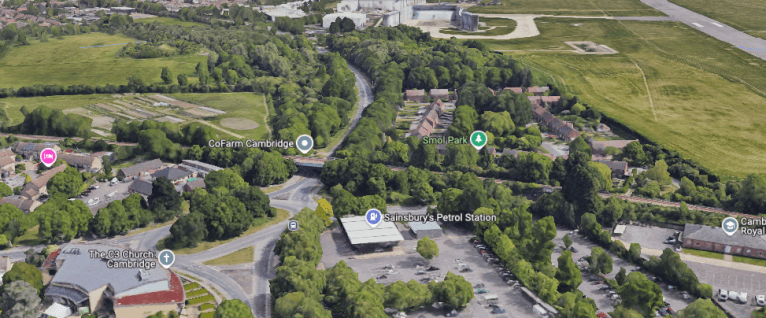
Above – the view looking sort-of north-eastwards from the Sainsbury’s Roundabout – with the old miserable diesel railway line going from left to right.
Combine that with a new large concert hall that was the dream of former Cambridge University Vice Chancellor Sir Ivor Jennings, and with a new large city hall for a Greater Cambridge Unitary council, what’s there not to like? Especially given the greater powers that Peter Freeman is likely to get with the Cambridge Growth Company.
Given that Cambridge City Council’s Civic Quarter proposals seem to involve vacating even more of Cambridge’s Guildhall (the consultation closes on 22 June 2025) and given that Cambridgeshire County Council has put the old Shire Hall on Castle Hill out of its misery by disposing of it via a 250 year lease to an apart-hotel firm, I can’t help but feel that a new second urban centre would give our city the chance for a new start – and one not dominated by the University of Cambridge.
With that in mind, any new Great Cambridge Hall could take inspiration from Peck and Stephens’ design for The Father of Modern Cambridge, Charles Henry Cooper who commissioned this design below.

Above – Peck & Stephens’ masterpiece in The Builder, 14 Jan 1860. We only got a scaled-down version of the large assembly hall built.
I’m trying to persuade anyone who is interested that a new urban centre of the merits of a civic square with four buildings adopting a theme of twin civic towers. King’s College Chapel has them at each end. Even the second-most famous structure in Cambridge (for most of us town people anyway), Addenbrooke’s Chimney has twin sets of chimney pots at the top.
A civic square with:
- Great Cambridge Hall on the northern side
- Cambridge East Station to the south
- A new lifelong learning college to the west (if ARU want to run it, splendid!)
- A new large concert hall & opera house complex named after Florence Ada Keynes (The Mother of Modern Cambridge) – i.e. Florence Hall, to the east which would also spill out into a new nightlife and entertainment sector. (Given that a new opera house for Cambridge was the dream of Cambridge musician Ludovic Stewart, the County Council’s Music Adviser and conductor of the Cambridgeshire Holiday Orchestra, we could name the smaller opera house attached to the larger concert hall after him)
Anyway, that’s my vision and how Anglia Ruskin University could into it.
Food for thought?
If you are interested in the longer term future of Cambridge, and on what happens at the local democracy meetings where decisions are made, feel free to:
- Follow me on BSky <- A critical mass of public policy people seem to have moved here
- Like my Facebook page
- Consider a small donation to help fund my continued research and reporting on local democracy in and around Cambridge.
Below – given the fun and games (i.e. the artistic limitations) of the new stations at Cambridge North (and in particular its hotel – we’ve got to do better than ‘acceptable’ design) and Cambridge South, I’d want the entrance to the railway station to look something like this in Budapest, Hungary. i.e. not Network Rail’s ‘minimum viable cost’

 The Cambridge Town Owl