
On a hot evening in mid-June in 2025, there were people around in town, but hardly any of them were going into the pubs and bars
TL/DR? What are the social impacts on Cambridge of the pro-sci-tech economic policies pushed by Government and supported by a host of influential institutions?
Image – Bar open – but was anyone inside?
I wasn’t planning on going into town this evening but I got an email from a society I used to volunteer for lots in a previous lifetime some 20 years ago saying that one of the longstanding dance teachers was retiring after nearly a quarter of a century of teaching in the city (i.e. pre-dating Strictly) – and they were having a mini-celebration after his final class.
Inevitably a lot of comparisons were made about Cambridge in the mid-2000s vs Cambridge in the mid-2020s.
One of the starkest images as I walked back to the bus stop was the rows of empty chairs and tables in one of the main venues on Regent Street. There were a fair number of young adults in town – a mix of Cambridge students and locals. But hardly any of them seemed to be going into the venues along Regent Street.
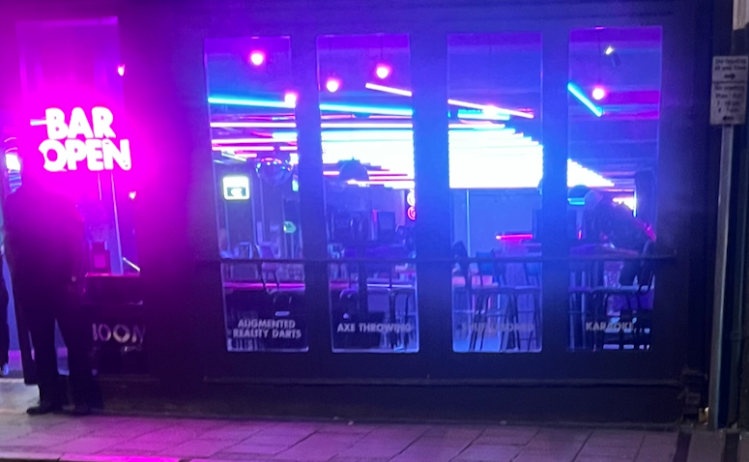
Above – one empty venue in Cambridge earlier on just before 10pm
Walking back past my local before I got home half an hour later, I noticed that too had closed – even though the website said it was meant to be still open.
What the hell is going on in Cambridge’s local civic economy?
The headlines pumped out of the press releases from the sci-tech, and property sectors seem to be oblivious to what is happening in the rest of the city’s economy. Furthermore, all is not well at Cambridge University either.
“This academic year has been challenging for May Ball and June Event committees. Emmanuel’s June Event, Sidney Sussex’s Garden Party, and Clare’s May Ball all had to be cancelled due to a lack of ticket sales, while Robinson’s May Ball was downsized.”
Varsity Cambridge – 13th June 2025
‘ Is Cambridge going to become just a centre of chains and tech industries’
Perhaps the venues that traditionally serve customers who are earning below the median salaries/wages in Cambridge are the ones struggling in the face of chronic inequalities.
“A 2017 Centre for Cities report, external described Cambridge as the UK’s most unequal city, with some of the country’s highest living costs.”
Above – A city divided by a gap in healthy life expectancy in BBC Cambridgeshire, 08 Apr 2025
*Chronically high land and property prices are poisoning our city*
…as I wrote in a recent blogpost – noting in particular the ageing audiences at a number of recent events that I had been to. Furthermore, my old dance teacher told me how much lower the numbers of dancers have been compared with 20 years ago – when as some of the long term members also there this evening told me, the numbers are a fraction of what they were. Yet they were already significantly lower in the late 2010s – as were those of other societies in the face of rising costs, in particular of room/venue hire.
CambridgeBID / VisitCambridge should fund some research seeking the insights of those on the front line
- Bar staff
- Private security staff on the doors
- Bus and taxi drivers
- Emergency services staff (Police and paramedics)
- Convenience shop workers who work late shifts
How does their day-to-day experience compare with the headlines about Cambridge’s wealth?
Finally, there is surveying the teenagers and young people themselves.
“Has anyone tried asking the teenagers and young adults why their presence in our nightlife has shrunk back compared with 20-30 years ago in Cambridge?”
As I wrote a couple of weeks ago
“What does the Cambridge BID say?”
For a start, their strapline to their 2023-28 business plan hints at who matters and in what order.
Above – Cambridge BID 2023-28 Front Page which reads: ‘Creating a world-class experience for all who visit, live and work in Cambridge, a global city’
Also:
“Cambridge is a world-class city and its competition and marketplace now are not just regional and national, but increasingly international.”
Above – from https://www.cambridgebid.co.uk/background-to-bids
“Well that’s a load of… …exactly”
**I think what you’re trying to say is that the words and the rhetoric from the publicity materials appears to have some inconsistencies with the realities on the ground…**
If the Cambridge BID is creating a world-class experience for me as someone who lives in the city, world class experiences must be absolutely awful.
But then remember that the Cambridge BID is legally restricted in what it can do, and also has very skewed incentives that were ultimately set by a previous generation of ministers and approved by Parliament over 2 decades ago. (See The Business Improvement Districts (England) Regulations 2004).
“Is Cambridge a global city?”
No. It really isn’t. It’s a settlement with a globally-recognised name, and also a settlement whose city council has a royal charter from King George VI granting it city status, but what makes a city in the UK is not the same as most of the rest of the world.
I’ll leave it to this UN Habitat Paper from 2020 to discuss what makes a city as far as international definitions go. But if your municipal authority for your built up area isn’t even in control of (or even having oversight of) things like your side roads, your city’s police force, or basic primary healthcare, then what you have governing it doesn’t sound like it’s fit for purpose for running a city.
If you want to see how overcentralised the UK is, see how enfeebled the Greater London Authority is compared with its international counterparts.
- Comparing the powers of international cities to London (2025)
- International comparison of global city financing (2016)
- London Finance Commission – one year on (2014)
- London Finance Commission – Independent Report (2013)
If somewhere like London cannot get the independence from HM Treasury that it needs to govern itself properly, Cambridge has no chance.
Furthermore, in order to achieve some of the priorities of the Cambridge BID, other institutions have to move first. i.e. Westminster.

Above – Cambridge BID (2023) p7
Encouraging residents and commuters to spend money in Cambridge when their disposable income is minimal… …how are they meant to do that when so much of their income is hotwired towards paying for financially extractive practices such as sky high rents through to paying the extra costs associated with retailers renting commercially-expensive spaces? (Hence my earlier blogpost on the impact of high land and property prices on our city and the people who make it)
With homes that were originally designed for families to live in now being snapped up for use by Air BnB, private college student accommodation, or even second homes, all of these represent revenues lost. While some businesses that serve those who stay in the properties concerned, such is the short term, high turnover built into the model that the local neighbourhoods also lose out from not having longer term residents who may want to put down roots and get involved in community life.
Again, the fault is not with those booking Air BnB or the private college students. The fault is with Central Government for preventing city councils from managing their municipalities. Whether it’s through legal prohibitions / lack of legal powers, through to deliberate underfunding resulting in weak enforcement, the symptoms of the structural failings of local government in England are all too visible. Not surprisingly the top two political parties are finding that after 14 years of Tory austerity, and many shortcomings of the current Labour Government, we find our selves in an era of five party politics.
In depth research on the social impacts of the sci-tech (and property?) economic boom in Cambridge, and of the policies that underpin it?
This is something for university-level researchers to really look into. Recalling the 2014 paper from the University of Cambridge imagining our city in 2065, containing a wide range of views. Including this striking one:
“Top people from around the world will still want to gather together to meet and discuss their research and ideas. The University’s unique selling point — its USP — will be its convening power, bringing key individuals to Cambridge to experience personal interactions and chemistry despite the large carbon, cost of international travel in an energy-deprived world. At every level, from undergraduate via graduate student, postdoc and sabbatical professor to top executive and world leader, Cambridge will be one of the key venues to come and be seen, and to rub shoulders with the global intellectual elite. If it sounds like an exclusive conference venue, then that may be about right.”
Sanders, J (2014) in Cambridge 2065, p48
Food for thought?
If you are interested in the longer term future of Cambridge, and on what happens at the local democracy meetings where decisions are made, feel free to:
- Follow me on BSky <- A critical mass of public policy people seem to have moved here
- Like my Facebook page
- Consider a small donation to help fund my continued research and reporting on local democracy in and around Cambridge.

 The Cambridge Town Owl