…One which involves enabling the institution which Parliament established getting extra funding from somewhere (tax the punting operators and colleges?) to pay for much-needed maintenance to the lock gates & barriers that hold the water back…because if nothing happens and everything collapses…
Nothing like a headline to make politicians go ***Eeek!***
It’s made all the more complicated by the fact that the institution responsible for the river between the Mill Pond and Clayhithe near Waterbeach is one established by an Act of Parliament – the first of which was in 1702. (You can read about them here)

Above – see the latest information updates here.
“David Goode, chair of the conservators, warned: “On the river stretch along the Backs between Mill Pond and Jesus Lock the water level is held artificially high by the sluice gates at the lock.
“If what is holding the water back collapses, all the water drains away and what you’re left with is a measly, muddy trickle that definitely won’t support the punts. There would be a lot of consequences: the loss of punting, exposing of the foundation of college walls and the devastating impact to the appeal and economy of Cambridge.”
Cambridge News 21 June 2025, and also in Varsity UK here on the same date
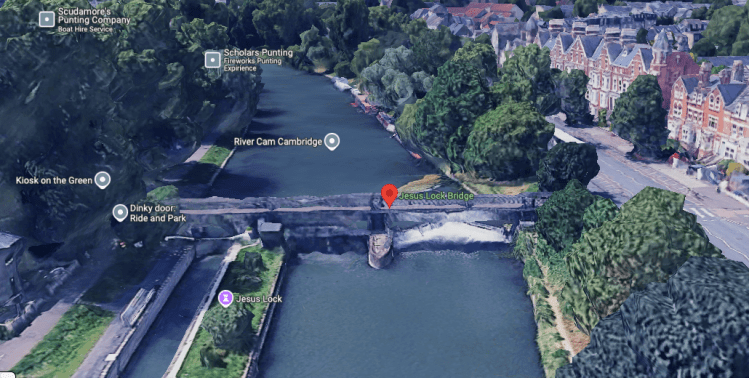
The lock gates are these ones on G-Maps
Whenever you walk over the bridge, you get some sort of a sense of how much water is held back, but this is the first time I’ve pondered what would happen if the barrier were to collapse.
Note the conclusion from the crisis paper:
“It remains our opinion that unless specifically instructed by state or court, the necessary funding required by the Conservancy to ensure long-term survival will not be made available. A national review on infrastructure and its funding is required, enabling struggling waterways and navigations to look after this invaluable asset.
“The Conservancy may yet need to be incorporated into another organisation or simply become unviable and inoperative as it is unclear how the organisation may secure the necessary income stream to avoid similar crises in the future.”
Above – Cam Conservators – An Organisation in Crisis (2025) p4
“Maybe the collapse of the lock gates might wake ministers up on how archaic the governance structures of some of our waterways are?”
It’s actually more complicated than that – not least because of the continued unlawful discharges of raw sewage into the River Cam by Anglian Water. Furthermore, the number of ordinary residents who would be affected by the knock-on effects (for example the risk of bankside collapse with no water pressure from the river to push back the other way). Finally I’m not the sort of person to wish people out of jobs. It’s not just the punting industries but all of the seasonal bar and restaurant staff that would lose out too.
It remains to be seen whether the legislation on the water industry and on local government will enable a more sustainable system of governance and maintenance for the River Cam – for example could the Conservators be rolled into the new Greater Cambridge Unitary Council?
“Who pays?”
You only have to look at the annual accounts of some of the punting companies to realise that there’s scope for them to be taxed in order to help pay for the upkeep of the River Cam

Above – one punting company via Companies House.
Yet such is our over-centralised system of government that any changes would have to be incorporated into new legislation either tabled by, or approved by HM Treasury. For what is a relatively minor river that happens to have a world famous chapel not far from it, it really shouldn’t be the business of the national finance ministry of one of the top ten economies in the world to be tabling legislation on who should pay what levels of tax on it.
Hence my repeated calls for local government to be granted taxation powers over a much wider range of assets and business activities *independent of Whitehall*
Unfortunately the Government’s ‘fair funding review’ that is currently out for consultation here, doesn’t go anywhere near that.
If you are interested in the longer term future of Cambridge, and on what happens at the local democracy meetings where decisions are made, feel free to:
- Follow me on BSky <- A critical mass of public policy people seem to have moved here
- Like my Facebook page
- Consider a small donation to help fund my continued research and reporting on local democracy in and around Cambridge.

 The Cambridge Town Owl