
Turns out that it is – as this new research paper by Dr Cleo Valentine and colleagues in the ground-breaking field of neuroarchitecture demonstrates
Image: Town and Country Planning in Britain (1968) – noting that there still is not a guide for children on town and country planning that can enable them to help shape the future of where they live.
Visual Discomfort in the Built Environment: Leveraging Generative AI and Computational Analysis to Evaluate Predicted Visual Stress in Architectural Façades
The authors state in their abstract:
“The built environment is increasingly recognized as a critical determinant of human health, profoundly influencing neurophysiological and psychological well-being. Previous studies show that specific visual patterns can elicit cortical hyperexcitation and visual discomfort, particularly in individuals with a predisposition to cortical hyperexcitability. However, traditional approaches to examining visual stress have yet to capture the complexity of ways in which the built environment may contribute to visual discomfort.”
Above – Valentine et al (2025)
“That reads like a lot of complicated stuff that I don’t understand! Remember I last studied biology in 1996”
That’s why at the CFCI Annual Debate at the Cambridge Union I called on the professionals there to support the case for a new lifelong learning centre for Cambridge which had a travel hub co-located. Amongst other things.

Above – Basic Science Education for Adults (ACACE 1981) – educating society about the discoveries science has made since we left school not only means people can get more out of the discoveries that are made, but also enable people to find out earlier about career-switching opportunities in fields that (in Cambridge at least) have chronic skills shortages.
We used to be good at adult education and lifelong learning
Sadly Thatcher’s Government started dismantling the institutional infrastructure that was once there, and none of the successive governments that followed chose to rebuild it – focusing instead on basic skills and discrete, commissioned programmes through outsourcing and commissioning agreements.

Above – Protecting the future for adult education (ACACE 1981) digitised here
The Advisory Council for Adult and Continuing Education was disbanded in the early 1980s, shortly after it published this report on local learning centres. Nearly 40 years later in 2020 the Commons Education Select Committee said every town should have such a community learning centre for adults.
Why those shared spaces matter: They provide somewhere for people to discuss matters affecting their collective futures. In somewhere like Cambridge, that includes discussions on academic papers like this.
“The built environment significantly influences human physiological and psychological responses, affecting both immediate neurophysiological reactions and long-term well-being. Urban populations in industrialized economies spend approximately 95% of their time in or around constructed spaces. The global increase in time spent within constructed microenvironments has prompted extensive research into the relationship between architectural environments and human health”
Above – Valentine et al (2025) – Introduction
My reason for bringing the two together – Dr Valentine’s research, and the lack of a lifelong learning centre, is because too many residents, nearby commuters, and students are not being included in the discussions on the future of our city. Hence making the point to Create Streets: Nothing about us without us when it published its own vision for the future expansion of the city – recalling the many AI-generated images that aroused much comment.
But when you compared the vision/mood of Create Streets to what the Commercial Estates Group proposed in their submission to the emerging local plan…

…Exactly!
Yet you can see the swathe of low-density housing in the background – something that almost everyone in the previous evening’s debate cautioned against.
History overlooked?
Three of the big drivers for the low density sprawl:
- The rise of the motor car and the desire to have off-street parking
- The psychological and public policy impact of the U-boat blockades in wartime – hence the large allotments in back gardens (such as my late grandparents had in the late 20th Century in this part of the city which were only separated by two lines of thin wire held up by metal posts)
- The public health lessons learnt from slum clearance and the desire to have massively–improved ventilation and a reduction in overcrowding in new ‘Homes fit for heroes’.
In subsequent years, other drivers of urban design emerged, as highlighted in Essex County Council’s guide from 1973 here. You can also see a digitised copy here.
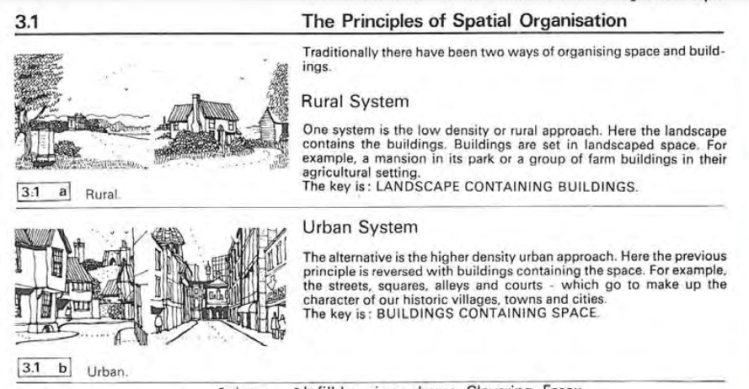
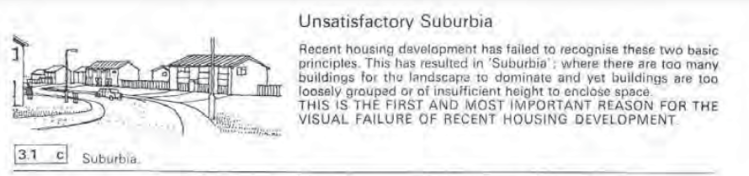
Above – Essex CC (1973) p33 – describing how and why suburban low density sprawl feels ‘wrong’
Using AI to generate facades and building types – and then using 21st Century science to measure how the human brain response to the visual stimuli
This is the real substance of Dr Valentine’s research. From her own photo collection, she illustrated the sorts of ‘high-contrast regular repetitive visual patterns in the built environment’ that gives me nightmares!

Above – Valentine et al (2025) Fig.2
Now compare these with what the developers of the Hobson Street Cinema (currently at appeal) want.
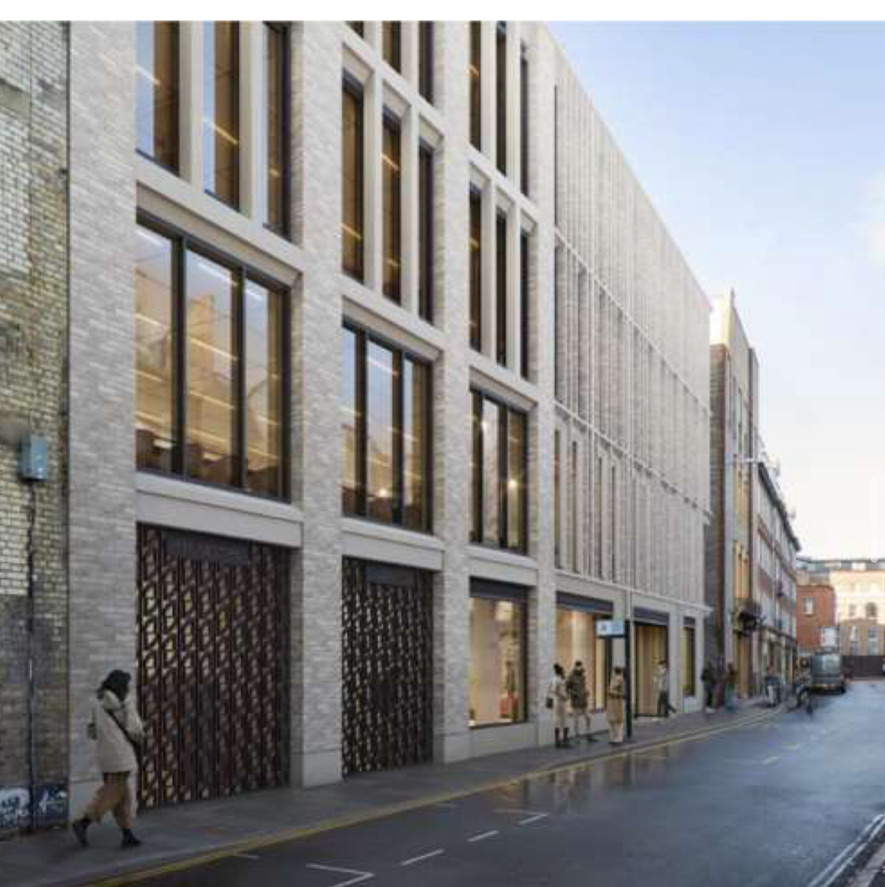
Above – ugly stuff submitted to the Greater Cambridge Planning Service (this is my subjective opinion! (as I wrote on 27 Aug 2024 here).
What Dr Valentine and colleagues have been able to do – and for which I am very grateful for, is to put into technical language the aspects of contemporary building design that sets my heart racing for all of the wrong reasons.
Now let’s look at Dr Valentine’s use of AI to create a set of options for window types for a second floor
This for me is superbly done – you’ll need to download the article (it’s open access here) and scroll down to Table 5. on pp12-13 of the PDF.
The baseline is image 1 – top left of the set below
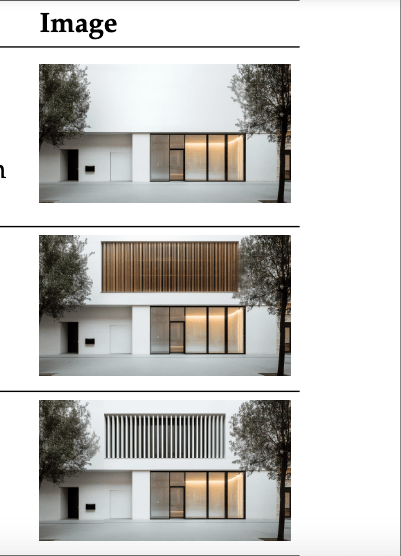

Above – details from Table 5 in Valentine (2025)
You have a choice of *nine* to pick from. For me, the final image (bottom right of the set above with the semi-circular large archway where both ends of the arch align with the sliding doors below it.)
Again, it’s down to personal taste but the failure of all of the other designs to line up with the vertical edges of the glass doors below it is what stands this one out. As Dr Valentine and colleagues state:
“Image 9 combined a large central arch with multiple smaller arched windows, resulting in a mixed geometric composition that lacked a dominant repetitive element.”
Again, as a non-specialist unfamiliar with the technical language, I do not have the capacity/capability to put into technical terms what Dr Valentine and her fellow researchers have been able to do. Which is why as a case study I think this paper needs to be shared more widely – far beyond specialist audiences and out into communities that take an interest in town planning applications and the future urban design of their villages, towns, and cities.
Why?
Because studies like this and public engagement using such case studies (ideally in partnership with the researchers who did the hard work) empower the general public and enable them and their elected councillors to hold developers accountable for the designs they submit for construction. For me at least, there is a huge public interest in this.
Food for thought?
If you are interested in the longer term future of Cambridge, and on what happens at the local democracy meetings where decisions are made, feel free to:
- Follow me on BSky
- Spot me on LinkedIn
- Like my Facebook page
- Consider a small donation to help fund my continued research and reporting on local democracy in and around Cambridge.

 The Cambridge Town Owl