
Dr David Skinner Anglia Ruskin University and Dr Will Brown of the University of Cambridge are challenging the almost-entirely positive narrative being spun about Cambridge’s sci-tech bubble – and through it providing much-needed scrutiny on the wider structural inequalities which are driven [institutionally] by the University and its colleges
It’s quite a controversial – even inflammatory thing to put into text, but when you look at the University of Cambridge across its 800 years+ history, structural inequalities are an inherent part of it. After all, in England any attempts to found additional universities (such as at Northampton in the 13th Century, and also at Stamford) were stomped upon – although it was mainly Oxford’s lobbying of monarchs that were responsible for this. (Feel free to read the debate about which is England’s ‘third’ university on WikiP here). Then there is the ongoing research on how the University and its older colleges benefited from the Slave Trade in the context of the large financial endowments the older colleges in particular have built up over the centuries.
But this piece isn’t about the historical. Rather it picks up on one of the points made at the end of Dr Skinner’s presentation to a group of us at The Cambridge Room in The Grafton Centre earlier today (26 June 2025)
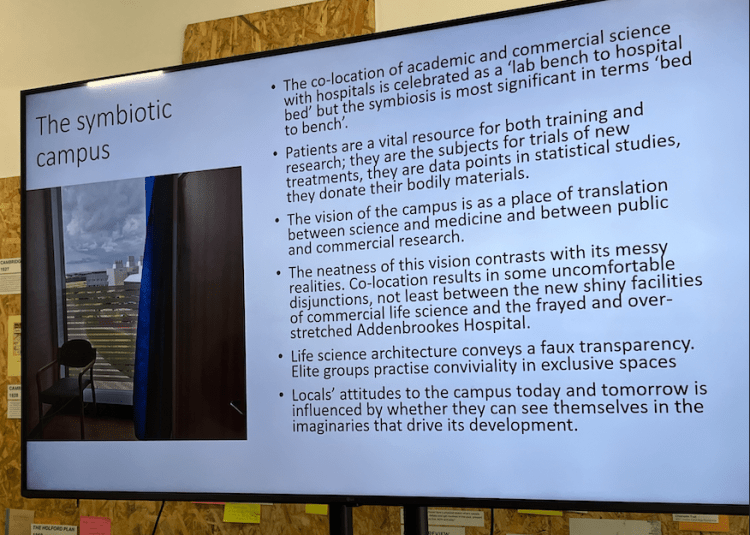
Above – Dr David Skinner (2025) of Anglia Ruskin University – part of his project: Cambridge – a sense of place with Will Brown, exploring the relationship between the Cambridge Biomedical Campus and neighbouring communities
“Our project aims to enhance the local conversation about the growth of the campus and its future impacts. A key element of the use of on-the-move methods, walking through the site with groups of people and conducting walking interviews with key informants. As of November 2024 we have guided over a hundred and forty people around the site and conducted over twenty interviews.”
Above – Cambridge: a sense of place – about
The project’s origins with the Queen Edith’s Community Forum
Former Independent ward councillor Sam Davies MBE mentioned Dr Skinner’s emerging project back in April 2023 (see the end of her blogpost here) following Dr Andy Williams’ talk to our community forum which I wrote about and provided video links here. Dr Williams is well-known in Cambridge science and policy circles having served in a series of non-executive roles on a number of committees including the GCP and Combined Authority. Hence his comments in his presentation about how previous governments had not enabled Cambridge to build the infrastructure it needed to sustain the huge growth rates we’ve experienced still resonate with residents today. If we step back a year to July 2022, we see Ms Davies putting her concerns directly to the CBC representatives and a property consultant from Knight Frank, Emma Goodford (who a few months ago joined RAILPEN of Beehive Centre fame). Ms Davies asked:
“What is the likelihood that investment pours into [The Cambridge Biomedical Campus] in order to deliver this integrated masterplanned world-leading vision, while residential neighbourhoods next to the Campus continue to be degraded by the loss of local character, piecemeal conversion of family homes to HMOs and flats, loss of biodiversity due to sub-division of gardens, negative externalities of Campus-generated activity, etc? How would you address this asymmetry?”
Above – Sam Davies MBE to CBC, from 10 July 2022
You can listen to the video of the response here
As Ms Davies mentioned, she was referred to what is now called Kendall Common from the one of the other Cambridge’s – this one being the Massachusetts daughtership in the USA. And their intro is:
“Kendall Common is underpinned by progress, empathy and a constant drive to do better. We are creating an authentic, inviting, and dynamic environment to knit the people of Cambridge together”
Above – Kendall Common’s vision – which at the time Ms Davies was writing, included all these benefits

Above – via Sam Davies’ now closed blog here
“Can we have all that for Cambridge UK?”
No.
“Why not?”
HM Treasury won’t delegate the tax-raising powers and Whitehall won’t bring in the policies to empower local government sufficiently to enable Cambridge (or anywhere else in the UK for that matter) to bring in something like this independent of ministers.
The UK’s democracy is based on the convention of Parliamentary Sovereignty, not on a written and codified constitution that very clearly separates the powers not only between Legislature and Executive (i.e. Westminster and Whitehall), but also the different tiers of the state. Imagine local councils having a much wider range of local taxes that it could levy. Then imagine government ministers having no legal powers to tell councils what they should set those rates at or what they should spend them on. That.
“Progress update since that response?”
The response from Ms Goodford is striking in that the first thing she does is to undermine the testimony that Ms Davies provided – by saying that such investment in the former’s experience was overwhelmingly positive. The problem with Cambridge is that the investment is coming into an already overheated economy and housing market that does not have the capacity to handle it. Which is why ministers are establishing a development corporation – something which reflects the enfeeblement of our local government structures and institutions over decades.
Part of the problem is that Ms Goodford is probably the wrong person to be responding to that question. Because ultimately this is a Political issue, and in a dog-eat-dog world of the property consultancy industry, if a client states to said consultancy that they want to buy a property in south Cambridge that is a detached house with a large garden, and turn it into a block of flats, sell them off, and bank the profit, that’s what the consultancy will facilitate for a fee. What the cumulative effect of the piecemeal conversion that Ms Davies talked about is not the industry’s problem as far as they are concerned – until the long term negative impacts start hitting property prices. But that’s a problem for a future generation.
Yet as we know, such is the huge influencing power of the development and property lobby (look at how long it is taking for the Grenfell Inquiry issues to be resolved) that any radical plans that might deal with this will be heavily lobbied against. Which then brings us to the can of worms of our malfunctioning democracy and institutions of state – one that I don’t want to open in this blogpost!
Will Drs Skinner and Brown be doing their presentations again?
I’ve asked them to do one for the Queen Edith’s Community Forum so watch that space. Additionally I think there are other groups and organisations in and around Cambridge that should be commissioning them to do similar presentations because so many of the issues that they have raised go to the heart of Cambridge’s and Cambridgeshire’s governance structures. Accordingly, with the restructuring of local government taking place, this is a very important case study that can (in the eyes of the public) turn vague political concepts that go above most people’s heads into something much more understandable and tangible.
Food for thought?
If you are interested in the longer term future of Cambridge, and on what happens at the local democracy meetings where decisions are made, feel free to:
- Follow me on BSky
- Spot me on LinkedIn
- Like my Facebook page
- Consider a small donation to help fund my continued research and reporting on local democracy in and around Cambridge.

 The Cambridge Town Owl