
In October next year it will be a decade since Cambridge Past, Present, and Future convened their Keeping Cambridge Special event. How have we done in the years since the 2016 event?
Above – The Cambridge Room. See their events calendar and discussions covering the future of our city.
“Keeping Cambridge Special is an initiative started by members of Cambridge Past Present & Future. It aims to get representatives from all sectors of the community together to discuss some of the major challenges facing the greater Cambridge area.”
Above – introduction by CambridgePPF (with more video links further down)
In the days before most public venues installed their own in-house live-streaming systems, I was often invited to film the growing number of ‘future of Cambridge’ meetings that happened in Cambridge throughout the 2010s. The impetus for venues to bring in live-streaming and video-recording facilities ultimately came about with the lockdowns, even though (in local government circles at least) I had been calling on councils to install their own systems to make it easier for the public to find out what’s going on. (There’s a wider issue about the proper archiving of such digital video files which I’ll leave for the experts).
Dr David Cleevely and Serendipity
“Serendipity doesn’t have to be left to chance; we can systematically and intentionally design for it and create the opportunities for it to happen”
This also links with the research by Dr David Skinner of Anglia Ruskin University and Dr Will Brown of the University of Cambridge on the sociological issues arising from the creation and expansion of the Cambridge Biomedical Campus in their project: Cambridge: a sense of place, which they introduced at The Cambridge Room earlier this week
The reason why is because what Drs Skinner and Brown are looking at is *how* the attempts to achieve what Dr Cleevely concept sets out, and how successful or otherwise those attempts so far have been. To summarise, the benefits of serendipity created by both institutional policies and wider urban design improvements may be benefiting the affluent and connected, but are they benefiting those on the lowest incomes? Are they helping design out and end poverty for those in the most economically-deprived parts of our city. (And I don’t mean pushing them out of the city to be replaced by more affluent people – that just moves the poverty (and the people suffering from it) elsewhere).
Furthermore, the risks to growth are also party-political. The Green Party – most hostile of the political parties to the present pro-growth policies, gained three seats at the recent county council elections (25% of the Cambridge City divisions), and polled over 6,800 votes in last year’s general election in Cambridge – their highest ever. As politicians and the corporate supporters of growth found out the hard way in 2023, they cannot take for granted the consent of the people without meeting their concerns and needs.
As I wrote up in my blogpost on taking on the inequalities on the Cambridge Biomedical Campus featuring the pair’s presentation, former Queen Edith’s independent councillor Sam Davies MBE repeatedly raised the challenges and issues in university and local government circles, but was all too often ignored, dismissed, or perhaps along with many others, ‘designed out’ by our over-centralised political and governance structures. What more of the decision-makers should have done was to have assessed what former Cllr Davies was saying, and if necessary added them to their risk registers and come up with mitigating actions.
Having spent the past 15 years observing and interacting with individuals and institutions shaping the future of my home town following seven years working in central government – and combined with nearly a decade studying and researching our forgotten local town histories, I’ve often found myself in this strange position of having all of this seemingly random information stuck in my mind but with few people to talk to about it. (Something that is both a combination of my own personal shortcomings, my undiagnosed ADHD plus the lack of a civic structure for local history that can be used for local public policy making).
Keeping Cambridge Special – who said what?
Before I move onto Dr Cleevely’s contribution, I want to highlight what the former Master of Fitzwilliam College, Nicola Padfield said in her presentation.
“Personally, I think it’s nuts that we don’t have more railways… …in twenty years time we’ll look back and think ‘How slow they were to decide what they were doing!’ [Note the applause that followed!]“
Above – Nicola Padfield (01 Oct 2016) at Keeping Cambridge Special
Nine years later and the public inquiry for the Cambourne-Cambridge Busway has only just completed its first preliminary hearing.

Above – snapshot of what Nicola Padfield called for (speaking in a personal capacity) at Keeping Cambridge Special 2016
- Decent railways
- An overhead tramway or metro
- Shared taxis instead of buses and no more busways/guided buses
- Bicycles and walking – i.e. active travel routes which she expanded on in more detail towards the end of her presentation
- Cheap public transport
Note the list above was put together in the very early days of the Cambridge Connect Light Rail project. The publicity until then was little more than Dr Colin Harris’s public speeches, and me sending out social media posts to anyone who would listen.
Dr Cleevely and Wendy Blythe of the Federation of Cambridge Residents’ Association agree on some of the key problems
“Wendy, your sense of crisis – about the speed, folly, and ugliness that we see as opposed to beauty, sustainability, and public engagement, is capturing it, absolutely right”
Above – Dr David Cleevely (01 Oct 2016) Keeping Cambridge Special
I highlight this because Dr Cleevely and Mrs Blythe – both of whom who have been very generous in their support for me in times gone by, have contrasting visions for the future of our city, and both have been involved in the debates over an extended period of time that future historians looking at the growth of Cambridge in the first half of the 21st Century are more than likely going to have to quote both of them.
Mrs Blythe’s speech which you can watch here, highlights many of the issues that were later picked up on by Create Streets in 2023 in their Promise of Cambridge piece, following Michael Gove’s announcement to supersize Cambridge.
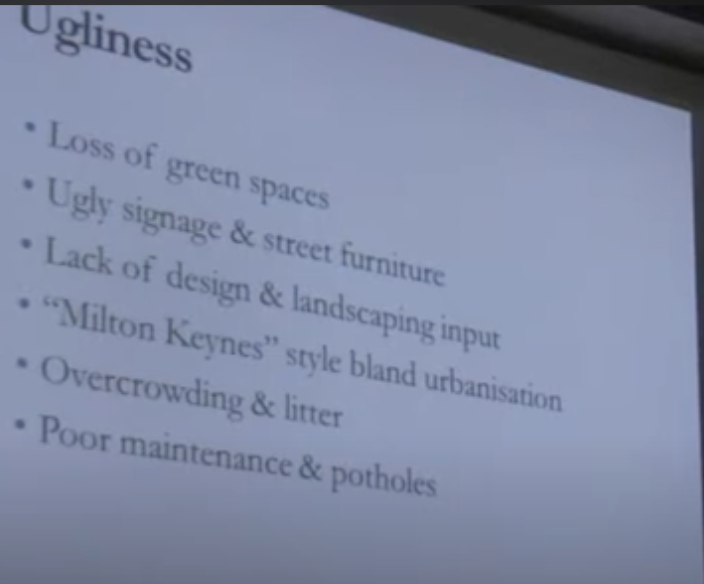
Above – Wendy Blythe of the Federation of Cambridge Residents’ Associations (01 Oct 2016) at Keeping Cambridge Special
One of my takeaways from the Peter Freeman’s speech from the event that Mrs Blythe was one of the main organisers of earlier this year, included his concerns about things like poor design and the risks of not bringing residents and the people of city and county with them.
Further on in Mrs Blythe’s speech, she commented on issues that Ms Davies raised in her question to Emma Goodford of Knight Frank on 07 July 2022 in a webinar hosted by the Cambridge Biomedical Campus Ltd. Have a listen to the question and the response – noting that Ms Goodford (in my opinion at least) did not acknowledge – and rather tried to dismiss or rebuff the issues raised by Ms Davies. (I discussed that exchange further in my earlier blogpost)
Dr Cleevely on the huge predicted growth of Cambridge’s economy
Dr Cleevely crunched the numbers in 2016 looking at the huge rates of growth in turnover and employment. On existing trends he extrapolated the numbers, pulled some back (because nowhere can sustain 7% growth per year every year for half a century), and predicted that by 2065 Cambridge would have:
- 600,000 population for Cambridge’s urban geographical footprint (as we are spilling over our 1935 era boundary)
- 1 million workforce (so *lots* of commuting in from outside
- 30 mins train journeys from London King’s Cross 60 mins from Oxford by rail
- 100,000 in life science
- Called on strategic planning for the wider Cambridge area to return, similar to what Cambridge architect Tom Foggin called for in his speech. (Something the current government has brought back following its abolition by Eric Pickles in 2010).
“What happens if we don’t plan?”
Dr Cleevely answered that question with this slide:

Above – Dr David Cleevely (01 Oct 2016) highlighting the risk of urban sprawl with unplanned and unrestrained growth
Which is why Dr Cleevely then made the case for a new metro system for Cambridge. Again this was in the very early days of the Cambridge Connect proposals. Yet as we have seen recently, the new Mayor for the Combined Authority (which itself had not been invented back in 2016!) has put his support into a light rail for Cambridge, and is opposing the applications for the proposed busways which still have plan for what will happen to the buses when they reach Cambridge.
Concerns about urban sprawl remain
We saw that earlier this week at the Cambridge Forum for the Construction Industry’s annual debate at the Cambridge Union.
“This House believes Cambridge should grow up (and not out)”
Yet as I noted in my writeup on the above, in the previous phase of Cambridge’s expansion starting in the late 1990s, our city was offered a choice of either minimal expansion (i.e. a continuation of the Holford-Wright vision from 1950) or six different types of expansion. As the late 1990s graphics below show us, we’re on the way to getting all six types of growth rather than the two or three types we might have selected from the choices available

Above – Cambridge Futures in Lost Cambridge via the Wayback Machine
No one (yet) is discussing a second urban centre for Cambridge
As I have stated repeatedly, given that ministers want Cambridge to expand even further than the levels proposed in the emerging Greater Cambridge Local Plan 2031-40, we need to start a very serious debate *now* about where a second major urban centre for our city is going to be. This is because our historical centre no longer can support all of the functions that a settlement of its type requires:
- A municipal centre of governance for us town people
- A very large centre of higher education (and also private education such as language schools, cram colleges, university preparation courses for international students, as well as the traditional private schools)
- A centre for retail and commerce
- A tourist centre for millions of visitors per year
- A regional transport hub
Given that Shire Hall has been sold off rather than having been converted into an expanded Museum of Cambridge / extended heritage and arts site, and given that Cambridge City Council’s vision for The Guildhall does not appear to involve having many staff there, far better in my view to build a new beautiful grand city hall (think what Birmingham has in Victoria Square) and have new institutions that fulfil new civic functions that we currently lack:
- A new large lifelong learning centre and adult education college named after the late Sir Michael Marshall (because of the chronic skills shortage – and design it with the users who will be using it too – noting what Derby’s WEA produced in the 1960s)
- A new large concert hall as conceptualised by the former Cambridge University Vice Chancellor Sir Ivor Jennings back in June 1962, and initially worked up by Cambridge City Councils Architect and Chief Town Planner Gordon Logie (see here, scroll halfway down)
And have the new Cambridge East railway station as the transport hub. I.e. my vision from September 2024 remains. That then makes the southern section of the Cambridge Airport site the ideal place for it – noting the site is owned by the Marshall family, hence the naming of the lifelong learning centre after the late Sir Michael feels more than appropriate – and also provides an incentive in terms of civic design and civic pride).
Events of the next six months will give us an indication of what – if anything can be achieved. I get the sense that a lot is going to rest on the Cambridge Growth Company as the development corporation given the shortcomings of the existing institutions over the past decade. The buck for that stops at the desks of the ministers that enfeebled and disempowered them over the decades. One big question for the future unitary council is what *additional* powers (legal, tax-raising, spending, and policy-making) will it need to ensure it does not become the enfeebled unitary council that Peterborough City Council is? Something the Bennett Institute could start the debates on?
Food for thought?
If you are interested in the longer term future of Cambridge, and on what happens at the local democracy meetings where decisions are made, feel free to:
- Follow me on BSky
- Spot me on LinkedIn
- Like my Facebook page
- Consider a small donation to help fund my continued research and reporting on local democracy in and around Cambridge.

 The Cambridge Town Owl