
Two reports published earlier in 2025 cover community venues in South Cambridgeshire villages, and industrial/warehouse supply/demand in and around the city
You can read the reports from the Greater Cambridge Shared Planning Service here. The most recent reports are:
- Greater Cambridge Industrial and Warehousing Sector Study 2025
- South Cambridgeshire Community Facilities Study 2025
“Which reminds me – we are still awaiting an indoor leisure facilities strategy for Cambridge, aren’t we?”
I’ve lost track. All I know is that the multi-lane rowing facility and the 50m swimming pool set out in the Cambridgeshire Horizons (undated) document from around 20 years ago still have not been built.

Above – from Cambridgeshire Horizons (undated)
“Where’s the rowing facility meant to be?”
It’s one of the long-delayed proposals from the Cambridge Sports Lake Trust (click & scroll down).
From their PDF linked, the rowing lake facility starts just north of the A14 at Milton by the Country Park (Good luck getting finance and approval for a bridge over the canal!)
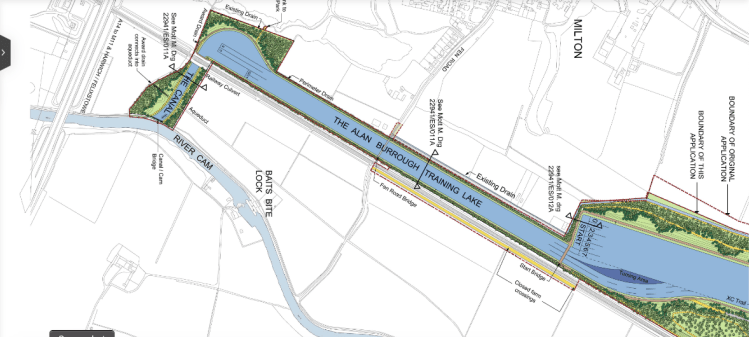
…and then continues northwards next to the railway line up to Hornsea and Baits Bite Lock

Above – from the Cambridge Sports Lake Trust.
You can see how the CSLT has been getting on via their annual returns to the Charity Commission
Upgrading ageing leisure infrastructure
I wrote about this back in Sept 2021 following a report by the Association for Public Service Excellence (APSE) and others.
“Our research has found that nearly two-thirds of the local council leisure estate is ageing and past its replacement date”
Securing the future of public sport and leisure services – APSE Sept 2021
“How good are South Cambridgeshire’s facilities?“
Generally good.
“Of the 93 facilities audited:
- 64 can be classified overall as Good or Excellent.
- 25 were Average
- 4 Poor and none Very Poor.
Above – Cambs ACRE (2025) Para 6.11
There is, however a huge reliance on volunteering.
“The consultation with managers of the District’s community facilities has revealed the sheer effort that their (mostly volunteer) management committees put into maintaining their buildings. 70% have undertaken refurbishments in the last 10 years and over a quarter (26%) have a major renovation (by which we mean a new roof, floor, kitchen toilets or heating system) planned for the next 5 years.”
Above – Cambs ACRE (2025) Para 6.12
This is a huge issue for the future of Cambridge as it expands and becomes a unitary council. Furthermore, it highlights a huge risk associated with an economy increasingly characterised by a high turnover of population, and insecure working conditions for too many people. The same goes for the number of homes built as family homes that are being converted into short term lets.
You will struggle to build a vibrant and sustainable community sustained by volunteers in the long term if job insecurity and high population turnover are two of its characteristics
Which is why the recent book co-authored by Professor Claire Colomb of the University of Cambridge on short term lets and their impact on European cities, is very timely.
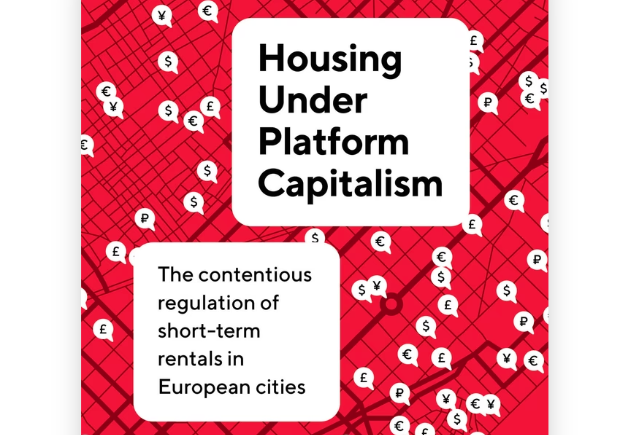
Above – Housing Under Platform Capitalism (University of California Press)
“This book makes a crucial contribution to comparative urban politics in the twenty-first century, investigating the capacity of local states to govern housing markets and platform capitalism in an era of globalized human and capital flows. In the face of this worldwide shift, Housing Under Platform Capitalism insists that institutions and regulations can champion the public good by protecting the right to housing and ultimately limiting corporate power.”
Above – from the synopsis.
Given how under-powered English local government is in everything, what powers could ministers and Parliament grant to local councils to restrain this sector? Noting that in Barcelona and other Spanish cities, people are already protesting over what ultimately is a failure of governance, regulation, and enforcement. Noting that I picked up on former Cllr Sam Davies MBE raising similar issues a few years ago in my earlier blogpost about inequalities on the Cambridge Biomedical Campus. We’re still nowhere near resolving them.
“Anything special about warehouses?”
It’s a sub-regional issue – it crosses county boundaries.
Their list of main recommendations included suggestions such as:
- Extensions to existing locations on the A14 that provide local distribution and
manufacturing provision, or potentially on the A428 - Extensions to existing mid-tech locations such as Bourn or Sawston
- A Cambridge urban fringe industrial location to support general industrial and
trade park activity – population serving uses - A new mixed industrial / tech park on the Strategic Road Network (SRN), preferably but not critically located on the Cambridge fringe
- A new industrial / distribution park on the Strategic Road Network
- Seeking to avoid further losses of existing industrial stock
Above – Greater Cambridge Industrial and Warehousing Sector Study (2025) para 7.25
Note the last point which refers in part to the firm on Clifton Road in Coleridge, Cambridge. This area contains a host of firms that provide essential services and supplies to small businesses – esp in the building, construction, and maintenance trade without whom those working in the sector might otherwise have to drive out of Cambridge to get new supplies on the same day. Time, money – and also unnecessary pollution from vehicle emissions. Which is also why the report identifies Cambridge East (in/around the airport) as a site for a new industrial estate for such businesses.
Either way, both reports are of interest to those scrutinising the future plans for our city and county.
Food for thought?
If you are interested in the longer term future of Cambridge, and on what happens at the local democracy meetings where decisions are made, feel free to:
- Follow me on BSky
- Spot me on LinkedIn
- Like my Facebook page
- Consider a small donation to help fund my continued research and reporting on local democracy in and around Cambridge.

 The Cambridge Town Owl