One of Cambridge’s most influential employers’ groups says Cambridge’s new unitary council should ‘align…with the functional economic area of Cambridge’.
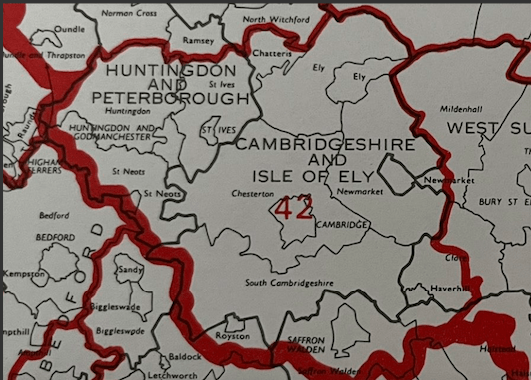
Image – the proposals for a Greater Cambridge Unitary from the Redcliffe-Maud Report of 1969
You can see what the proposals meant for Cambridge in my Lost Cambridge blogpost.
“Proposals should align as much as possible with the functional economic area of Cambridge. This change alone is a critical success factor for the region. Functional economic areas are not only an economic lens but also has a strong correlation with the community lens, where people identify as their local area. This should be seen as a one-time opportunity to create meaningful administrative areas, rather than being bound by existing boundaries for ease“
Above – Cambridge Ahead press release 01 July 2025
Which is splendid from my perspective as it matches what I’ve been calling for, for years!
As I explained in this blogpost back in 2024, Nathaniel Lichfield’s study of the Cambridge Sub-region (below-left) identified the smaller local centres of the market towns around Cambridge along with Cambridge’s economic sub-region. And this was before the A14 and the M11 were built – a time when the motor traffic had to plough through Cambridge’s city centre. Below-right is a more recent ‘travel to work area’.

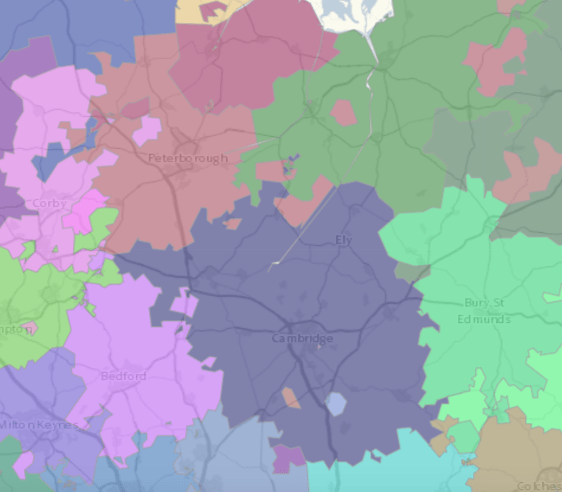
Above-left, Lichfield’s analysis from 1965. Above-right – Cambridge & Peterborough’s bus travel to work area commuting patterns 2011 – from the ONS here
In August 2024 I had a look at what devolution for Cambridge might look like, noting we’re still awaiting the detail of the Devolution Bill to be published by ministers. Furthermore, I had a look at how an expanded unitary council would deal with surrounding town and parish councils, as well as the existing city of Cambridge here. Because one huge concern many rural communities have is the risk of remote decision-making at the expense of local communities – an issue that sank Redcliffe-Maud’s proposals.

Above – “Don’t vote for R.E.Mote” – depicting an advert from anti-Redcliffe-Maud-Report campaigners. Birmingham Daily Post 06 Oct 1969 in the British Newspaper Archive
“What else did Cambridge Ahead say?”
“Government should consider future growth potential in the population size assessment and not be bound by an arbitrary number with only short-term relevance. More important is that new councils align with functional economic areas.“
Which is a response to the arbitrary ‘500,000’ population target set by the Minister for Local Government. There is no statistical or research base for this number. You can find numerous examples of where a number is selected by a minister because it sounds reasonable at the time to a specific audience. For example Tony Blair’s target to get 50% of school leavers into higher education. Given the huge building plans ministers have for Cambridge, there’s no point in designing a new local council for today only to find it is obsolete by the time the reforms have been implemented.
“Local authority functions that support good growth are maintained through the transition and are designed to operate more efficiently and effectively in the future.
“Funding arrangements for new councils should provide for core public services to be delivered well – with the Cambridge area being an example of a place where quality of life applies to attracting and retaining global talent, as well as the local community.“
This is town and transport planning. The challenge here is on the specifics. No one would go public and say: “I am in favour of bad growth!” So in reality this could be interpreted by opponents of the huge growth plans as much more nuanced than perhaps the authors realise. Perhaps most importantly, who gets to say ‘No!’ to big developments and on what conditions? For example this speculative development proposed for greenbelt land that’s not in the current or emerging local plan just up the road from Bar Hill, north west of Cambridge on the A14?
Local government funding has been a constant moan of mine – and sadly the Minister for Local Government said such an overhaul is not going to happen. He was cross-examined on it back in February by MPs, but it didn’t look like HM Treasury was or is going to budge on this. Which means ministers will continue to create more work for themselves because lobbyists like Cambridge Ahead, and powerful interests such as the University of Cambridge will continue to contact ministers rather than working with local and regional tiers of government as would happen in other less-centralised countries.
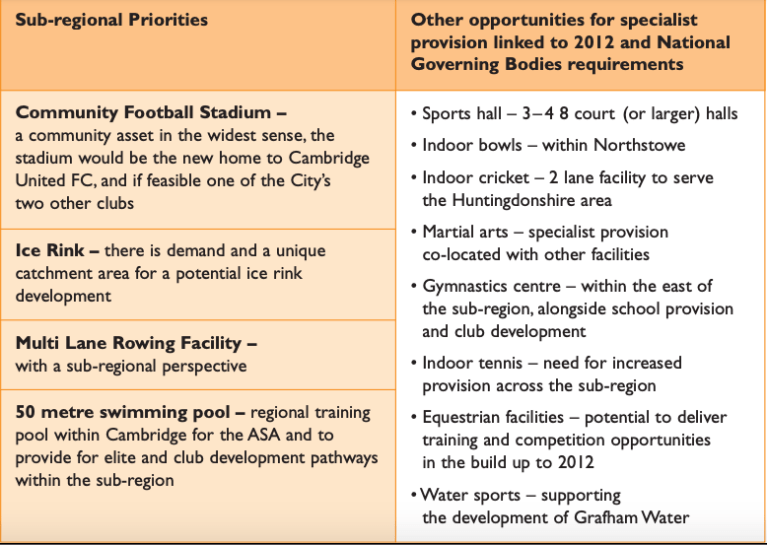
Above – from Cambridgeshire Horizons in the mid-2000s in my blogpost on a new masterplan for Cambridge.
It should not be beyond the ability of ministers to bring in a new system of local government funding that would enable Cambridge to tax the wealth generated in its sub-region to pay for new infrastructure and facilities, enabling central funds to be spent in areas that cannot raise funds locally.
” There should be demonstrable local support from the business and employer community.“
In addition to local support from residents in the unitary council area? (So not just the city of Cambridge)
“New structures across the CPCA area should establish sustainable unitary councils that can thrive in their own right, as well as interact meaningfully as a Strategic Board with the Mayor.
“Cambridge is in receipt of other Government interventions beyond devolution, notably the Cambridge Growth Company. New structures should work as a coherent whole in this context too.“
Personally I don’t think we need the Combined Authority (same as the Cambs Unitaries Campaign) – I prefer the principle of the old government offices for the regions, in particular for strategic planning that cuts across multiple boundaries such as East West Rail. But we are where we are.
Could Cambridge Ahead co-organise some events that are open to all, and enable people from business backgrounds to discuss the proposals with people from other sectors, with young people, and with residents more generally?
The simple reason being that these changes will affect all of us. This isn’t an industry-sector-specific consultation that won’t be of interest to residents. Quite the opposite.
Lack of trust in politics. And business
We saw what impact the hearings from the Grenfell Inquiry had on the construction industry.
“The report pulled no punches. A lethal combination of dishonesty, deregulation and incompetence on the part of industry and government over a matter of years led to combustible cladding being installed on the tower.”
Above – Chloe McCulloch in Building.co.uk 11 Sept 2024
If there is one thing that risks alienating the public even further, it’s private, sector-specific meetings between senior politicians and affluent interests. Which is why I’m often critical about groups such as this one which have the ability to invite ministers on visits knowing the invitation will be accepted. Who are the groups whose voices are seldom heard and whose interests are little known or considered in policy-making circles?
Some of the events have to be in places and venues where the powerful and affluent are the ones who feel outside of their comfort zone
This was something my old department in my civil service days started discussing when it came to overhauling procurement functions – i.e. booking community-owned venues for events rather than standard conference facilities owned by multinationals. It meant going to parts of London and other towns/cities where we’d otherwise never go to, but that was the point.
The same goes with the future of Cambridge and any consultation and discussion events that are organised in the looming consultations. It may not be popular with some, but given that the new local councils will be vested with huge responsibilities to support the most vulnerable in our society, why on earth would any discussions about the creation of such councils be held in expensive conference venues where delegates will inevitably be shielded from the day-to-day realities of what many of the people who make up our city and county live with?
Food for thought?
If you are interested in the longer term future of Cambridge, and on what happens at the local democracy meetings where decisions are made, feel free to:
- Follow me on BSky
- Spot me on LinkedIn
- Like my Facebook page
- Consider a small donation to help fund my continued research and reporting on local democracy in and around Cambridge.

 The Cambridge Town Owl