
“There’s a shortage of water, there’s a transport crisis, and there’ll shortly to be a power crisis [i.e. lack of electricity]”
Above – Peter Freeman to Nick Dines from 2m30s
The Chair of the Cambridge Growth Company Peter Freeman was interviewed by Nick Dines for his Better Places podcast, which you can listen to in full here. It was a really informative interview so credit to Mr Dines for his lines of questioning. As I set out below, there are a number of things that Cambridge residents and readers of this blog might not have heard him say or be quoted on before.
Note this video by Mr Dines follows Mr Freeman’s appearance at Great St Mary’s where he faced his first public audience – video links, links to slides, and more via my blogpost here. As a result we get some insight into what the latter is learning and where he is forming some firm views on how he intends to proceed.
“So we have crises in:
- Water
- Transport
- Electricity (unless the privatised utilities get their act together…)
- ….did someone mention housing too?
I dare say we have a governance crisis too – one where the local tiers of the state have been so fragmented and enfeebled that they have long since lost the powers and resources (if they ever had either) to deal with the problems in their geographical areas. And don’t get me started on the climate emergency and the challenge of building all of these homes and facilities without so much as releasing a molecule of carbon dioxide or methane!
“The DC will help. The rules we can set for intervening mean that the developments are infrastructure-led, mixed use, place-making, they are not just monocultures of estate housing, or estate business parks”
Peter Freeman 4m30s
Interestingly, he stated that for Waterbeach Newtown was provided with a loan from Homes England (an agency of the Ministry of Housing, Communities & Local Government) to pay for the infrastructure up front.
“Our first job for Cambridge is to work out beyond the emerging local plan (i.e. 2031-40) how much additional housing is realistic for takeup”
Peter Freeman 6m30s
“I have been listening to local politicians who have been worrying about [Cambridge’s problems] for far longer than I have. I have to come up with a business plan to take to The Treasury to say: This is the way that these things which are public goods and public benefits are necessary if the Government wants growth in Cambridge, can be financed.”
Peter Freeman 8m30s
He said that in Cambridge, everyone knows each other (2 degrees of separation!) which he said was a huge benefit. The problem is that the huge growth in Cambridge will inevitably undermine this. It has to – and it is already being undermined because of the decisions taken by previous generations of politicians and decision-makers.
“The new mayor is particularly keen on rapid mass transit [i.e. light rail] which historically was not financially viable. But if you cast your mind forward and say we are really changing the scale of the town, it probably does become affordable. The role of the DC is to become the bridge between shorter term pressures such as ‘you’ve got to have a 5 year land supply’ to a longer term ‘what can the city become?’“
Peter Freeman 14m00s
Interestingly he says that the Cambridge Growth Company should not cross county boundaries – but rather have separate working relationships instead of a statutory duty to take over parts of other counties.
He also mentioned that he was looking at a time frame of a quarter of a century (Peterborough’s newtown extension was 1968-88 – what are the lessons from there?) He also said that the development corporation should be separate from local government. His concern isn’t just with the inevitable instabilities that local government politics causes (This is year number 15 I’ve been blogging about local democracy in/around Cambridge!) but also because he wants to ensure the finances for the corporation are ringfenced from the many other demands of local government (eg social care).
Nick Dines asked the big question: Local accountability
Have a listen from 17m50s here.
Mr Freeman said ultimately it will be about who is on the board of the development corporation. Mr Dines then reminded Mr Freeman of the messy structures – ones that only ‘open conversations’ can resolve as he said.
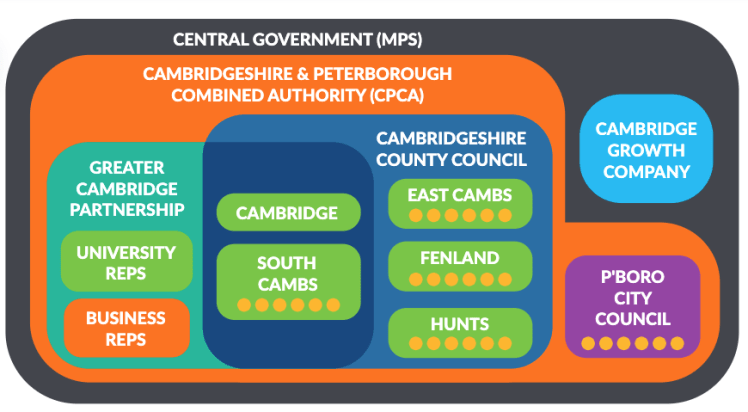
Above – Cambridgeshire’s governance structure by CamCycle
The different levels of the challenge:
Mr Freeman mentioned the pressure on public services and the need to build new facilities (along with the pressure on utilities this brings – especially water). He said most of the housing should be delivered in the form of ten or so master plans where they can be sustainable, mixed use developments rather than small developments dotted about all over the place. It sounds like his main recommendation is that the developments need to sustain new facilities, amenities and public services.
Small piecemeal developments – and the disadvantages of
It was interesting to hear Mr Freeman state how the historical pattern of housing growth in southern England over the past half century was ‘the worst of all worlds’ – i.e. the additions to lots of villages that spread the stress of new builds everywhere but without being able to build new facilities because small populations cannot sustain them. The conversation thread in this CamCycle FB Thread reflects more than a few exchanges over the years between urban and rural over amenities and public transport. Recall the former Master of Fitzwilliam College, Cambridge saying in 2016 that she did not want to see lots of empty buses in a future Cambridge.

Mr Freeman said that one of the conversations to have with the surrounding villages is about who wants what, and what are the trade-offs? For example he mentioned two scenarios.
- A large village where residents want more facilities and more affordable homes for children (especially where schools are at risk of closing) and people in lower-paid jobs that are essential for the functioning of their communities.
- A small village that does not want new housing and would quite like to be left alone
Given Mr Freeman mentioned the figure of around ten masterplans, he also stated that his preference is for the small villages that don’t want the housing growth should be left alone, and that the conversations with those wanting some new homes and new facilities should be started there.
Getting the costs of building down by reducing the risks
De-risk the planning process and investors will be willing to reduce the return expect versus one that requires the investors to do the land assembly, get the planning permission and so-forth. Have a listen to Mr Freeman here.
“In 2050, what should good growth for Cambridge look like?”
A good question by Mr Dines – to which Mr Freeman said: “People would be saying ‘Go and visit Cambridge!” rather than somewhere in Continental Europe. He also described the joy he gets from seeing how the public use the King’s Cross regeneration he was responsible for. The most striking sentence he used at the end was when he said that a successful Cambridge in 2050 is a place where people choose to be.
“Sounds familiar”
I used the same phrase in earlier blogposts:
“This is one of the reasons why I come back to creating places where people choose to be”
“The lifelong learning centre in a new civic quarter – creating a place where people both want to be, and also can have various needs met at the same time“
Above – Cambridge Town Owl 16 Feb 2025
That package for a new urban centre again?
The four anchor institutions:
- A new city hall for a unitary council (where decisions are made)
- A new lifelong learning centre
- A new large concert hall
- A new railway station and public transport interchange
….all around a new civic square. If you can create a situation where your lifelong learners are mixing with the local councillors and council officers, using the same public transport systems, and even going to similar shows in the entertainments quarter at or behind the concert hall, that helps break down the barriers.
As some of us said back in 2015:
- Many Bridges
- One Cambridge.
- It’s your city.
Be. The. Change.
If you are interested in the longer term future of Cambridge, and on what happens at the local democracy meetings where decisions are made, feel free to:
- Follow me on BSky
- Spot me on LinkedIn
- Like my Facebook page
- Consider a small donation to help fund my continued research and reporting on local democracy in and around Cambridge.

 The Cambridge Town Owl