
Several public questions on bus services, something on light rail, heavy rail, and more strategies – is the huge consultancy spend at a cost to the corporate memory of the public sector?
You can read the meeting papers here – noting a number of public questions (item 5) on buses. Which reminds me:
Relaunch and AGM of the Cambridge Area Bus Users Group
The campaign group (see their website here) is relaunching with a gathering at the Mill Road Community Centre round the back of the Mill Road Library. (What’s happening with that building? Any updates?)
Date/time: Friday 18th July 2025 – 10:45
Venue: Mill Road Community Centre, 6 Hazell Street, Cambridge, CB1 2GN
More on FB here for those of you still using it
If you are interested in supporting in any way, however small (eg being the eyes and ears of bus services in your neighbourhood), please contact Richard Wood here.
Structural changes from National Government – including new powers and duties being brought in under the long-awaited Devolution Bill (plus a further ministerial update due in the next fortnight) mean that there are a host of things that will need to be thrashed out.
The A10 from Ely to Cambridge
One of Mayor Paul Bristow’s top three priorities for roads in Cambridgeshire & Peterborough included dualling the main road from Ely to Cambridge. Critics have asked what happens to the traffic just as they did when Mayor James Palmer commissioned plans for upgrading the A10.

Above – from the first consultation in the late 2010s by former Mayor James Palmer
The papers (see item 11) show that a number of things will need to be updated.
“The definition of the problems and the need for intervention needs re-evaluation…The DfT will want to understand how the project interlinks with the Milton Interchange. As such the interrelationship between the project and Milton Interchange will need to be reconsidered. The Combined Authority have met with National Highways where there was agreement that as the A10 is developed, the impacts on the Milton Interchange will need to be assessed and accommodated.
Above – CPAC Transport Committee Item 11 P3-4
A revamped transport strategy?
As mentioned in previous blogposts, Cambridgeshire is about to get its fourth transport strategy in a decade.
“The Greater Cambridge Transport Strategy will act as a dedicated sub-strategy focused on the Greater Cambridge area, helping to inform and prioritise future funding and investment decisions. It will also strengthen the case for securing additional transport funding to support local growth and connectivity ambitions in the short, medium and longer term.”
Above – CPAC Transport Committee Item 12 P2
See the current transport strategies here – and scroll down for the Greater Cambridge one.
What’s striking is that we seem to be back to where the old Cambridge City Deal was in the mid-2010s.
“Specialist consultants (WSP) have been appointed to identify site-specific transport interventions needed to support planned growth. A broad ‘long list’ of potential measures is being developed to ensure all viable options are considered…. …Wider engagement and formal consultation is planned during the evidence review phase in late 2025”
In one sense it was inevitable irrespective of who won the 2025 CPCA mayoral election. Peter Freeman of the Cambridge Growth Company (See his latest interview in my previous blogpost) meant that light rail would have to be a consideration.
In that paper the CPCA indicates they are expecting regulation of e-scooter hire schemes to be devolved to Combined Authorities. (Another reason for the importance of the Devolution Bill).
And finally we hear news of a revamped [heavy] rail strategy – see Item 12 Appendix B which inevitably has to take into account of both East West Rail, a possible Cambridge East Station, and the uncertainty over the funding of the long-delayed Ely Junction upgrade.
“We await further information from DfT about what may be included in their allocations.”
…as the CPCA papers state in item 8
On light rail
The CPCA is still calling it Rapid Mass Transit [because old habits die hard?] See item 8 of the agenda – the Director’s Highlight Report. It’s a controversial issue with some of us (me) because it has enabled successive senior transport officers to water down European-style light rail visions into diesel-spewing buses of the likes we still see on the present busway.
“The Assistant Director for Transport is actively engaging with a range of service providers, including those specialising in light rail and autonomous transit technologies, to explore mass rapid transit (MRT) solutions that align with the region’s long-term growth and connectivity objectives.
A recent site visit to Coventry provided insight into the deployment of very light rail technologies, while lessons from the Greater Cambridge Partnership’s autonomous vehicle pilot are informing the Combined Authority’s approach to innovation, integration, and scalability.”
Above – CPCA transport Committee item 8 p3 para 3.3
Where Mayor James Palmer came unstuck on light rail / CAM Metro
Ultimately there were two different visions:
- Cambridge Connect Light Rail
- Cambridge Ahead / CAM Metro
In 2017 Cambridge Ahead, the GCP, and the University of Cambridge (the latter having representation on the former two) published a paper titled “Affordable Mass Transit for
Cambridge and the Wider Region”. (Which used the term Affordable Very Rapid Transit – or AVRT) It’s worth a read for those of you interested in the background. What makes it interesting is that it’s a textbook example of ‘value engineering’ – reducing the costs to as low as possible while ensuring you meet the bare minimum criteria. For example:
Pages 12-13 (p7 of the pdf) show how to reduce the costs of a traditional electric-powered light rail with overhead lines into a much smaller rail-less rubber-wheeled smaller option that eventually became the abandoned CAM Metro.

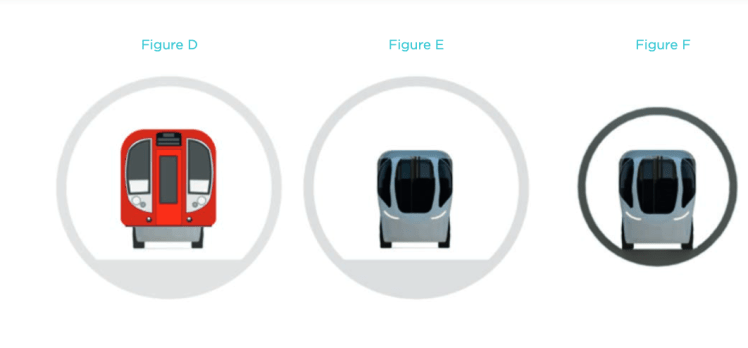
Above – AVRT Report by Cambridge Ahead / GCP / Cambridge University (2017) p12-13 / p7pdf
This reminds me of what Dr David Cleevely said in this excerpt in the Cambridge Independent (02-09 July 2025) in an interview with Mike Scialom – screengrabbed from my paper copy.

As Dr Cleevely mentioned, Dr Nik Johnson scrapped the scheme when he became mayor. One of the reasons for this was because of the four year terms of office. Where Mayor Nik Johnson was coming from was from a part of the county where bus services were few and far between. Furthermore, he had issues with value for money.
“I want to start my term as mayor with a clean sheet and consider all transport options with a fresh eye. This project has all the hallmarks of being an expensive folly and a potential blackhole for national and local government finances.”
Dr Nik Johnson to Construction News, 11 May 2021
Hence why he focused what little time and money he had on trying to revive the lost bus services – in particular from Huntingdonshire where he was a former councillor. (Hence it being the starting point for the Tiger Bus service).
When the proposals in the AVRT Report were published in the Cambridge News in early 2018, Josh Thomas, the then Local Government Correspondent went to town on it – with the editors and headline writers going for the jugular over the proposed design of an underground bus interchange. A year later a second report going into the numbers and architecture was published – you can read it here.
“So, who was to blame for lots of expensive being done by consultancies and officers, and nothing being built?”
George Osborne as Chancellor. The buck stopped with him for signing off such a ludicrous plan that created so much confusion and overlapping competencies that the whole thing was already imploding only a few years after the GCP got going. Because by that time his party’s candidate for the CPCA mayor (an institution which still feels like it was written on the back of an envelope) was selected, it was already clear that there was going to be a turf war *within* the once mighty Cambridgeshire Conservative Party. As it turned out to be. Sound public policy – and ministerial responsibility should involve creating stable institutions that can withstand reasonable party political change both locally and nationally. This was clearly not the case here.
“So…now where are we?”
Still facing the same problem that the AVRT illustrated with the diagram below some eight years ago:

Above – AVRT Report (2017) p26 / p14pdf
The Chatteris Reservoir and suburban rail
The Director’s Highlight Report covers this in para 3.4 as part of the Wisbech-March rail link proposals. The original assessment that only explored a short shuttle link between the two Fenland towns inevitably came up with a very low Benefit-Cost-Ratio. But no one was talking about extending that line towards Chatteris, Ely, and onto Cambridge other than me and a few other public transport campaigners. When the Wisbech-March options appraisal report was published in November 2024, I wasn’t the only one that was scathing of it.

Above – “Wisbech Rail needs to be integrated into a bigger project”
…so I wrote, quoting Dr Andy Williams, one of Astra Zeneca’s main consultant advisers.
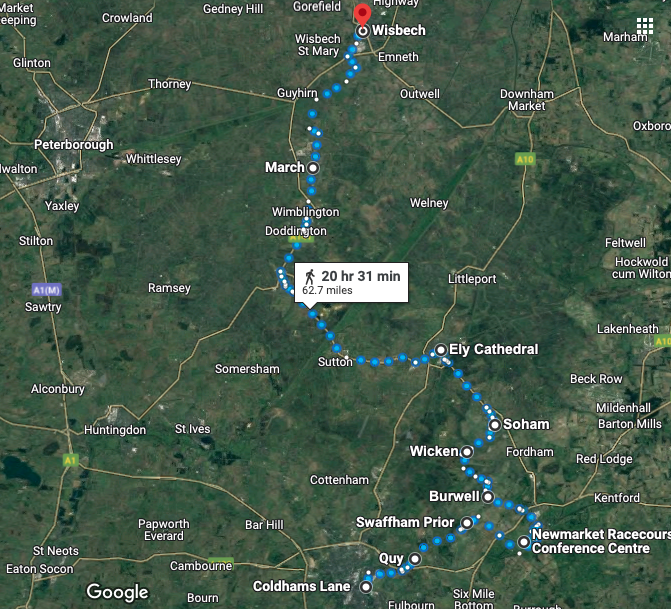
Above – from October 2022 where I pondered how a new route could link up Chatteris (where we know the new reservoir will be built) along with the visitor centres of Wicken Fen and Newmarket Racecourse.
The cheaper route for the above would simply involve following the Ely-Soham-Newmarket-Cambridge rail line via the reconstruction of the Newmarket Chord. But thinking ahead, I went (in this case) with the option of creating new rail routes to some of the villages on the old Cambridge-Mildenhall line while at the same time creating public transport access to Wicken Fen and the Newmarket Racecourse & Conference Centre.
The Wisbech-March report seems to have picked up on things that I’ve been blogging about for years. Which is splendid!
The game-changer in the thinking behind the Chatteris Reservoir was the intervention from ministers who take the view that the time-scales are far too long. Hence the ministerial announcement on 29 May 2025 here. Although ministers over-egged the pudding with their wording:
“In a significant intervention to speed up delivery of much-needed reservoirs, the Environment Secretary Steve Reed has seized control of the planning process to build two major reservoirs for the first time since the 1990s.”
The initial proposals always assumed that the decision for the reservoir was going to be taken by ministers anyway – as I wrote back in September 2021
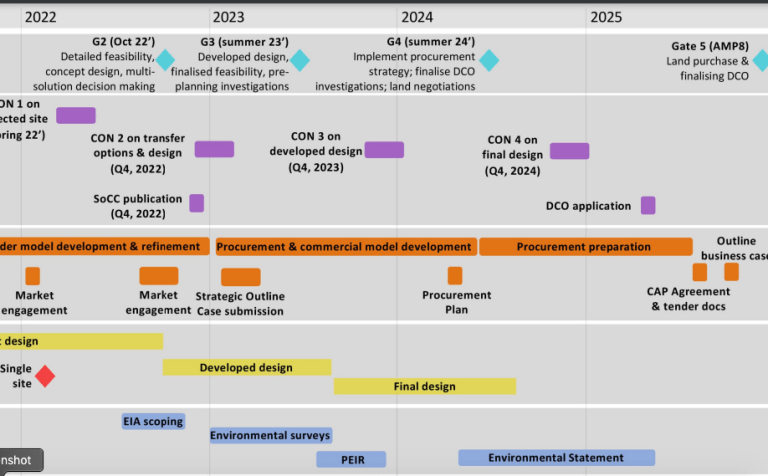
Note the anticipated ‘DCO Application’ on the right hand side in purple. Development Consent Order anyone? But then hey, why turn the door handle and push when you can smash down the damn thing in spectacular fashion?
Anyway, the two things the CPCA are actively considering are:
- Proposed Reservoir and Visitor Destination: This major new tourism and leisure development could significantly boost visitor numbers and year-round footfall. Improved transport links, including sustainable rail or light rail access, would be critical to ensuring the site’s success and maximising its contribution to the local economy.
- Improved Regional Rail Links: Enhancing connections between Wisbech, King’s Lynn, and Peterborough would improve access to jobs, education, healthcare, and services, stimulating wider economic activity and reducing transport inequalities.
Above – CPCA Report Item 8 Director’s Report, p3 in para 3.4
Rail links were not included in the proposals from Anglian Water. It will be interesting to see how these can be incorporated alongside building new rail infrastructure in Fenland. This was something I looked at before when asking about a new ARU School of Dentistry in Peterborough – proposing a location by the railway station.
Below – from the New Adlestrop Railway Atlas (updated 2024)

Above – you can see the old rail links pre-Beeching cuts. Much of the old March-Chatteris-Somersham line has since been turned into the A141. It would take a very bold politician to convert it back!

Above – you can see the line of the old Cambridge-Huntingdon railway which if you remember was meant to go all the way to Hinchinbrooke Hospital.

Above – the original guided bus proposals from the first county council newsletter from over 20 years ago.
So there are still some transport options to play with!
If you are interested in the longer term future of Cambridge, and on what happens at the local democracy meetings where decisions are made, feel free to:
- Follow me on BSky
- Spot me on LinkedIn
- Like my Facebook page
- Consider a small donation to help fund my continued research and reporting on local democracy in and around Cambridge.

 The Cambridge Town Owl