Mr Ben Obese-Jecty MP (Cons – Huntingdon) contested the proposed overhaul of local government in Cambridgeshire in a Westminster Hall debate, forcing the Minister for Local Government, Mr Jim McMahon MP (Lab – OIdham West…) to reply for the Government
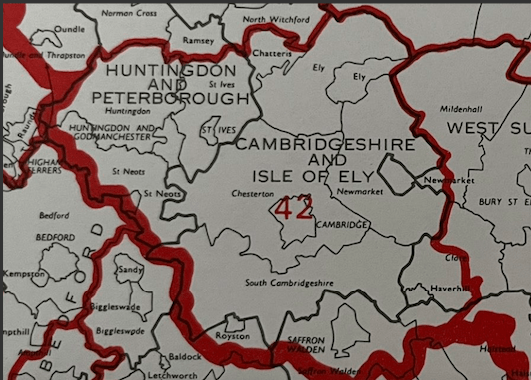
Image – abandoned proposals for a Greater Cambridge Unitary from Redcliffe Maud’s report of 1969
You can watch the debate here, chaired by former Cherry Hinton councillor Graham Stuart, who was the Minister for Climate Change in the last Conservative Government. You can read the transcript in Hansard here.
The Government’s overhaul of local government in England.
I’ve long been of the view that overhauling local government in England needs something on the scale of the Redcliffe Maud Report 1966-69, which was in the form of a Royal Commission that took three years to collect its evidence and report back. (You can see the digitised documents here)

The proposals in Redcliffe Maud above would have been my starting point for negotiations had the previous government carried out the recommendation made by the Public Administration and Constitutional Affairs Committee back in 2022 – one that had a Conservative majority, mindful that select committee MPs drop their party allegiances in select committees.
In the grand scheme of things, Mr Obese-Jecty MP made a decent case for the concerns he raised.
The problem that both him and the former Defra Secretary Steve Barclay MP (Cons – Fenland) face is that their party should have put in place the mechanisms for a new Royal Commission or similar as recommended by their fellow party MPs. Furthermore, such was the very public disintegration of the Conservatives in the last Parliament (as reflected in the 2024 General Election result where they somehow managed to lose North West Cambridgeshire – a safe-as-military-fortresses blue seat to the now former Chesterton councillor Sam Carling MP representing Labour.
“That doesn’t make the problems raised by Mr Obese-Jecty go away though”
One of the most effective things he did was to seek input from all of the councillors at Huntingdonshire District Council, and the county councillors in the Huntingdonshire divisions. As a result, he was able to quote from all parties and independents.
“Among all these voices, Huntingdonshire local voices seem sidelined at best, if not ignored at worst.”
Above – Ben Obese-Jecty quoting Cllr Dr Alex Bulat (Labour – St Ives South & Needingworth), Hansard 08 July 2025, 11.19am.
One of the lessons learnt from Redcliffe-Maud was to ensure the reforms could be done in a single Parliament rather than assuming/hoping you win the next election. Harold Wilson lost the 1970 General Election and by the time he was returned in 1974, Sir Edward Heath’s Government had brought in the system that in Cambridgeshire at least, we are broadly familiar with today. Such was the state of the country in the mid-1970s with the oil price shocks and industrial discontent that the last thing it needed was another protracted round of local government reform at a time when Labour’s majority was small and the death rate of MPs was so high that, as happened, the by-election losses ultimately cost the party dear.
“…a new funding system will be implemented in the 2026-27 financial year, with fundamental changes in the needs distribution, council tax equalisation and, crucially, a business rates baseline reset. It is therefore essential to model the proposed options on these forthcoming changes in order to understand how they will impact each unitary in 2028. Initial independent modelling suggests that Cambridge city council may lose 25% of total resources and South Cambridgeshire district council 35%—combined losses of £18 million due to the baseline reset.”
Above – Ben Obese-Jecty MP (08 July 2025)
Because local government finance is so complicated, it’s very difficult to work out what the actual impact of the proposed changes are going to be. To figure it out yourself you need:
- The knowledge of public administration to know where to find the data in an era where hardly anyone is taught citizenship/civics to a level where you might want to look for it
- The maths/accounting skills to crunch the numbers
- The time to crunch the numbers
- The desire to crunch the numbers
- The means by which to communicate your results – and also having an audience willing and able to publicise said results.
Which is why I thought it best to wait until council officers and councillors had done the hard work
“Other than ‘A Lot’, how much is 25% of the city council’s resources?”
The annual budget consultation for 2025/26 for Cambridge City Council helps us out.
“We currently spend £97.2 million per year to deliver services in Cambridge (of which £26.2 million is received from Government and passed directly to Housing Benefit recipients). Due to factors largely outside our control, these operating costs are rising.”
Above – Budget Consultation 2025/26, Cambridge City Council
Round it up to £100million and you’re looking at a cut of £25million. Given that just over the same sum goes directly to housing benefit recipients, that doesn’t leave much for the municipal council to spend on ‘the world’s greatest small city’. Which is why I said in my previous post following the Transport Secretary’s refusal to fund the Ely & Haughley Junction rail improvements, the Chancellor really should be pressed to enable councils to have much wider and deeper independent tax raising powers so that more affluent parts of the UK can tax their excess wealth and use the revenue to pay for things without needing to worry about ministerial approval. That way the Chancellor could then redirect central funds to those areas that lack the economic base from which to raise revenue.
What happens if ministers don’t do this? Then services for those in most need are cut.
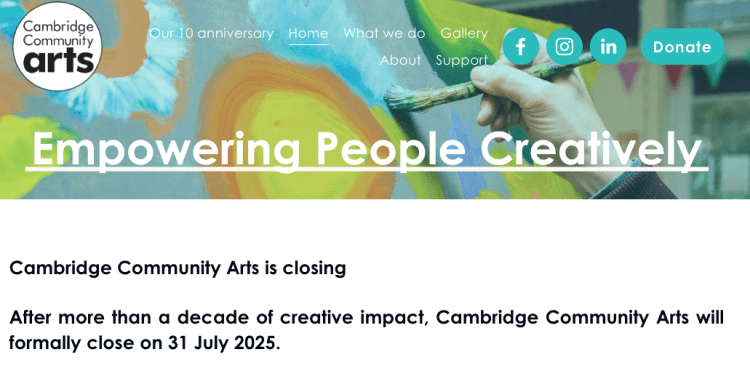
Above – a soul-destroying decision but one in which Cambridge Community Arts had no choice because of austerity and because of the collective failure of Cambridge to develop a significant philanthropic culture within its affluent circles to keep such important components of our civic society going.
There’s no one person who is to blame just as much as the decision to wind up Cambridge Community Arts was not something that was a bolt of lightning from nowhere. Things like this are a very long time in the making. So enfeebled and underfunded is local government in and around Cambridge that we struggle to get the basics properly resourced. Which is why we can’t have nice things.
Cambridgeshire’s over-complicated local governance structures.
Fenland’s Steve Barclay MP picked this up. In his early days he was a half-decent scrutiniser on the Public Accounts Committee but then went and threw it all away in ministerial office! (Again, my view is that legislature and executive should be separate – both being an MP and being a minister are more than full-time jobs, and as Cambridge is finding out the hard way, having your local MP as a Minister means you become one of the one-in-six constituencies that are short-changed by the system. Anyway, Mr Barclay said…)
“In Cambridge, there is the Greater Cambridge Partnership, which covers transport. Also in Cambridge, there is the metro Mayor of Cambridgeshire and Peterborough, who covers transport, too. Cambridge city council and South Cambridgeshire district council also cover transport. The Oxford to Cambridge authority is looking at the rail link between the two. There are so many different bodies dealing with transport into Cambridge.”
Above – Steve Barclay MP (08 July 2025)
Or as CamCycle illustrated, the diagram below.
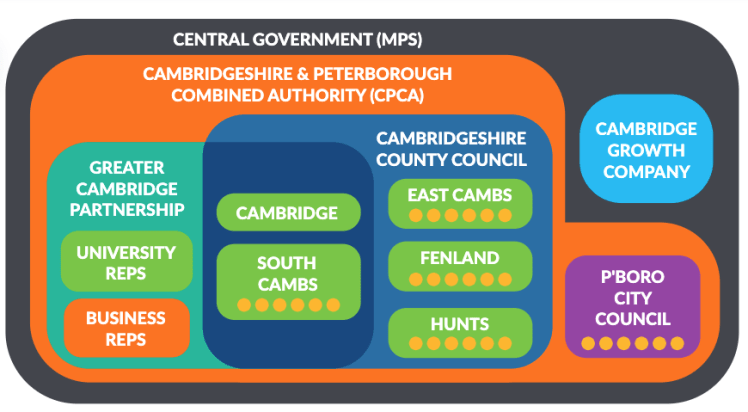
The problem for Mr Barclay? His party in government established these structures.
Citizenship education for adults
Finally, I remain of the view that not nearly enough of the voting population know the essentials of politics and democracy in the UK to be able to make an informed judgement on local government reform. They didn’t in the EU Referendum (irrespective of which way they voted) because ministers never made the effort to educate the public about how the institutions functioned and malfunctioned.
Lifelong learning in the UK: the need for adult citizenship education
The case is made by Qasir Shah of University College London here. If there are any MPs or peers watching, please submit that report to ministers and ask them for a formal response to the recommendations in the paper. Only Labour used to be red hot on adult education and lifelong learning – especially on things like democracy and social reform as one of their first ministers Arthur Greenwood wrote over 100 years ago before he became a minister.
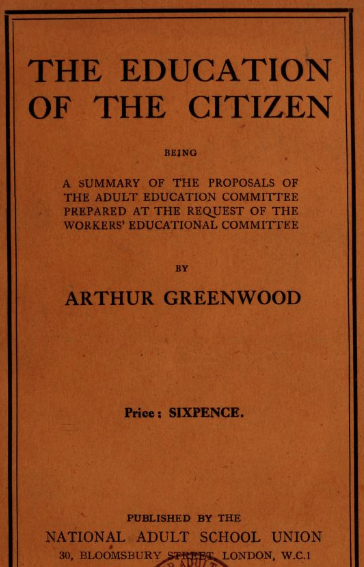
Above – The Education of the Citizen, 1920 – for the Adult School Union – it would be almost another decade before universal equal suffrage was won.
Given the threats to democracy, could the overhaul of local government include democracy refreshers – and introductions for those of us adults never taught about it in the first place?
If you are interested in the longer term future of Cambridge, and on what happens at the local democracy meetings where decisions are made, feel free to:
- Follow me on BSky
- Spot me on LinkedIn
- Like my Facebook page
- Consider a small donation to help fund my continued research and reporting on local democracy in and around Cambridge.

 The Cambridge Town Owl