Or to give it its full title: The English Devolution and Community Empowerment Bill. And it’s very complicated
You can read the Bill documents here, although you will get more sense of what ministers want from it from the explanatory notes. See also the Local Government Association’s briefing here.
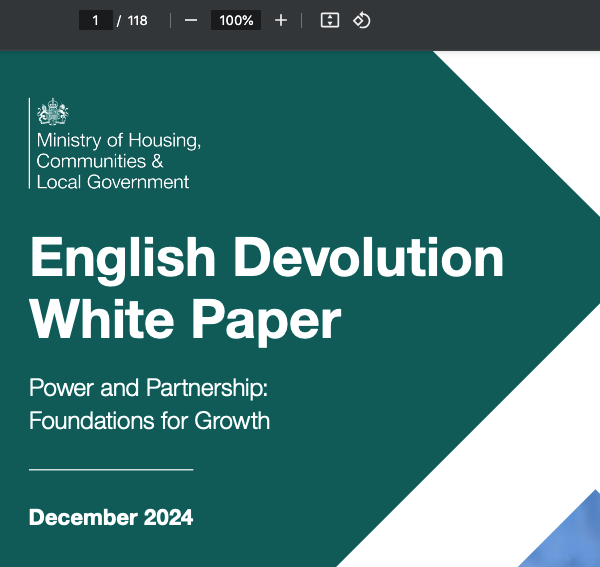
What the Bill does is put into law the policy statements made in the English Devolution White Paper of December 2024, which I wrote about here. White papers are formal statements of Government policies in a specific policy area, that are presented to Parliament. They also act as signals to affected persons and institutions to make preparations for the changes being brought in.
The complexity of the Bill concerned – with so many amendments to existing laws (four pages of titles of Acts of Parliament!), reflects why I preferred having a much wider Royal Commission on Local Government (like the one chaired by Lord Redcliffe-Maud 1966-69) This is what the Public Administration and Constitutional Affairs Committee of the previous Parliament effectively called for back in 2022 which were set out in:
We’ve had half a century of changes to the structures of local government brought in back in 1974 that we are long overdue a complete overhaul. The English Devolution Bill does not do this. The reasons include:
- Ministers have put far too many restrictions on what changes can be made – mainly in the name of expediency in order to get the changes in place before the next general election
- The Treasury is still digging its heels in over the prospect of any new independent revenue raising powers for local and regional tiers of government in England.
The centralisation of the governance of England – by former Communities and Local Government Secretary Prof John Denham
I worked in the department during Prof Denham’s short tenure (ten months) in post, which meant that his ideas on Total Place never got the chance to get off the ground before George Osborne and Eric Pickles crushed the local government sector with a reckless programme of austerity.
Prof Denham wrote that England’s centralisation evolved through four dimensions.
- First, following [Leon] Brittan [as Chief Secretary to the Treasury 1981-83] and [Margaret] Thatcher, the central state has tightened its grip on public spending, seeking both to control its levels and how money is spent.
- Second, the autonomy of local government to raise local revenues has been weakened through central controls on council tax and on leveraging the use of assets.
- Third, large areas of public service provision that were once the responsibility of the local state have been removed from local democratic control or influence. The merit of increasing transfer of democratic power from local to central in this way has never been examined.
- Fourth is the reduction of local democracy and the concentration of local power in fewer hands. The next wave of reform is now grouping local authorities into mayoral combined authorities.
Above – John Denham in Centralised by design, 21 Nov 2024
The main themes of the legislation
The policy titles in the explanatory notes [see p2 here] are:
- Devolution structures
- London
- Duties and Powers
- Strategic Authority [i.e. Combined Authority] Reforms
- Local Government Structures and Accountability
- Communities
The functions that the Cambridgeshire and Peterborough Combined Authority will take control of will include:
- Transport and local infrastructure
- Skills and employment support
- Housing and strategic planning
- Economic development and regeneration
- Environment and net zero
- Health, wellbeing and public service reform
- Public safety.
New policy commissioners appointed by mayors of strategic authorities
The significant growth in functions and duties (and presumably funding grants from central government?) is accompanied by a new role of appointed commissioners.
“A mayor may appoint up to seven commissioners to act as leads in relation to the seven areas of competence.” [LGA (2025) Clause 9]
It will be interesting to see how the appointment arrangements work out. Looking at the legislation, it looks like the Strategic Authority’s Overview and Scrutiny Committee (In our case, the CPCA’s O&S Committee) would carry out the public confirmation hearing where committee members cross-examine the commissioner nominated by the Mayor, and make a recommendation to the Combined Authority Board as to whether to confirm the appointment or not. The details however, are dependent on any secondary legislation ministers table in Parliament following this Bill’s enactment (i.e. when it becomes law) *and* on any guidance that ministers publish, telling Strategic Authorities the processes they are expected to go through.
What this means in effect is that the current CPCA Mayor Paul Bristow in the existing structures for Cambridgeshire and Peterborough would not be able to appoint party-political allies into posts that lacked the experience and competencies needed for the job because he does not have a party political majority on the CPCA Board. Therefore he has the options of appointing a non-party-political type [unelected bureaucrats anyone?!?] to the posts, or simply not appoint separate commissioners, and keep all of the roles ‘in house’.
The advantage of having appointed commissioners is that for really complex policy areas that a mayor has little policy experience in (or perhaps little interest in at all), they can nominate someone who has both and is also trusted by the mayor to make a good job of it. That also means that responding to detailed scrutiny of the policies is carried out by someone else. The disadvantage is that in the mind of the electorate, they might see such a post as ‘outsourcing responsibility’. Sort of ‘contracting out’ so to speak. This wouldn’t be a problem if society had much higher rates of political literacy and civic engagement. But we don’t.
Regulation of e-scooters
The Bill brings in new powers for ministers to make regulations about renting e-scooters and vehicles that fall under the definition of micromobility vehicles. The law change effectively adds a new body of law to the Road Traffic Regulation Act 1984.

Above – Schedule 5 of the English Devolution Bill as introduced in the Commons
The licensing authorities for the e-mobility vehicle schemes will be the Strategic Authorities (i.e. the CPCA for Cambridge).
Again, it is drafted in such a way that we won’t know the details until the secondary legislation and departmental guidance is published.
“What about privately-owned e-scooters?”
“The UK remains the last major European economy where e-scooters are still banned to use anywhere except on private land and their use on UK roads is currently illegal. That is still a matter of surprise to many, as we see the numbers grow on our streets alongside the Department’s permitted rental trials.”
Huw Merriman, then Chair of the Committee, 02 Oct 2020
Nearly five years later and we’re still nowhere near. It remains to be seen what the current Transport Secretary proposes – only new legislation is long overdue.
A few other things that might affect Cambridge and the Government’s growth plans
- Mayoral Development Corporations – will the Cambridge Growth Company be established as a development corporation under the oversight of the Mayor, or will it report directly to ministers? (See the IfG’s briefing here)
- Mayoral duties to collaborate [with other mayors]. This will be interesting when it comes to the structures for Hertfordshire, Essex, and Norfolk & Suffolk Strategic Authorities – all of which are a decade or so behind Cambridgeshire and Peterborough. This matters for the market towns over the county border such as Haverhill, Newmarket, Royston, and Saffron Walden, all of which are within ‘light rail’ reach.
- Skills and education functions get a mention but in the grand scheme of things these are feeble, minuscule, and cover a very specific cohort of the population rather than wider and more general adult education.
- Tourism – as the LGA guidance states, Clause 40 “…extends the powers currently available to local authorities over encouragement of visitors and promotion of visitors, and power to facilitate provision for entertainment, dancing, premises suitable for entertainment, maintenance of a band or orchestra, and promotion of the arts to CAs and CCAs.” [Does that mean we can get a new large concert hall?!?!]
- Community Infrastructure Levy – Clause 33 – part of a pattern of empowering strategic authorities with powers that local councils already have. This also co-ordinates with some additional powers to aid strategic planning functions. Note the Bill also requires local councils to comply with the new local transport plans
- Public health and health improvement duties – Clause 43. This will be interesting to see in the context of the CPCA Mayor’s proposal to remove the restrictions on Mill Road Bridge. There are a host of existing restrictions in current and proposed legislation that effectively blocks him from doing this unilaterally. One other obstacle is health improvement. If the evidence shows that removing the restrictions would worsen the health of local residents, that alone could be enough to scupper any plans.
- Unitary councils – Part III of the Bill empowers the Secretary of State for Housing, Communities and Local Government to push through with the restructure of local government in England by removing a number of existing legal obstacles. The main one is that it creates a new power to direct two-tier areas to come up with proposals to create a single tier authority – a process that most are going through anyway, although some local councils have not followed the guidance correctly and/or are not co-operating with neighbouring councils.
In the grand scheme of things this is really heavy, dense policy stuff – and much of it will inevitably go over the heads of the public simply because of the huge amount of background reading needed to make sense of it
Which is one of the reasons why I think a nationwide programme of civic/citizenship education for adults should be developed and delivered alongside it given that the whole process is going to take several years before it is complete.
Food for thought?
If you are interested in the longer term future of Cambridge, and on what happens at the local democracy meetings where decisions are made, feel free to:
- Follow me on BSky
- Spot me on LinkedIn
- Like my Facebook page
- Consider a small donation to help fund my continued research and reporting on local democracy in and around Cambridge.

 The Cambridge Town Owl