A co-sponsored motion for next week’s full council meeting concludes that of the options available, the existing Greater Cambridge Partnership boundaries (i.e. South Cambridge District *including* Cambridge City Council in the middle) is their preference
You can read the meeting papers here
“That a unitary authority based on the current boundaries of Cambridge City Council and South Cambridgeshire District Council, alongside viable arrangements for the rest of Cambridgeshire and Peterborough, is likely to be the best option for the residents of Cambridge.”
Agenda Item 10s of Full Council 24 July 2025
The options considered
Below from the agenda at item 5. The pictures are from page 6 of the officer’s paper.
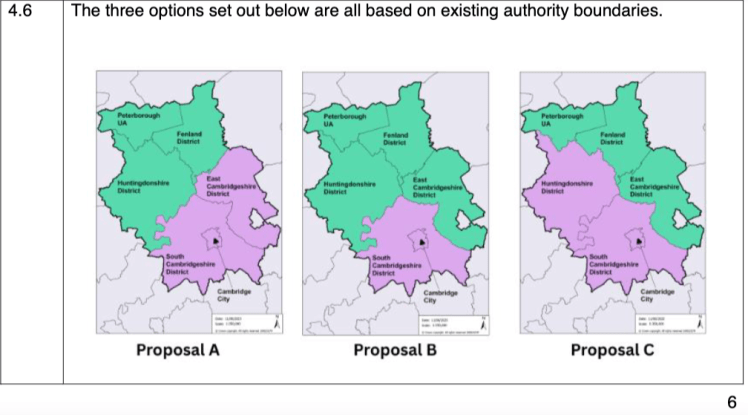
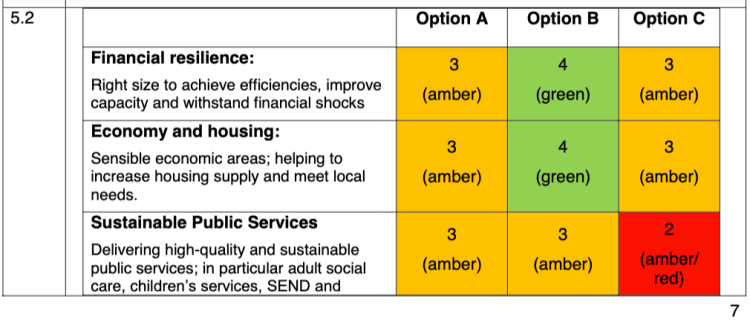
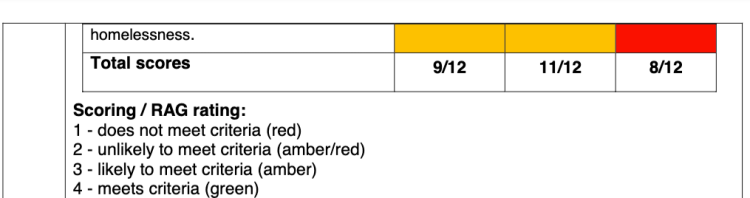
As council officers, they have to go with the evidence and the instructions issued alone. In this case, the parameters of local government reorganisation are set by the Minister for Local Government, Jim McMahon MP. That guidance said that councils had to come up with proposals for the boundaries of new unitary councils *based on existing district-level council boundaries*
This rules out the sort of overhaul that the Royal Commission on Local Government 1966-69 (The Redcliffe-Maud Report) proposed. One of the main reasons for this is the very short timetable for the reforms. The reason why the Redcliffe-Maud reforms were not implemented was because Harold Wilson’s Labour Government (which launched the Commission) ran out of time to implement it – and lost the subsequent general election in 1970. The Conservatives under Sir Edward Heath put forward their proposals in 1972 with a launch date of 01 April 1974.
Combined Authority Board meets – with little content on light rail in the papers
You can read the papers for 22 July here
Item 10 is the Chief Executive’s Highlights Report which summarises who has been doing what over the past few months. Linked to the overhaul of local government are the proposed new legal powers and responsibilities that the English Devolution and Community Empowerment Bill contain for Combined/Strategic Authorities.
“The Bill also outlines a range of additional powers for Mayors, including:
- New licensing powers for rental e-bikes
- Enhanced planning powers to set the direction of growth across their areas
- The ability to develop tailor-made Local Growth Plans aligned with national missions
- Streamlined powers to accelerate housing and infrastructure development, including:
- Introduction of Mayoral Development Orders
- Simplified processes for establishing Mayoral Development Corporations”
Above – Agenda Item 10, p3, CPCA Board 22 July 2025
The other two things of note are the failures of the transport funding bids for the Ely Rail Junction upgrade, and the dualling of the A47 in northern Cambridgeshire, one of the least connected parts of the county.
The other thing is the publication of the videos from the UKREiiF 2025 property conference – see the CPCA’s playlist here.
“Nothing on light rail?”
Only a few words in the Local Growth Plan item 12

Above – a diagram from item 12
“There are currently four Enabling Infrastructure Priorities in the LGP Working draft, based on:
▪ Water
▪ Energy
▪ Skills
▪ Rail
These priorities will typically focus on key projects that are of the level of a Nationally Significant Infrastructure Project (NSIP) and can have a genuinely strategic impact on the entire area.“
Above – Agenda item 12, p5.
The problem at the moment is that all of these things are outside of the direct control of the CPCA. Water and energy are privatised, and rail is in the control of the Department for Transport. Skills spending is ultimately within the gift of HM Treasury. With minimal independent revenue raising powers, combined (soon to be ‘Strategic’) authorities remain the delivery agents of central government – and will remain so unless this changes.
Cambridge City Council calls on ministers to enable historic cities that attract disproportionate numbers of tourists to be able to tax the industry
You can read the press release here.
“If tourism in historic cities like ours is to remain sustainable and internationally competitive, we need to be given the means to manage the flow of visitors and to address some of the negative impacts of tourism on local residents, public realm, and infrastructure. Scotland and Wales have these powers now, as do many cities in Europe. We were disappointed not to see anything from Government in the Devolution Bill to provide similar powers in England, as we want Cambridge to have the same.”
Above – Cllr Cameron Holloway (Lab – Newnham) – Leader of Cambridge City Council
Ultimately it will be The Chancellor who decides, but as the Deputy Prime Minister is the most senior Cabinet Minister with local government in her portfolio, she is the first minister to approach on something like this.
“What does Scotland have?”
The Scottish Parliament passed the Visitor Levy (Scotland) Act 2024. Following this, the Scottish Government published this guidance for local councils looking to make use of the new powers. The City of Edinburgh Council ran a consultation which came back with a number of interesting findings – which you can read here. Ultimately, Scotland’s capital city voted to bring in a new levy which will come into force in July 2026. The levy:
- is a 5% payment on the cost of the paid, overnight accommodation. The levy will be charged before VAT and will not be charged on extras like parking, meals, drinks or transport
- will only be charged on the first 5 nights’ stay
- will be charged at the same rate every day of the year, indefinitely, for stays from 24 July 2026 onwards.
The levy will apply to:
- hotels
- self-catering apartments
- aparthotels
- bed and breakfasts
- guest houses
- hostels
- student lets – only when let to visitors and non-Edinburgh students
- vehicles or boats (vessels) which mostly stay in one place
- holiday/short-term lets including residential properties with licenses for
- home sharing
- home letting
- secondary homes
- caravan/camp sites
Above – From Edinburgh’s Visitor Levy website
I can’t think of any reason why local councils – the current or the new unitary councils, should not have similar powers.
Furthermore, I think there’s something to be said for some of the revenues from the levy to help promote attractions outside of the core tourist hotspots in a unitary council area. i.e. for Cambridge, ensuring that promotions for attractions outside of the city are promoted both at major transport hubs, and also for city residents for local tourism.
It remains to be seen how ministers will respond.
If you are interested in the longer term future of Cambridge, and on what happens at the local democracy meetings where decisions are made, feel free to:
- Follow me on BSky
- Spot me on LinkedIn
- Like my Facebook page
- Consider a small donation to help fund my continued research and reporting on local democracy in and around Cambridge.

 The Cambridge Town Owl