The Sing! Community Choir’s summer concert in Cambridge earlier reflected how community choirs can grow and evolve over an extended period of time
It was Katy Roper of the Cambridge Science Centre who recommended I go along to this after we had met at the Cambridge Zero Carbon event (where I think I pleaded with the Science Centre to help lobby for a new generation of science evening classes for adults who either had never been in a modern science lab because their school/college facilities dated from a different era and thus their career choices had kept them away from such places ever since. In the olden days they used to have guides for re-introducing adults to science (like this one from the early 1980s).
The big picture problem is that in my previous profession (public policy), science was all too often seen as something very complicated but which made The Treasury lots of revenue. And all too often, the world of science treated party politics (and thus many things around it) as a world full of liars, frauds, scoundrels and knaves who dealt with manipulating evidence to such an extent that no scientist worthy of the name would have anything to do with such a world. So long as the financial grants kept coming in!
A number of things have happened since then. The first is that a critical mass of people in the world of science has realised they cannot remain separate from the world of politics and public policy – you only have to look at what’s happening over the Atlantic to know that these are not happy times. For them or anyone else it seems. The second is that the artificial divide between arts and sciences is being questioned and put under a level of pressure greater than I can recall in my lifetime.
Most of the scientists I’ve gotten to know in life have been through hobbies involving dance and music – not through public policy or the civil service
Which in itself speaks volumes given that the learning culture in 1990s South Cambridge that I grew up in was very much on focusing early and putting exam success over and above everything else. Which meant that trying to keep additional interests going (especially during A-levels) was very difficult indeed. Hence why I’m still gutted nearly 30 years after the time that we never had the chance to do the equivalent of the English Bacc as recommended by the National Baccalaureate Trust. (See my blogpost here).
All of that contrasts with the work that both Katy and also Mario Satchwell who several of you will know, who work at the Cambridge Science Centre during the day, and are key participants in the Sing! Community Choir in Cambridge, which was founded in the early 2010s. (Mario played a very good drum and percussion set last evening).
Over a decade of performances
You can browse through their video library here – something that is also worth archiving in the Cambridgeshire county archives. I mention this because during his years in Cambridge both as a student and later as a teacher, Brinley Newton-John (Olivia’s dad) sang in many musical performances across Cambridge and District between 1935-53, events that were very well reviewed (as were his singing talents) and not one recording that I know of survives. Although it’s not really his fault that he didn’t know how famous his Cambridge-born daughter would go on to become! Such online video libraries are also records of how community groups (not just musical ones) have changed and evolved over time.
A number of community choirs have established themselves in Cambridge in recent times – to the extent that I wondered if anyone in politics was picking up on this and the collective message it was reflecting. Those of you who get the Cambridge Biomedical Campus’s e-newsletter will know that the Sing! Choir is so popular that they now have a waiting list. They also have that hard-won critical mass of tenors and basses too. (I’m sure there’s a research project waiting for someone to find out why men seem reluctant to join local community choirs!)
‘Climb aboard the Freedom Train!‘
I first stumbled across them as annual participants in the Mill Road Winter Fairs – often at St Barnabas Church opposite Gwydir Street. They then teamed up with Helen Weinstein of Historyworks for a local history project (I think it was city council funded) about the railway workers of Romsey, Cambridge. (Hence the big R near Mill Road Bridge). Helen sent me along to the rehearsals at Coleridge Community College to try out for the performance (until I found that I could not do more than basic choreography and also sing in tune at the same time. It’s a bit like trying to play the piano with both hands doing separate things – my brain cannot cope!)
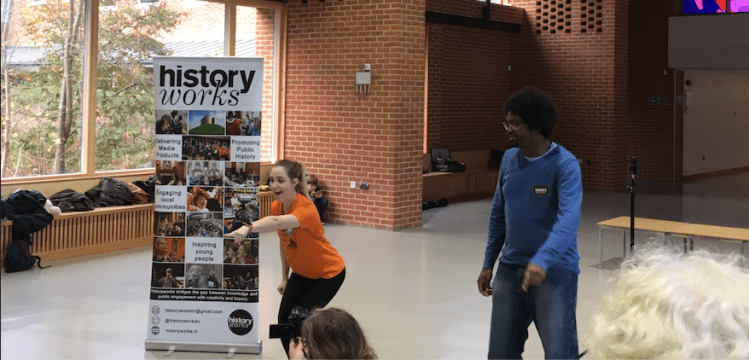
Above – from November 2017, learning how to do musical theatre in Coleridge CC’s atrium
The result of the choreography and singing sessions was a handful of show pieces including the Gospel Freedom Train performed at the Mill Road Winter Fair 2017 at St Philip’s Church – see the video here!
The title and theme of the summer concert was Sunshine in my Pocket.

The event was also a fundraiser for the Clean Shelter charity responding to the horrors of Gaza. Several of the choir having worked with poet Michael Rosen in previous projects also covered the theme of speaking out against human rights abuses, and they incorporated a song co-written by Bethany Kirby of the choir, and Michael Rosen called Our Word, Our World that was commissioned by HistoryWorks and first performed at The Guildhall back in 2020 for Holocaust Memorial Day in Cambridge.
The Guildhall isn’t the only venue with a challenging acoustic!
Credit to the sound engineer because the main hall at Netherhall/Oakes SFC has a ***really poor acoustic***
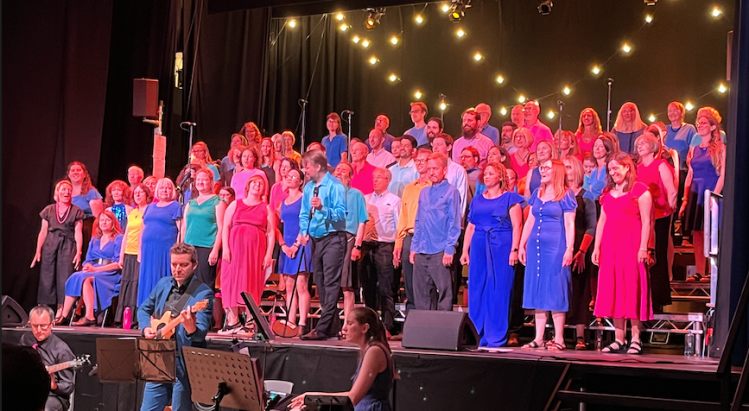
Above – Sing! Choir kicking off with a familiar Bon Jovi number that my older brother over-played in the early 1990s!
Actually, they made a good go of it – band included, not least because of the huge challenge overcoming the terrible acoustics of the hall. (I spoke to the sound engineer at the end).
Could local wealthy firms on the science parks off Fulbourn Road around the corner help pay for a new community theatre for a part of Cambridge that continues to have more homes built nearby?
Given how public funds are, and given the wealth we’re told is generated by the local economy (the venue is just around the corner from ARM’s Cambridge HQ amongst others), those local firms really should be stepping up to pay for a revamp of that hall given that The Leys in Cambridge has this place. A reflection of being one of the most unequal cities in the UK? It’s a long overdue improvement not least because of the range of groups and uses the venue is used for. (I’ve been to public talks, performances, and also have rehearsed in it over the past decade or so).
Meeting the needs and preferences of a diverse audience
There were a couple of other challenges they had to deal with as well. One of them was the inevitable challenge of what to do with very young children in what was a family-friendly event hosted in quite a large school hall on a hot, sultry evening in the middle of a heatwave. No toddler will want to sit still through the whole of the performance. At the same time, there were inevitably people in the audience who found the presence of children dancing/running up and down the aisle and in the space at the back more than an irritation. What’s the solution? (Is there one?)
It’s not simply a case of having a creche or a play zone at the back, just as it isn’t easy to have two separate performances on the same day. In my experience the only way you can make such a set up work is by curtailing the number of songs/length of the performance. Artistically this creates a challenge where music directors want the package of songs and the performances to be greater than the sum of their parts.
Not being in familiar company while being CFS/ME’d up to my eyeballs
In previous lifetimes I’d often be a social butterfly in situations like this, but during the interval where most of us went outside, I found myself in a strange situation where I didn’t know anyone, although I recognised a few faces from people who you either see at similar sorts of events over the years, or perhaps might pass down Mill Road. So I spent most of the interval sitting there ‘people-watching’ as I often do at similar events when in that condition. A few other community activists and local residents have mentioned to me that from this autumn they want to make more of an effort to go along to more local events that they otherwise don’t normally go along to – recognising that over the past couple of years we’ve lost some significant pillars of our communities. This was also reflected in the concert that evening when it was announced that one of the leading musicians in the band was leaving Cambridge to return back to France. The challenge of running any voluntary or community group in a city with a high population turnover – perhaps a little easier in Cambridge compared with other places?
Cambridge’s ageing civic society institutions
The choir has a younger age profile compared with many similar community choirs in Cambridge that I’ve seen/heard over the years. The same goes with many of the campaign groups who are engaging in the big consultations about the future of our city. As I mentioned in this blogpost following the launch of a new community choir in North Cambridge, I suggested that the challenges are structural and are related to the huge inequalities that disproportionately penalise younger adults on lower incomes. Not least because community groups all over the city are more than aware of the lack of younger adults involved in their activities and movements. I.e. the scale of the challenge is beyond the resources of small community groups.
Community engagement for young adults moving to the city because of work
Listening to a couple of people in their 20s over the weekend who moved to Cambridge in recent years, they told me that unless you are part of ‘The University’ there is little sense of community. Hence why they told me they had moved out to surrounding towns/villages which are more pleasant. Without wanting to fall down a housing policy wormhole, this in part is one of the reasons why I’ve tried (without success) for over a decade to persuade the city council to co-organise a Cambridge Societies Fair – a bit like a Freshers’ Fair that universities have, but for town and county societies that on an annual basis bring as many people to and groups together in the same place at the same time to find out what is available. It’s also why as local government is overhauled, we ensure that increasing social capital is part of the debate. Because it’s hard to avoid the conclusion that while some gain handsomely from the sci-tech and property bubbles, our civic and social capital has been hollowed out. And that is unsustainable.
If you are interested in the longer term future of Cambridge, and on what happens at the local democracy meetings where decisions are made, feel free to:
- Follow me on BSky <- A critical mass of public policy people seem to have moved here (and we could do with more local Cambridge/Cambs people on there!)
- Like my Facebook page
- Consider a small donation to help fund my continued research and reporting on local democracy in and around Cambridge.

 The Cambridge Town Owl