
…stated the WEA [Formerly the Workers’ Educational Association] in response to the community cohesion report: The State of Us. At the same time, the More in Common group published their report: Shattered Britain. What are the risks to community cohesion in our polarised city, and what are the limited policy options for local government?
- Read The State of Us here, which was produced by The British Future & Belong Network.
- Read Shattered Britain here, by More In Common
But before you do so…
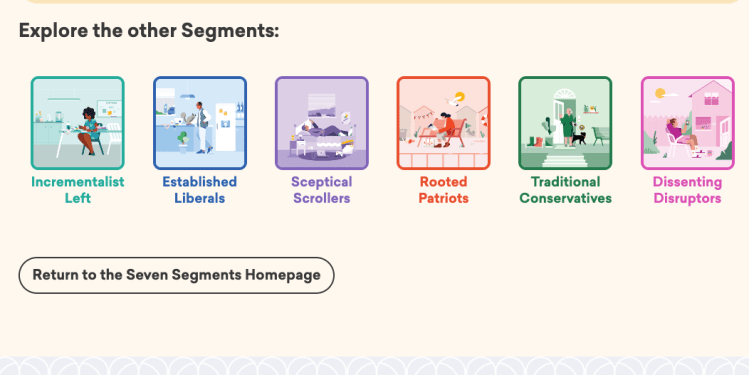
Take the quiz!
They don’t store your responses, and you get to find out which segment you most align with.

Above – which segment are you?
Apparently I’ve not changed since my University days in the early 2000s.

“What were the other categories?”
Above – **I see myself as more of an intermediate actually!**
“What are progressive activists like?”
If they are anything like me they are completely nuts – out of control.
“They are more likely to have spent time in higher education: 46 per cent have degrees and a fifth have postgraduate degrees. Their level of education means that many Progressive Activists have high incomes, but because very few of them own a home and many of them are in student debt, they are a lower wealth segment.”
Above – More in Common report on Progressive activists
“Who is at the other end of the spectrum/matrix?”
The TeamNigellists.
“The Who?”
The dissenting disruptors of which there are an estimated twice as many.
“And what do they do? Or think?”
“Older members of this group might tune into [#GBeebies], whereas the younger members are more likely to use social media and internet platforms such as YouTube, where they might hear directly from politicians such as [TeamNigel himself]. Many avoid mainstream news entirely, seeing it as biased against people like them.”
Above – More in Common on dissenting disruptors
Actually, this relates to what the leader of the Liberal Democrats, the former Energy Secretary Sir Ed Davey told the BBC about their failure to scrutinise critically ReformUK politicians in current affairs broadcasting.
Furthermore, there are few terrestrial TV shows aimed at the mass market that can use satire effectively to make serious points. I’ll leave you to be the judge of the song below from a decade ago.
Above – Newzoids with Nigel as an ordinary bloke.
“What does the WEA state about the Government’s policies?”
First, the results of their survey:
- 88% WEA learners meet people on our courses they wouldn’t usually meet, with 64% meeting people from different backgrounds
- 87% WEA learners reported gaining skills that could help them in voluntary work – volunteering being one of the main ways of strengthening relationships between people
- 47% WEA learners said they felt less isolated & more socially connected
That top stat is huge – which is why the decline and collapse of the once buzzing WEA network in Cambridge is a civic tragedy.

Above – see that county-sized hole? – from the WEA here:
Even as late as 1999 there was still a significant program in our city – something I wrote about in Lost Cambridge here.


Above – from the Cambridge Evening News 08 Dec 1999, p64 via British Newspaper Archive.
Note the venues – schools, museums, and civic society institutions with their own premises.
“And yet adult education budgets are being slashed. What funding remains will be directed towards narrow work-based outcomes, leaving the future of courses that best support people to learn together, make friends and share their new skills and knowledge with their family and neighbours at risk.”
Above – WEA 16 July 2025
Which is what I’ve been saying for years. And not just me.
“Cambridgeshire has a diverse and dynamic economy. It has a strong global profile and it is also functioning as a hub of the economy in the East of England…Within the labour market, skill shortages are becoming an increasing impediment to realising investment in the area, particularly in construction, health, education and other public services. In addition, there remain large numbers of the population locked into low paid employment often involving long hours of shift work with little prospect of career progression or personal improvement.”
Cambridgeshire’s Local Area Agreement 2006-2009, p52, in Cambridgeshire’s lifelong learning offer is still far too narrow, 11 Jan 2025
The rot started in the early 1980s
Despite the efforts of the old Advisory Committee for Adult and Continuing Education and others, the sector was hit badly by Thatcher’s austerity – the committee itself being disbanded.

Above – Protecting the future for Adult Education (1981) ACACE digitised here
There were hopes in the late 1990s for a renaissance when The Learning Age policy paper was published by new Education Secretary David Blunkett – the now Lord Blunkett was the minister that brought back citizenship education into the National Curriculum. Today? Towns and cities across the country are reaping the the bitter harvest of decades of public policy failures to invest in adult education and lifelong learning.
“Community strength and cohesion are about people living well together. Social relationships, sometimes described as social capital, is the thread that links community strength and community cohesion.”
Living well together implies some sort of interaction. As I mentioned in recent blogposts, outside of University circles this is not happening nearly as well as it should be in/around Cambridge. The State of Us cites three types of relationship building.
- Bonding relationships – of people with similar characteristics, citing people who:
- live in close-knit communities,
- work in labour-intensive workplaces
- share a similar class, religious, and/or ethnic background (and collective life experiences?)
- Bridging relationships – of people with different characteristics. Back in 2016, Vaughan-Alicia Watts of PWC wrote about how their annual PWC Panto helped bridge those gaps (especially social class) within large institutions
- Linking relationships – between people and institutions, especially those that make decisions that affect people’s day-to-day lives. Again, this is where citizenship education is important.
Why the failure to empower local government in Cambridge has made it harder for the above-relationships to develop
I concede that this is anecdotal and could not be much more than a prompt for further investigation by academia or public policy institutions. But here goes.
- The chronic housing crisis in Cambridge combined with the huge house price to salary ratios in the city makes it very difficult for all but the wealthiest to buy houses in the city. As a result, Cambridge’s residential neighbourhoods have seen homes on residential estates:
- bought up by Air BnB landlords
- private colleges for student accommodation
- private investors for short-term lets
- The rise of insecure working arrangements – zero hours and fixed term contracts
- Few people will want to invest time and effort into a home/neighbourhood that they might have to move out of at the end of term/year/contract
- Few people will want to put down roots in a place they may have to move out of at short notice
- People in rented accommodation in a city with a high cost of living are less likely to have the disposable income to fund a social life – which then has a knock on impact on local businesses and the wider city economy
- Lower levels of civic and political participation from those least able to afford to live in Cambridge, reflected by
- Lower levels of voter turnout (60% in 2024, the second lowest in Cambridge’s electoral history for general elections since universal equal suffrage)
- Greater difficulty in maintaining civic society institutions and community groups
- Greater difficulty in finding volunteers and active participants to help communities become nicer places to live
- Increased risks of anti-social behaviour, crime, and more because of declining levels of trust between residents and institutions with legal responsibilities to enforce the law
Ministers seem to have forgotten some of the lessons learnt from their predecessors in Gordon Brown’s Government
One of the big lessons Prof John Denham of the University of Southampton learnt when he became the Secretary of State for Communities and Local Government was the limits of central government when it came to managing local government. Or rather, that was something his predecessors had learnt from trying to micromanage everything through big spending, paperwork-heavy centrally mandated programmes. Hence during his short tenure he brought in the concept of Total Place – something he has been lobbying the current government to bring back.
“The basic idea is very simple. In any part of the country, there’s public money being spent now. It might be on the police service, the prison service, probation, health, social security, schools, your local council services. But nobody ever really takes a look at all of that money and says, are we using it in the best possible way?”
John Denham to Jess Studdert of New Local, 31 Jan 2024
You can see Prof Denham’s latest blogposts here
It doesn’t feel like local government in and around Cambridge is in a position to manage the risks of declining social cohesion
Despite the efforts of the Liberal Democrats in Cambridge with their petition here, anti-social motoring – in particular the use of vehicles with unlawfully-modified engines remains an issue.
As for cycling, the cost of cycle thefts in Cambridge is huge – with CamCycle estimating in 2020 that the city took a £3million hit from such crimes. For a city with a high population turnover – inevitably involving lots of people moving into the city as well as leaving it, bike theft is hardly going to make new arrivals think highly of the city. Quite the opposite if they have bought into the dream that the those marketing the city have sold. (The Stolen Bikes in Cambridge private FB group has over 12,000 members. Our city’s population is only 150,000!)
The message to HM Treasury’s senior civil servants?
I think local councillors and civic figures should be telling them that places like Cambridge do not want their money for ministerial-approved initiatives. Instead, they/we would make far better use of a much wider range of revenue-raising powers that are independent of HM Treasury to enable councils to become more self-governing and self-reliant. Furthermore, it would enable those areas facing economic bubbles like Cambridge to take the necessary steps to alleviate the negative impacts of them.
In the meantime, ministers could then reprioritise central funds for those areas unable to raise revenues locally.
Cambridge does not need central funds for skills programmes. Far better for the city’s local council to be given the legal powers to raise the revenues needed from the employers in our city that are generating the wealth we’re continually told about. The continued reluctance and/or inability of the Combined Authority to build new community and learning facilities for such a rapidly-growing city shows that, whatever approach ministers think they have, clearly is not working.
If you are interested in the longer term future of Cambridge, and on what happens at the local democracy meetings where decisions are made, feel free to:
- Follow me on BSky
- Spot me on LinkedIn
- Like my Facebook page
- Consider a small donation to help fund my continued research and reporting on local democracy in and around Cambridge.

 The Cambridge Town Owl