
Be radical or don’t do it at all is the message from the title of their new report
Go Big or Go Home: Governing England’s polycentric regions. The policy recommendations are on pages 5/6.
The first major proposals for regional government came from Harold Wilson’s Labour Government in the 1960s at a time of significant regionalisation of public services – especially the then municipal and nationalised utilities. The Royal Commission on Local Government – AKA Redcliffe-Maud, proposed a tier of regional provinces.

Above – Redcliffe-Maud’s proposals for unitary councils within regional provinces, 1969
Michael Heseltine creates the Government Offices for the Regions – where in 2004 in Cambridge, I started my civil service career.
The map below is taken from a select committee report from 2007 in which the Government’s case for having such regions is quoted just above the map in this section here.

The Coalition Government abolished the regional offices – something that was a Liberal Democrat manifesto commitment in 2010, and also supported by the Conservatives and their new Local Government Secretary Eric Pickles who drove for the heaviest of cuts to the sector.
The creation of Strategic Authorities
Mark Sandford of the House of Commons Library wrote two useful reports on regional government for England.
- Long shadows: 50 years of the Local Government Act 1972 (October 2022)
- English devolution: mayoral strategic authorities (June 2025)
These give you some idea of the very long debate on how England should be governed – something that has been even more pressing with devolution for Scotland, Wales, and Northern Ireland. This was back in the news earlier on all things Votes at 16 – a Labour manifesto commitment. This is because the Scottish Parliament and Welsh Assembly passed legislation enabling 16 & 17 year olds to vote in local and devolved elections. As far as I know, there have not been any major problems creating significant demands for those rights to be repealed.
Votes at 16
The Votes at 16 news was announced as part of the Government’s plan for modern and secure elections announced in statements to Parliament today. See the press release here. Despite the protestations from some opposition politicians, the House of Lords won’t be able to block the legislation because of the convention of not voting down manifesto commitments which ‘the people have voted for’. Furthermore, note the positive response from the Committee for Standards in Public Life to the statement.
Radical devolution and Re:State
You can read their report here. Their proposed English Regions – using the term ‘provinces’ that Redcliffe Maud’s Royal Commission used, is below.
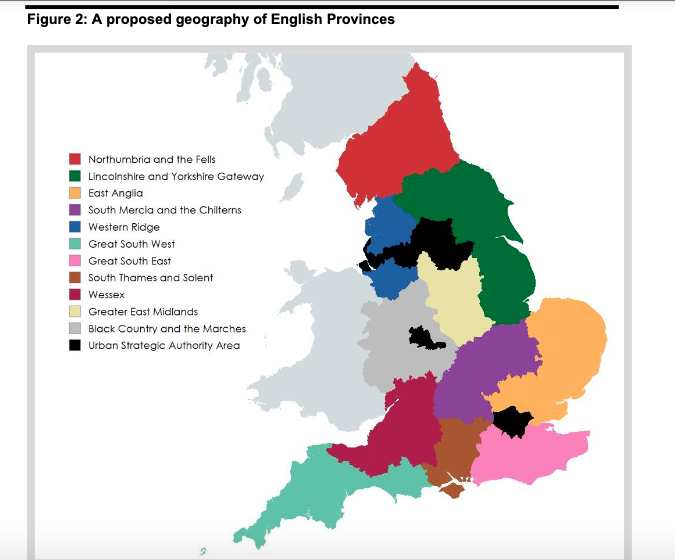
Above – from Go Big or Go Home
Now compare them to the Sub-National Transport bodies below, which I wrote about here in 2024.

Above: the sub-national transport bodies of the Department for Transport as of August 2024
“One of the few sceptical takes on Combined Authorities – one that picks up on the weaknesses of policies on the governance of England, is former Secretary of State John Denham, along with Janice Morphet in this recently-published paper.“
Above – from an earlier blogpost on Labour’s urban transport review
The paper by Prof Denham and Dr Morphet is worth reading here because it highlights the big ‘constitutional knot’ that goes right to the heart of how the UK is governed. That is the principal of Parliamentary Sovereignty.
“At the heart of this constitutional knot that is seldom discussed and appears to inhibit devolution in England, is the role of the Accounting Officer. This means that devolution to create more local, democratically controlled decision making is potentially stymied until this aspect of the constitution is reformed and replaced.”
Above – Denham and Morphet (2024)
Basically, someone has to be responsible and accountable for how taxpayers’ money is spent.
“When parliament calls a public sector organisation to account, it is its accounting officer who gives evidence. In turn, others in the organisation, operating using delegated powers, account for their own performance to the accounting officer.”
Above – The Accounting Officer Survival Guide (2015) HM Treasury, Para 3 p2/p3pdf
How do you create a system of accounting officers who are accountable to the people of their region rather than to Parliament?
“What does the Re:State report say about funding?”
This:
“Over and above mirroring the budgetary arrangements of Established Mayoral Strategic Authorities, Provinces should also be allocated a new Provincial Development Fund, drawing together money from the Rural England Prosperity Fund, the Farming Investment Fund, and a share of the new Local Growth Fund.”
Above – Re:State (2025) Recommendation 12, p6/7
Which understandably steers clear of the constitutional knot because once you start exploring it you fall down legislative wormholes about the devolution of power and responsibilities in Scotland – which are incredibly complex by their very nature. Furthermore, regional government for English regions is not nearly the same as the devolution for Scotland which historically used to be an independent state from England, and still has the legacy of that long history reflected in things like the Scottish legal system and their education system.
Re:State’s proposed provinces vs Urban Strategic Authorities
Before looking at that, it’s worth looking at some of the criteria they used to come up with the boundaries – the big one being population size. Page 8/9 has comparators of population sizes for other countries. Note however that the internal histories and geographies that resulted in these sizes are more than likely to contain things that are of no relevance to England’s experience. For example Germany and Italy were unified only relatively recently compared with England and France – it was only during Queen Victoria’s reign that both the former pair were unified. In Australia’s case, the vast land mass alone would make it all but impossible to micromanage the Commonwealth of Australia on centralised lines. (Think of the distances involved prior to 21st Century electronic communications).
“This paper sets out what the alternative model of governance for the greater part of England could look like: a plan for fewer, larger regions that are worthy of the name, capable of capitalising upon further devolution, coordinating dynamic new polycentric economies, building hub-to-hub connectivity over big geographies, and providing a genuine counterweight to the biggest cities and central government alike.” [my emphasis]
Above – from part 1.2 Diverse approaches for diverse conditions in Re:State (2025)
This is where the paper proposes separate ‘urban strategic authorities’ for the city regions.
“London, Birmingham, Manchester, Liverpool, Leeds and Sheffield – can function as genuinely regional governance tiers, despite covering relatively small geographically areas, because of their higher population densities and more internally centralised economic structures”
Above – Re:State (2025), p10/p11pdf
Hence the creation of separate USAs for London, Birmingham [plus Coventry], and the conurbation stretching from Liverpool through Manchester onto Leeds & Sheffield.

Above – from G-Maps here, you can get a sense of why the ‘Liverpool-to-Doncaster’ conurbation has been suggested as an Urban Strategic Authority – and how The Pennines gives the proposed province a somewhat awkward shape on the map!
“The SAs in England’s six largest cities are effective not only because of the scale but also
because of the ‘hub-and-spoke’ internal structure of these areas. This lends itself to the SA
form of governance. As one interviewee said, “the places which have benefitted most from
strategic authorities have an obvious centre”.”
Above – Re:State (2025), p13/p14pdf
Which is why the governance of Cambridge makes no sense to anyone unless you are a politician.
- Cambridge City Council – based in Cambridge
- Cambridgeshire County Council – based in Alconbury west of Huntingdon
- Cambridgeshire & Peterborough Combined Authority – based in Huntingdon.
- Peterborough City Council (unitary) – based in Peterborough
What makes things harder geographically is that the two largest settlements in the CPCA/Strategic Authority area, Cambridge and Peterborough, are at opposite ends of the area – both having formerly been part of Cambridgeshire County Council until the latter grew so large as to be converted into a unitary council in the late 1990s. The creation of the Combined Authority was, in my view a purely party-political move by ministers of the era. And I said so at the time – nearly a decade ago!
Re:State also come to a similar conclusion, stating that the CPCA is too small for their criteria – which for population is a minimum of 3 million. The CPCA area will be lucky to exceed 1 million by 2040 and that’s even with the looming new towns and pre-existing planned growth. The report states that it was housing and funding concerns that led to the demise of the proposed East Anglia Devo Deal of 2016 (which has been archived here – spot the missing logo of the city council which refused to sign up to it!) There was a lot more to it than that, but I don’t blame the authors for not going into the detail because it was one of the worst examples of public policy making for local government that I have seen – mainly because the key drivers were party-political, and the local party politics got very, very messy.
South Mercia and the Chilterns vs England’s Economic Heartland?
I guess that’s why the people setting up the sub-national transport body for that bit of England that’s too far south to be in the Midlands but too far north to be on the south coast, too far west to be in East Anglia and too far east to be in the West Country?
“Where is Mercia and the Chilterns anyway?”
Depends which time period you are asking about. Either way, I imagine the people of Cambridgeshire and Peterborough would want a name-change if such a tier became more prominent in decisions made about their part of the country. Unless the only other alternative put forward was ‘Oxbridge Province’. Which would put off all but those making their fortunes from the brands of the ancient and wealthy universities.
“Why?”
Because the brands of Oxford and Cambridge are marketed by their exclusivity, which they have a centuries-long history of being anything but inclusive. Yet the case Re:State tries to make from page 19 is a sound one *given the Government’s policy on the OxCamArc*.
“A Province could strengthen linkages between these centres through strategic investment in east–west rail, orbital road capacity, and integrated transport planning. It would enable more effective spatial planning, housing delivery, and environmental stewardship across shared corridors of growth. At this scale, the region’s innovation ecosystems – including multiple universities, science parks, and advanced manufacturing clusters – could be better aligned to support skills, R&D, and inward investment without micromanagement from Whitehall.”
Above – Re:State (2025), p19/p20pdf
To be clear, it would make no sense if the Government’s priorities involved ‘de-growth’ and a radical policies of redistributing wealth – including housing. (This and other policies being popular in green-left political circles as an alternative to large new developments).
“When work started on developing Milton Keynes, land contributed only around 1% of the cost of a new home. It now accounts for over half the cost of most new homes.”
Above – Shaun Spiers – How to save homes AND save the countryside (2018) Policy Press
Noting the quotation above, some of the problems associated with the housing crisis are not ones that will be solved by creating regional tiers of government. The policy powers and solutions reside with The Treasury.
Regional Governors of the provinces
“Rather than a mayor, each Province should be led by a directly elected Governor”
Above – Re:State (2025), p25/p26pdf
“Provinces, like Strategic Authorities, should have a board, composed of constituent council representatives and, where appropriate, other key stakeholders. This board would serve as the principal decision-making forum.”
Above – Re:State (2025), p30/p31pdf
There is still a significant democratic deficit in terms of accountability. This would need re-thinking given the experience of Cambridgeshire and Peterborough’s Combined Authority where you end up with an electorate returning:
- A politically-polarised set of constituent councils (and thus their representatives) who are unable/unwilling to work collectively
- Governors who appear to favour one part of their region over another – eg the one that provided them with the most votes
- Competing and conflicting electoral mandates across institutions – eg Mill Road Bridge which the new Mayor of the CPCA wants to remove the traffic restrictions on, vs the now Lib-Dem-majority county council (elected at the same time) that wants to keep it in place. The law empowers the latter. The case went to the High Court and… the judge upheld the traffic restrictions.
“Province Governors should be able to appoint appropriately remunerated commissioners as portfolio leads in their cabinet.”
Above – Re:State (2025), p31/p32pdf
This is where it gets confusing in the face of existing experiences. What’s the difference between The Board and The Cabinet? Is The Board meant to function as a sort of ‘Overview and Scrutiny Committee’ of the Strategic Authority? If it is, far better to have a general assembly with either directly-elected representatives, or as with the old regional assemblies, have nominated councillors from each member council acting as assembly representatives – and create scrutiny committees for each commissioner appointed. (With confirmation hearings with veto powers too).
“If devolution is to move beyond its current ceiling, and if reform is to deliver more than
marginal gains, England will need institutions with the legitimacy, capacity and coherence to act strategically. In most of England, that will mean thinking bigger and finally learning from the structures used by other countries.”
Above – Re:State (2025), p33/p34pdf
I agree. Inevitably there will be a host of issues people will raise with anyone who puts forward a plan like this, but at least Re:State’s authors had the courage of their convictions to do so.
Researching and writing a report on how nearly 60million people should be governed at a regional tier is inherently complex by its nature
On so many things there won’t be a right or wrong answer. Furthermore, what might be suitable in one era won’t be suitable in a later era. What should be the systems for institutional evolution that can happen in a way that doesn’t destabilise it?
Hence why the previous government should have listened to the Commons Public Administration & Constitutional Affairs Committee a few years ago when it called for a new commission to investigate and report on the governance of England.
System of government in England in need of serious overhaul, say MPs
Above – from 31 Oct 2022
Sadly the former Secretary of State responsible at the time, Michael Gove, was so dismissive of the Committee’s findings that they summoned him back for a public dressing down.
“The Committee is very disappointed by the quality of the Government’s response and the clear lack of attention paid to and engagement with both the specific content of the Report and the serious issue at hand. We remain concerned that rather than seeking a long-term, cross-party solution to the increasing issues with the governance of England, the matter will remain a political football, with the result that long overdue and meaningful comprehensive reforms will fall by the wayside.”
Above – Press release PACAC 01 March 2023
That same press release also criticised the opposition parties for not engaging either – mindful that the Liberal Democrats had far, far fewer MPs than they have now, and The Greens only had Caroline Lucas, whereas now they have four.
I remain sceptical that Labour’s proposals will be the end of it – simply because of the pace they are going at (which implies and accounts for the inherent lack of flexibility in the options available for councils being converted into unitary councils). At some stage this or a future government will have to launch ‘Redcliffe-Maud II’.
(Also, when you’re on a roll writing a blogpost and find out it’s 2am… from what I’ve read it’s a neurodiversity symptom!)
If you are interested in the longer term future of Cambridge, and on what happens at the local democracy meetings where decisions are made, feel free to:
- Follow me on BSky
- Spot me on LinkedIn
- Like my Facebook page
- Consider a small donation to help fund my continued research and reporting on local democracy in and around Cambridge.

 The Cambridge Town Owl