
Next challenge: filling the venues with people
From Friday 08 August there are a number of singing workshops at the Cambridge Corn Exchange as part of the the Big Big Collab in what is our largest civic hall’s 150th anniversary.
“Cambridge will be alive “with the sound of music” as part of this one-off special event. There will be free pop up performances from local singing groups happening in Cambridge Market Square throughout Saturday daytime too. Why not make a weekend of it in this fabulous city?”
Above – The Cambridge Contemporary Choir Festival
Vocal Remix at The Junction, Cambridge (in aid of The Arthur Rank Hospice)
This is one of a number of singing groups in/around South Cambridge which I listed in December 2024. Six months later, musician and councillor Dinah Pounds was elected Mayor of Cambridge and shared her vision with our city.

Above – Vocal Remix Cambridge which rehearses at Coleridge Community College – do book one of their free taster sessions.
Out of the singing groups that I’ve seen and/or performed over the past year, Vocal Remix is probably the most accessible and affordable if you live in my part of town, are on a low income, have little musical experience, but would really like to start somewhere. It works out at £7.50 per rehearsal so is comparable with many other evening classes.
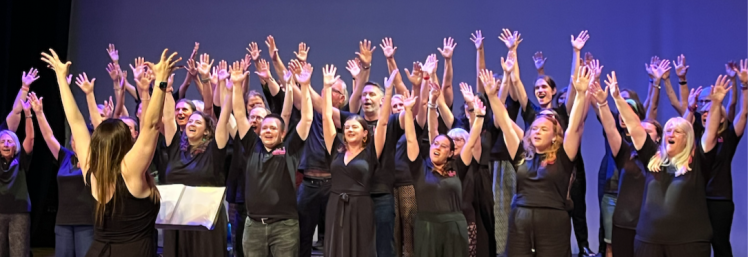
Above – Vocal Remix reaching for the stars at the The Junction in Cambridge. (Because even if you don’t get to the stars, you might get to the tops of the trees and the view from there is just as wonderful – as I often reminded myself during my ‘roaring twenties’ in the 2000s)
A growing city like Cambridge needs a diverse mix of community singing and choral groups
It’s easy to forget how much technology has enabled more people to sing along to better quality backing tracks using physically smaller but more powerful sound equipment. At the same time, the legal requirements to put on something like this feel much more onerous than in decades gone by. That or I was too young to notice. For example you still have to pay for a licence to use the backing tracks as part of a public performance. Essentially your choice at community-music-level is:
- Pre-recorded backing tracks
- One or two instrumentalists happy to help out
- Acapella (no musical instruments accompanying)
Once you start scaling up beyond what the Sing! Choir Cambridge have got to (i.e. four/five instrumentalists maximum), the costs of hiring musicians goes up significantly due to the extra rehearsal work needed for that many musicians, and the professional standard that those musicians need to be at. Which for me is one of the big things that stood We Are Sound Cambridge out from all of the others musically – have a look at their videos here.
Vocal Remix seemed more confident than their last performance at The Junction a year ago

Above – Vocal Remix with heart-shaped hands
There’s no right or wrong catch-all answer on whether to have basic choreography in performances. Here’s the Rock Choir, Cambridge at the Big Weekend in 2019 also singing to backing tracks and doing basic choreography – the group being part of the huge national franchise which enables them to put on huge national shows where the audience are part of the performance such as in Wembley Arena in London in 2011. But what you get in scale you lose in local control of what you can sing as a group.
There’s also inertia and generational barriers too. My earliest experiences of singing in childhood did not allow for any movement whatsoever in the repressed 20th Century. You stood up, sang a hymn, and sat down again and didn’t say a word while some adult talked at everyone. Trying to break free from such early habits can be surprisingly challenging. Furthermore, others (Whether participating or in the audience) may have their own preferences of staying still, moving with the vibe of the song, or having a choreographed routine or sequences. (I’m useless at the last of these. I can do one, or the other, but not both at the same time!)
A new research project on the social and psychological impact of singing as part of a choir or community group in Cambridge
Meg Spencer-Thomas, who several of you know through various music groups and projects over the years in Cambridge, is currently researching for a Master’s degree at the University of York. More specifically:
“For this research project, we are interested in understanding how group singing in Cambridge can contribute to individual and community well-being and exploring how festivals might enhance this.”
Above – from the guidance sheet for Ms Spencer-Thomas’s project survey
For those of you who sing or have sung in a Cambridge music group or choir, please see the survey here. It’s anonymous and you won’t have to provide any personal information. (That said, please read the participation information sheet via the link above).
The reason why her research is important to the city of Cambridge is that if her research can demonstrate positive benefits (health, combating loneliness in society, etc) of such groups and activities, it helps build the evidence base to put to the evolving local government institutions that supporting and funding such groups might have an even greater benefit (and reduce costs to the public purse elsewhere) than we were aware of.
Food for thought?
If you are interested in the longer term future of Cambridge, and on what happens at the local democracy meetings where decisions are made, feel free to:
- Follow me on BSky
- Spot me on LinkedIn
- Like my Facebook page
- Consider a small donation to help fund my continued research and reporting on local democracy in and around Cambridge.

 The Cambridge Town Owl