Furthermore, can they work with the EU to compel big tech firms to maintain the software and upgrades needed to keep older items functioning, or alternatively compel them to make the continuation of that work available to third parties?
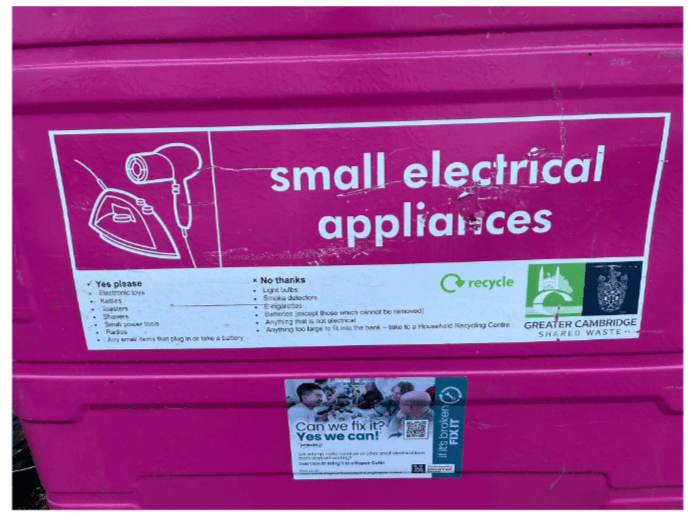
Image – Cambridge & South Cambs recycling bins for small electrical appliances
See The Guardian on 26 July 2025 here
All of my major computer purchases over the past decade have been refurbished models and in the grand scheme of things, they’ve served me very well indeed. The problem is the incentive that planned obsolescence creates – i.e. persuading buyers to upgrade their items much more frequently. One way to speed this up is to reduce the amount of time that new essential user-software will be maintained by the firm concerned. What can you do if your old computer gets a message that its operating software is no longer being maintained by the brand that made it, leaving your system vulnerable?
This is a particular issue with larger, more expensive items. Years ago (pre-lockdown), I bought a refurbished computer with a monster-sized screen that made online video conferencing much more user-friendly because the programmes automatically fitted more people into a larger screen. That plus I was going to use it for lots more video-editing until big life events intervened.
The environmental consequences of e-waste
“Modern business models for many consumer electronic companies operate under the premise that they will always be able to procure the necessary resources in a cost-effective manner necessary for manufacturing. However, many experts warn that shortages of 75+ key elemental components such as gallium and indium are at risk of depletion within the next 100 years.”
Build to Fail – the story of forced upgrade technology (2019)
EU Ecodesign regulations
The regulations, which are here, and which came into force in June 2025, now require:
- greater resistance to drops, scratches, dust and water
- use of more durable batteries, capable of at least 800 charge cycles while retaining at least 80% of their initial capacity
- clear rules on disassembly and repair, requiring manufacturers to supply key spare parts within 5-10 working days, and for at least 7 years after the product model is no longer sold in the EU
- longer availability of operating system updates, at least 5 years from the date the last unit model is sold
- fair access for professional repairers to the software or firmware needed for repairs
Above -EU Commission 20 June 2025
Which is all well and good (assuming the UK follows suit) but it won’t be of much use to the very large computers currently in resale shops up and down the country that are still useable in principle, but less so in practice. I just dread to think what the volume of e-waste will be given the UK has so few facilities for such recycling in proportion to the volume of waste that needs processing.
Furthermore, given Cambridge’s reputation in the field of all things computers, this should be a much, much higher profile issue for our city and economic sub-region.
If you are interested in the longer term future of Cambridge, and on what happens at the local democracy meetings where decisions are made, feel free to:
- Follow me on BSky
- Spot me on LinkedIn
- Like my Facebook page
- Consider a small donation to help fund my continued research and reporting on local democracy in and around Cambridge.

 The Cambridge Town Owl