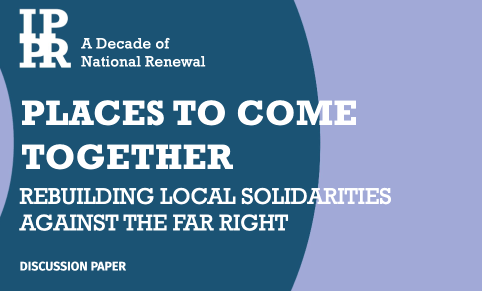
A new proposal written by Dr Sacha Hilhorst for the Institute for Public Policy Research proposes additional measures to reverse the long term decline of community venues and spaces where people used to meet
Although pitched as a response to the rise of TeamNigel and groups beyond, this framing feels like it is trying to reflect the urgency of the situation lest Sir Keir Starmer’s Government finds itself making the same mistakes Joe Biden’s administration made in not dealing urgently enough with the underlying causes early on.
“This discussion paper argues that the state should endeavour to create, facilitate and maintain spaces where solidarity might thrive.”
Above – Places to come together (2025) IPPR
“Sounds like another top-down ministerial initiative from a London think-tank. We’ve seen it all before”
Actually, this one is different because it looks at the history. Furthermore, the proposal for distributing the total funds is by formula grant which is based on data collected on economic, social, demographic, and environmental variables. That makes it harder to manipulate for party political purposes.
The historical example of a levy on an industry: Coal mining and the Mining Industry Act 1920
Amongst other things, the 1920 Act represented a significant intervention in the once mighty coal industry – an incredibly perilous occupation fraught with accidents and ill-health for the miners, and one that brought huge wealth to the owners of the mines. It’s difficult to get across to younger generations just how central to the UK economy the coal industry was – to the extent that well-planned strikes by coal miners could bring down governments, the last one being Sir Edward Heath’s in the mid-1970s just over half a century ago. The long term consequences of that was the rise of Margaret Thatcher and her subsequent government that reduced the once-mighty trades union movement to a shadow of what it once was.
The decline of community institutions and local government – where do you start in places where both of these have little presence along empty high streets?
This is why Dr Hilhorst proposes something far more radical than previous governments have proposed – a levy on the online mail-order industry, or a digital tax. The closest example I can think of was Tony Blair’s ‘windfall tax’ on the privatised utilities in the 1990s which raised the funds needed for the New Deal programmes. But that was a one-off levy on the back of years of angry tabloid headlines raging about the highly-paid ‘fat cats’ of the privatised monopoly utilities under the Conservatives.
“A digital tax won’t happen this side of the US presidential election because of the hawkish response it would get stateside”
Note the EU effectively had to back down against the US earlier this month, so it’s hard to see this coming back to the negotiating table without a significant strengthening of the EU as an institution, and also the building of alliances with other countries that want to do the same.
The other alternative available to The Treasury is to tax the products at the point they arrive at a warehouse for delivery. The effect would still be similar, but rather than being seen to tax specific firms that just happen to be American, it would make no difference where firms are domiciled/HQ’d, because it would be the item having already arrived in the UK that would be taxed, and/or the warehousing company storing it.
Personally I’d go a few steps further and impose a delivery levy to cover:
- Repairing the damage to roads caused by heavy delivery vans
- The construction of out-of-town freight-exchanges to mandate the ‘last mile’ delivery of light packets to be done by ultra-light local couriers (which themselves would add their own charge to the total postage bill
The impact of both would be to help rebalance the playing field between high street shops and online warehouse-ordering businesses, while at the same time creating new revenue streams for local councils. That would help reconnect the link between local revenues generated and local revenues spent. If done effectively, it could help make the case for replacing business rates too.
“What would the revenues raised be spent on?”
Dr Hilhorst writes of a new Welfare Fund created from the revenues of the warehouse levy or digital tax.
“Welfare Fund resources could be used to bring iconic buildings back into community ownership and retrofit them to become anchor institutions for the everyday economy, including FE colleges or childcare facilities, adopting a deliberately broad view of what constitutes community spaces. Such amenities would bring footfall, revive shared spaces and stem the sense of decline.”
Above – IPPR (2025) p11
Sounds good!
But it’s not without risks
Dr Hilhorst highlights some of these – such as community spaces being taken over by divisive groups more interested in controlling their own specific group or community – irrespective of how they identify, rather than integrating with others across a geographical area. From places of worship taken over by extremist preachers through to gyms or pubs becoming meeting places for extremist movements, you only have to look at the enforcement action taken by the Charity Commission to see examples of where they have had to take regulatory action against charities breaking the law.
A renaissance in adult education and lifelong learning could go hand-in-hand with Dr Hilhorst’s recommendations
This brings us back to the Commons Education Select Committee Report from December 2020, one that called for the establishment of a community learning centre for adults ‘in every town’. Combine that recommendation (and delivery of it) with a new generation of citizenship/civics education as recommended by Qasir Shah of UCL (also in 2020), the essentials of public and charity administration as part of the course offers, and also a comprehensive offer on media literacy as recommended by the House of Lords earlier this month, some of the risks could be nipped in the bud.
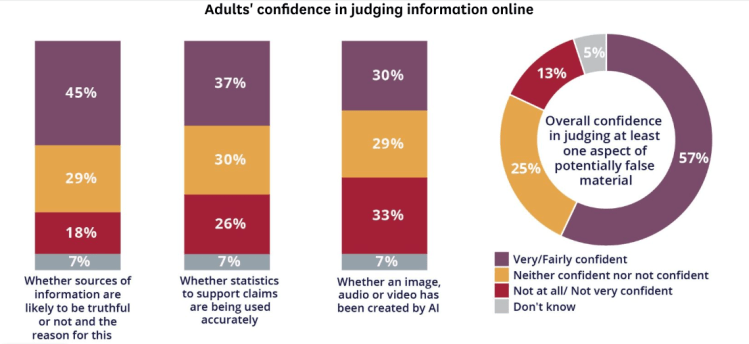
Above – House of Lords (2025) Communications and Digital Committee
Overcoming political and structural weaknesses in local government
The London Borough of Tower Hamlets is often cited as an example of dysfunctional local government, where ministers end up using their powers to take service delivery and asset management out of the control of elected councillors and elected mayors, and put them in the control of directly-appointed commissioners until said councils have been overhauled. A combination of bad stuff going on, combined with being in London (easy access to the London press) and a very diverse population with roots all over the world made for the perfect storm for any outlet wanting to use the case to make a point about immigration. The problem is that inflammatory coverage doesn’t try to solve the problems – which were and still are very real when you look at the massive inequalities in the borough. Furthermore, austerity has exposed a number of councils across the country under different political party leadership (think Liverpool under Labour, and Doncaster back in 2010 under a party to the right of TeamNigel – a leadership that was promptly stomped on by incoming Communities Secretary Eric Pickles who sent in a hit squad of commissioners to take over things).
“What do you do in the face of the sorts of local election results we saw earlier in 2025?”
In the county council elections in England, the Tories lost over 600 seats – mainly to TeamNigel as the latter found themselves in charge of ten county councils, six of which they have majority control. For the handful of unitary councils up for election, TeamNigel took control of three of those.
Part of me thinks it will only be a matter of time before ministers send in commissioners to those above-mentioned councils given the roaring trade in scandalous stories Private Eye Magazine is doing in their ‘Rotten Boroughs’ column.
The importance of citizenship and civics education for adults
I refer everyone to Qasir Shah’s paper for UCL (2020) again, noting that democracy education should not just be about party politics and elections, but something far more than that. It should provide enough opportunities for residents to learn about how the village/town/city where they live actually functions, and their place within it. Not least because so many public services are overseen by volunteers which most people have little knowledge of.
- Boards of governors / trustees of health service providers
- School governors
- Police and crime panels
- Trustees of parks, rivers, and wildlife organisations
- Trustees and volunteers of youth groups
…and that’s just to name but a few off the top of my head.
That’s not to say that everyone needs to take an exam at the end of it all!
From my perspective, the most important aspects are bringing people together to solve shared problems that they themselves have identified and defined, for the purposes of improving where they live for the benefit of the many.
Get it right and you won’t find things like this happening.
Food for thought?
If you are interested in the longer term future of Cambridge, and on what happens at the local democracy meetings where decisions are made, feel free to:
- Follow me on BSky
- Spot me on LinkedIn
- Like my Facebook page
- Consider a small donation to help fund my continued research and reporting on local democracy in and around Cambridge.

 The Cambridge Town Owl