Cambridge Community Arts pleaded repeatedly for support from our supposedly wealthy city (see their IG feed here). So why didn’t we respond?
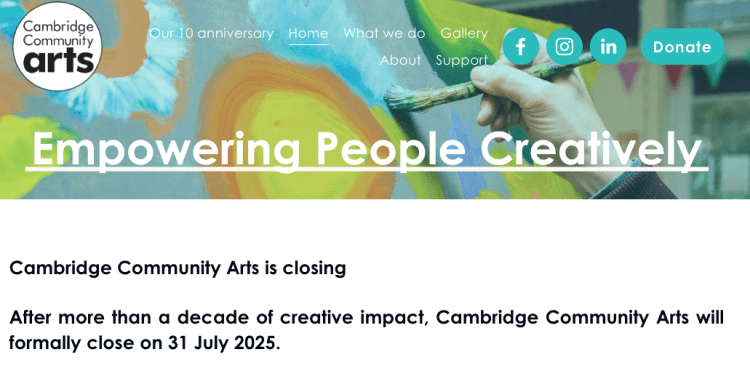
“After more than a decade of creative impact, Cambridge Community Arts will formally close on 31 July 2025.”
I knew a handful of people who were involved in the work of the CCA and also those who attended their courses. I also had a look around what they had to offer on their open days, but could not find anything that really resonated with me. This was due to a combination of my limited mobility combined with a desire to participate in something at a much larger scale – something that Cambridge persistently fails at for both town and gown. Yet it made a huge difference to the participants.
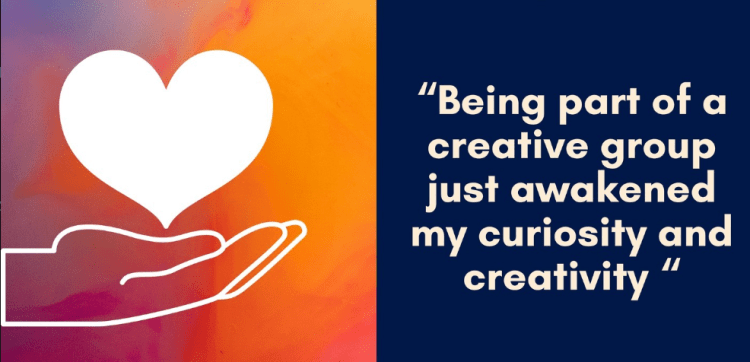
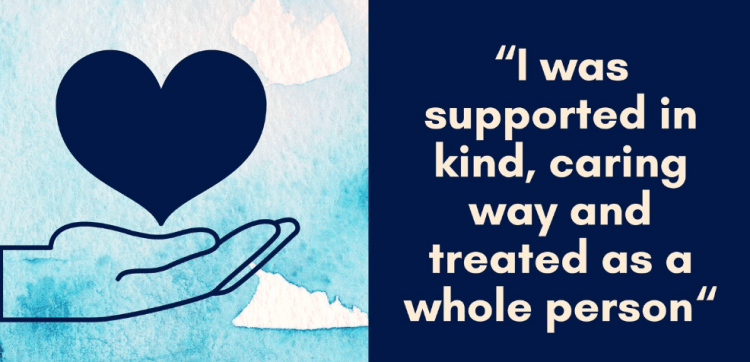
With the continued growth of our city and economic sub-region, Cambridge Community Arts should be expanding, not disappearing
Remember the talk by Peter Freeman in Cambridge earlier this year?
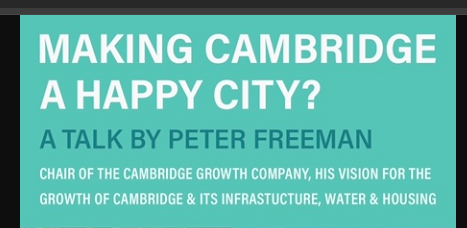
Above – here’s a quick reminder
We will not create a happy city if the arts for the many are continually cut
We lost The Big Weekend a couple of years ago, and this year we also lost the Strawberry Fair.
Don’t underestimate the impact that the loss of the Big Weekend had not just on the city but also for families on low incomes in the surrounding villages. One of the things that a new unitary council set up might be able to reverse is the loss of the Big Weekend given the number of visitors from outside the city boundaries that come to it. But this has to be funded by additional taxation through new powers provided to local councils – for example on things like the tourism industry and extractive business practices such as the buying of homes designed as residential properties for Air BnB and private student accommodation. (See what Edinburgh is doing in the second half of this post – can England get similar powers the Scottish Parliament provided to its local councils?)
The success of the Lionesses at the Women’s Euros in 2025 provided a much-needed antidote to the doom-scrolling and also the bone-crushing loneliness of our present era
The irony was that so many of the things that we saw on display, were in spite of, not because of the big institutions who have been very slow to support the women’s game. You only have to look at the differentials in the prize money.
- Teamwork
- Overcoming physical and mental pain
- Overcoming prejudice – resilience and resistance
- Support on-and-off the pitch (and the appreciation of that support)
- A group of individuals functioning greater than the sum of their parts
- Love and diversity
“Why wasn’t there a big screen on Parker’s Piece for the final?”
Because local government simply does not have the capacity that it had in 2006 where a big screen was put up for England’s first game of World Cup 2006 against Paraguay. A baking hot day, a damp squib of a game with England taking the lead in the third minute and doing little afterwards.
The local government reforms must reunite Cambridge’s fragmented civic society institutions and activities

Is that even more difficult than ‘the impossible’? Or are the impossible challenges only ones that involve the sci-tech bubble?
Interestingly, the new Chancellor of the University of Cambridge, Lord (Chris) Smith, Tony Blair’s first Culture Secretary might have something to say on this.
“During his four years as Secretary of State he restored free admission to national museums and galleries, established NESTA, the Film Council, Creative Partnerships for schools, and the Foundation for Youth Music, expanded funding for the arts and sport, championed the creative industries for the first time in Government, and began the switchover process for digital television.”
Above – Lord Smith’s profile at the Bennett Institute for Public Policy, Cambridge
It’s not only that which will be of interest to local government watchers.
“He worked for a housing charity and became a councillor in the London Borough of Islington.”
Which means he will have at least some familiarity with the fun and games of local government in England – mindful that when he was a councillor in the late 1970s/early 1980s, he faced the same environment of austerity and cuts from central government that the present generation has experienced over the past decade and a half. Furthermore, he’ll also have some policy knowledge of things like tourism taxes and the debate on how local arts can be supported by means other than central government grants and philanthropy.
Loneliness in society – politicians and decision-makers missing the bigger picture
Because there is no formal connection between tackling loneliness in society with the funding of adult education and lifelong learning, the savings that could be made to the healthcare budget through investment in the education budget don’t get made. Instead, an enfeebled local/sub-regional sector gets handouts from central government to pay for very narrow skills-related programmes as we have seen with the CPCA in our part of the country.
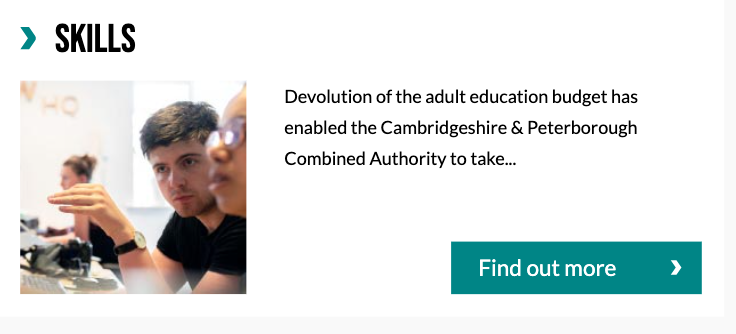
Above – the thumbnail on the CPCA’s website above confuses adult education with skills. The latter is a component of the former, not its entirety.
As I’ve mentioned many times before (eg here on lifelong learning & democracy education), successive governments have not granted combined (soon to be strategic) authorities with the powers to create the sort of adult education and lifelong learning ecosystems that could form the foundations for programmes and activities that deal with a whole host of social and environmental issues that go beyond ‘upskilling’. (Also, get a large ‘playground for adults’ incorporated into a new large adult education college and see what impact it has on people’s health!)
Exclusive groups solving social problems – while excluding society in the process
I’m sort of speaking from experience here because during my civil service days I was called out on this on a visit to East London nearly 20 years ago – and it has stayed with me. Furthermore, the contrast between the cancellation of so many free events over the summer for the general public vs the photographs in my social media feeds (Mainly Li) of people in office-based jobs either on above-median salaries or on career paths in that direction, was discomforting for me for a host of reasons.
“Annoyed that you didn’t get an invite?”
Well, here’s the thing. I went to at least one of those events this summer, but was so utterly fatigued up to my eyeballs that I couldn’t engage in meaningful conversation. Furthermore, most of the people there were socialising with people who they had worked with on various projects over the year. Put it this way, it ain’t fun going to a party where you don’t know anyone and you’re in a condition where it feels like you’ve not slept for 36 hours! (Hence also the link between CFS/ME, which I have, and loneliness/social isolation)
So, send me all the invitations you like, but given the long term state of my health, it won’t make much personal difference. I’d much rather the structures, systems, and processes on deciding the future of our city were open to so many more people from different backgrounds so that such social events are also open to them as well. Because politics and public policy are inherently very social sectors by their very nature. Yet the social barriers that are all too prevalent in our city result in inequalities that are not just about rich and poor, but also about the imbalance in which activities get the resources and which ones do not.
Food for thought?
If you are interested in the longer term future of Cambridge, and on what happens at the local democracy meetings where decisions are made, feel free to:
- Follow me on BSky
- Spot me on LinkedIn
- Like my Facebook page
- Consider a small donation to help fund my continued research and reporting on local democracy in and around Cambridge.

 The Cambridge Town Owl