
What happens when you put sketches and drawings of old through AI-tools?
Image – John Belcher’s guildhall line-drawn design of the late 1890s put through a generator and turned into a photograph
You can see the old guildhall designs that I’ve put through in this Lost Cambridge blogpost
As mentioned, the aim is to try and generate moods and themes that contrast with what is produced by developers and their consultants in the planning applications of the past couple of decades – ones that have divided opinions.
With it being August and also with my chronic fatigue being unusually heavy this month (I didn’t get out of bed yesterday – the post-exertional malaise from last week in Addenbrooke’s is lasting far longer than I expected), I’m finding I can only do passive things. Like throwing designs through AI-generators. Earlier today, I tried the old Playhouse where the Co-op long-since replaced the old Sally Anne’s charity shop.
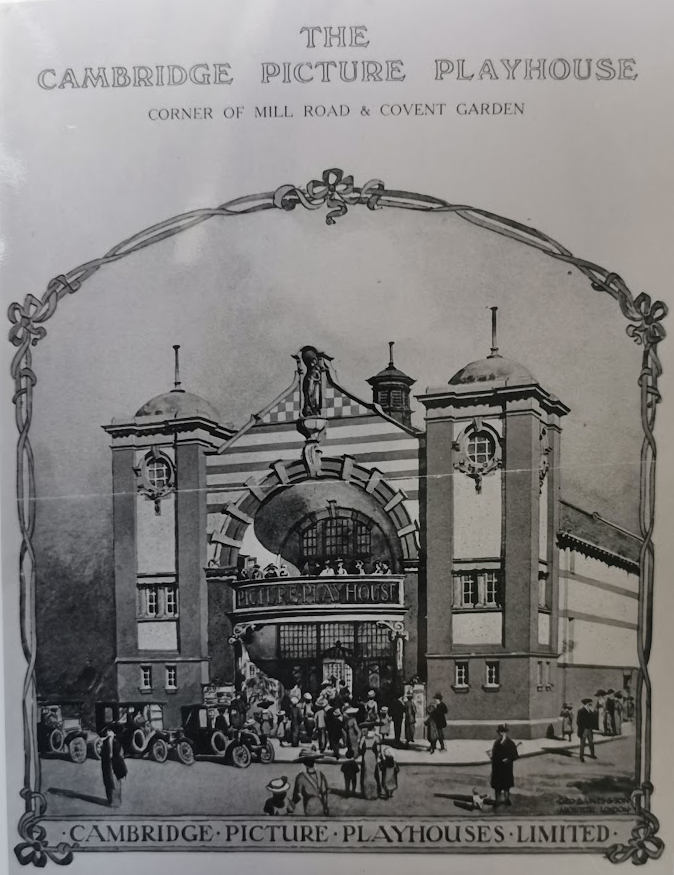
It came out like this when asked to put the dark bits in red brick, the pale bits in cream, and black metal for the internal windows
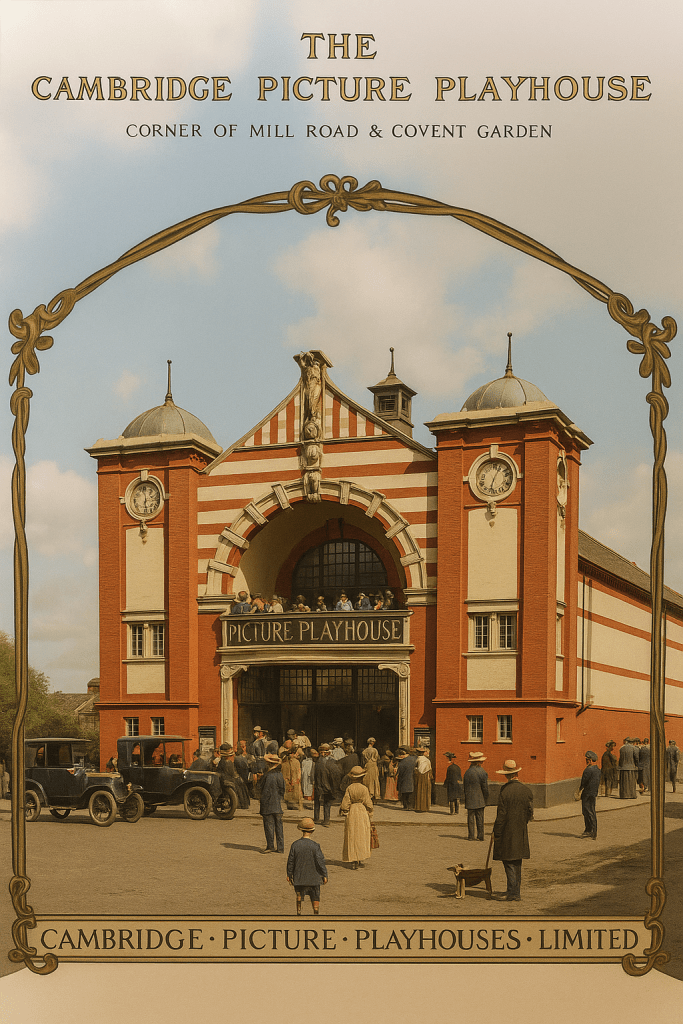
Above – CGPTAI reinterpreting the old Cambridge Playhouse on Mill Road
“Yeah – why won’t architects and developers design buildings inspired by past eras?”
You’ll have to ask them.
Chances are the way the system is structured incentivises ‘off the shelf’ designs where architects and consultants based far away from the places they are commissioned to work in and on, and who know little of the places they work with, are to blame. Consultation is expensive and time-consuming. All too often as we’ve seen in developments like The Paddocks in Cambridge an institutional absentee land owner will commission out-of-town consultants and plough through their proposals impervious to what local residents want, think, or need. Which is what happened here.
An expanded Central Library – then a war got in the way
This design which was meant to add to the 1884-built central library commissioned by our first municipal librarian and civic hero John Pink is let’s face it a fairly bland and inoffensive design. But it’s still more interesting than the minimalist slop that gets erected today.

Above – unexecuted expanded central library (1913) round the back of the Guildhall, from the Cambridgeshire Collection
I asked the generator to reinterpret how it might look today.

Above – inoffensive but a bit bland? An extended old library building opposite the Arts Theatre on the left (unbuilt at the time the original was drawn) and Wheeler Street on the right
Getting the generator to come up with designs based on historical written descriptions
One other interesting comparison is to compare what the newspapers wrote at the time on newly-built buildings versus what the generators come up with. Such as the old Mill Road Library.
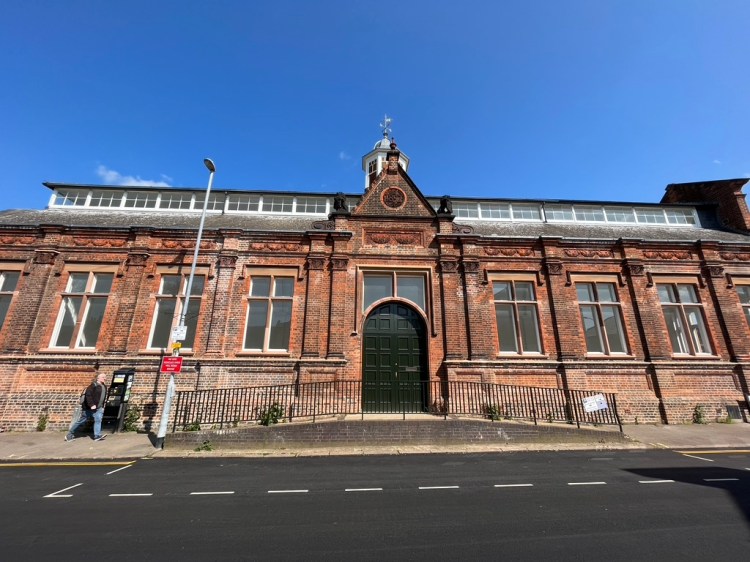
Above – the Mill Road Library from late 2024

Above – I can *sort of* see what it’s trying to do, but it didn’t quite work out! One thing that AI is not great at (or rather that you need to be very clear on) is symmetry.
With all of the things that I’ve played with so far – and this is the *very beginning* touching the edge experimentation, the results seem pieces that represent ‘getting to the starting point’ of a project. I.e. having visualised a theme, it’s now up to humans to intervene and:
- improve
- upgrade
- expand
…on what’s been put in front of them in order to come up with something that is both much more realistic and inspiring.
The risk of carrying on as normal
I’m struggling to think of any buildings in post-war New Towns that are big, grand, awe-inspiring, wonderful, beautiful, and iconic – and functional. Ones that inspire a sense of civic pride while also providing landmarks where people can locate where they are eg for the purposes of meeting up. New Town devotees will be able to list their favourites just as much as members of say the Victorian Society or the Georgian Society would be able to list their own. But what about the wider general public?
My worry for the future of Cambridge is that we’ll get cookie-cutter slop from developers like this CGI from the Commercial Estates Group that they’ve submitted for the next local plan for Cambridge on the south-eastern edge of Cambridge.

It’s just boxes and blandness enabling the developers and financiers to extract as much wealth from the land as possible while leaving little for the residents who end up moving there. (The lack of genuine open green space speaks volumes too).
Which is why I think collectively we should be setting much higher standards for public and civic buildings in new developments.
Food for thought?
If you are interested in the longer term future of Cambridge, and on what happens at the local democracy meetings where decisions are made, feel free to:
- Follow me on BSky
- Spot me on LinkedIn
- Like my Facebook page
- Consider a small donation to help fund my continued research and reporting on local democracy in and around Cambridge.

 The Cambridge Town Owl