Cllr Dave Baigent (now Ind, Romsey) resigned from Cambridge Labour Party today in order to sign up and support the new left movement alongside two former Labour councillors in Cambridge
You can see https://yourpartycambridge.uk/ and also Cllr Baigent’s press release (with contact details) here.
I’m not going to go into the national politics of it all – others have done that in far more detail than I could. Also, feel free to fall down the internet wormhole that are the hyperlinks to the history of leftwing politics in the UK via this WikiPage here.
The branch is organising a meeting on Sat 06 Sept 2025 with details to follow.
Remember Jeremy Corbyn’s speech in Cambridge back in 2015?
Have a watch of the video here – if you scroll to the end you’ll see that it was standing-room-only at Great St Mary’s as over 1,000 people packed into the building – with several hundred outside who heard a shortened version of that speech.
“Expect there to be an almighty scramble for seats on any ‘steering committee'”
The fractured and splintered nature of the British Left – similar to their opponents on the Right, will inevitably result in the jostling for influence in new branches across the country. History tells us this whenever a new ‘left-of-Labour’ movement starts to gather momentum.
- Socialist Labour under former National Union of Miners’ leader Arthur Scargill in 1996 in opposition to Tony Blair
- The Socialist Alliance electoral pact in 2001 at the time of the anti-globalisation protests
- The Respect Unity Coalition (The George Galloway-led movement following the second Gulf War)
- The Trade Union Socialist Coalition formed in part against the post-2010 cuts to public services
- Jeremy Corbyn winning the Labour leadership in 2015 – resulting in a massive influx of new members including longtime leftwing activists and former members
- The Your Party movement in 2025
For anyone joining up to the movement today, one question worth asking at the inaugural meeting in Cambridge is: What are the lessons from the previous movements?
It’s worth remind ourselves that there are many things happening now that are unprecedented
I.e. there may not be a straight-forward historical case study or example to learn from. For example the huge influence that the bosses of multinational tech corporations have on UK politics – whether from social media posts promoting extremist posts to funnelling funding via gamed algorithms to similar extreme movements that promote division and disinformation (with the financial incentives to do it).
With all of the above in mind, it’s worth having a look at More in Common’s Shattered Britain report here. Which parts of society will the new party be focusing their attention on? The report came up with seven segments. The quiz they had put me in the below:

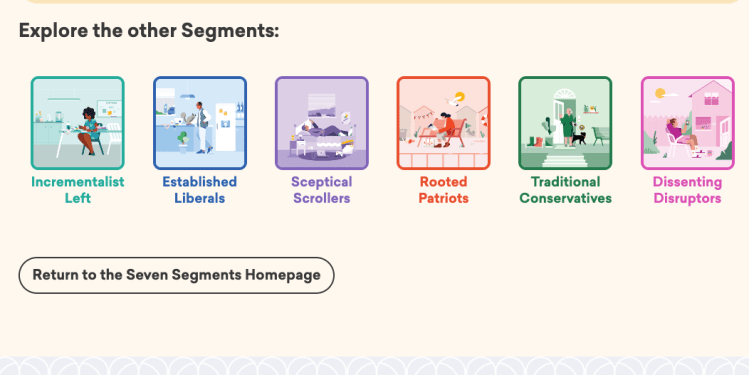
Above – I wrote more about the report here
“What does this mean for The Green Party?”
That ultimately depends on who they elect as their leader.
A Zack Polanski Green-Left leadership is one that Jeremy Corbyn said he could work with. One led by MPs Ellie Chowns and Adrian Ramsay – who both represent rural constituencies and are on the Green-Right of the party (in the grand scheme of things) have been much more hostile to the prospect of linking up, noting that many of their constituents don’t look favourably on Jeremy Corbyn – mindful that they too want to hold onto their seats at the 2029 general election.
Electorally there are the English local elections in May 2026
These include all of the London boroughs – which Labour are defending most of. They also include some new unitary councils and mayoralties, and the postponed county council elections that didn’t happen this year in many safe Tory shires and counties including Norfolk, Suffolk, Surrey, the Sussexes, and Essex. Expect TeamNigel to tear lumps out of the Tory votes there. It’s not clear whether we’ll see the former taking overall control of the councils mindful that a number of those counties are in London commuter belt unlike the county councils further north. There are also a host of metropolitan boroughs in the north of England that are also up for election too – again Labour are defending many of those. Remember that Labour lost four seats to Independent candidates running on a platform strongly critical of Labour’s policy on Gaza. The four of them along with Corbyn and Zarah Sultana MP later formed the Independent Alliance. Which means that any council candidates standing in those constituencies will already have some organisational structures in place for further electoral campaigning.
“What will the political and electoral impact be in Cambridge?”
It’s too early to tell at the moment. While some activists who joined The Green Party locally due to its left-of-Labour stance have resigned to join the Your Party Cambridge Branch, in one sense next year’s city council elections are of limited impact because the following year the elections for the new unitary councils are likely to take place. That alone will force the hands of all parties to campaign in the villages and new estates on the edge of, and outside of Cambridge. One of the reasons why some in Labour opposed the Government’s policy on unitary councils was that in a single stroke it removed Labour’s control of local government at The Guildhall – nominally handing it over to the Liberal Democrats who electorally ran riot in Cambridge the last time Labour was in Government (See Cambridge Elections by Mr Edkins here – count the number of LibDem city council seats in 2009). Given the continued significant levels of housebuilding in and around the city, there are huge opportunities for all of the parties contesting the elections to recruit new voters, activists, and candidates.
“Will you be joining?”
Any political party or movement that would even consider having an opinionated, unstable lunatic such as myself as a member is probably not one that I’d care to join. I wouldn’t survive five minutes inside any political party, so I’m better off outside of all of them. Also, civil service policy training is hard to shake off. I can’t do party tribalism, nor am I comfortable defending other people’s policies that I either don’t fully support or don’t know enough about (and never will either!)
“Should people go along to the meeting on 6th September?”
That’s up to them. If they’re curious, why not? Let them go along and judge for themselves. The one thing to look out for with any party political meeting anywhere are the demographics of the people there. To what extent do they reflect the broader population of where the meeting is taking place? Who is conspicuous by their presence and profile? Who is conspicuous by their absence? Mindful that the Government confirmed a few weeks ago that it would be tabling legislation for Votes at 16 in line with Labour’s manifesto commitment.
If you are interested in the longer term future of Cambridge, and on what happens at the local democracy meetings where decisions are made, feel free to:
- Follow me on BSky <- A critical mass of public policy people seem to have moved here (and we could do with more local Cambridge/Cambs people on there!)
- Like my Facebook page
- Consider a small donation to help fund my continued research and reporting on local democracy in and around Cambridge.

 The Cambridge Town Owl