
How does it all link to the latest research from the Government on Local Civil Society Infrastructure, and opinion polls for the 2029 General Election?
I won’t repeat what I wrote at the start of the year here, which looks at the diversity of students’ groups, and the collective benefits to city and county of holding such an annual event.
Realistically it may not be until the new unitary council is up and running that something like this gets up and running. The simple reason being local government’s capacity will be even more limited than it already is in trying to restructure itself with what few additional resources ministers have provided.
Local Civil Society Infrastructure – what it is and how to build it up
The Department for Culture, Media, and Sport published a report in July 2025 on all things Local Civil Society Infrastructure (LCSI), and it was summarised here by NAVCA – which also link to six separate reports here.
Their headline finding reminded me of the Communities in Control White Paper back in 2008 from my civil service days when ‘stakeholders’ asked the department for its definition of a community. The department did not provide one – mainly because the term was so contested and at the same time generalised as to be meaningless. Like when you get estate agents selling luxury apartments with telephone number price tags inviting you to ‘be part of this new community’.
“There is no agreed definition of which organisations and functions fall within local civil society infrastructure. This presents a challenge in defining the scale of LCSI.”
For example an organisation could be building up and destroying local civil society infrastructure at the same time. Take a large corporate estate agency prioritising off-plan sales to buyers abroad before local first-time buyers get the chance to access what’s for sale, versus the same large firm sponsoring a major annual civic fundraising event such as a half-marathon as happens in many towns and cities.
Part of the problem is that central government does not appreciate how its policies for the economy, business, and trade affect the success or otherwise of local civic society organisations
Because DCMS sits in a very small silo compared with other parts of Whitehall, it inevitably gets overlooked in policy conversations that it really needs to be part of. I watched them find this out the hard way in the negotiations for local area agreements nearly two decades ago. In the days when central government monitored local government performance much more closely, when it came to deciding what the top 200 or so priorities for central government were in the form of a ‘national indicator set’, there were intense negotiations as to who would get how many of their ‘indicators’ on the list. (Have a look at the list here and the snapshot detail below).

The point some senior civil servants made about DCMS was that out of the top 200 problems the country faced, was the use of public libraries, or the number of people visiting museums and galleries up there? Others had issues with effective the selected variable was – for example NI-4 on the percentage of people who feel they can influence decisions in their locality.
This is where public policy gets really complex
…and not surprisingly there are some in party politics (Especially on the Right) who say that the state should simply step back and let ‘Big Society’ get on with it. Which is what David Cameron and his coalition tried to do. What they didn’t appreciate was that many ‘Big Society’ organisations had a highly-developed working relationship with their local councils. Such was the speed and scale that austerity clobbered the latter that no government policies could be developed to compensate for the damage that did to the sector.
Looking back at those days, I can’t help but wonder what a Redcliffe-Maud-style overhaul of local government could have achieved – although one could argue that the Lyons Review partly covered this. It’s worth reading the summary document on what methods of financing local government and local services he looked at, and what he ruled out.
Take another example of where DCMS priorities conflict with say international trade and investment policies
The Department for Culture, Media and Sport (DCMS) see the increase in Local Civic Society Infrastructure as a social and economic good, and thus is a policy objective. Chances are that several policy areas in the Ministry of Housing, Communities and Local Government share this viewpoint. Therefore, they may want to lean in on housing policy – and in particular the functioning of property markets to increase/strengthen LCSI.
But…this may cause issues with the Department for Business and Trade, and through them The Treasury and indirectly the Foreign Office. For example, there has been an intense debate about whether overseas buyers should face restrictions on buying UK residential properties in order to favour first time buyers and new families. Numerous articles (such as this from the New Statesman in 2024) highlight that the scale of the housing crisis is having a negative impact on fertility, with people putting off having children till later in life, or not at all. At the same time, developers will argue that most overseas buyers will buy new build properties and that their willingness to buy ‘off plan’ (i.e. before the property is built) enables developments to proceed. Furthermore, the Treasury and the DBT see this ‘investment’ in residential property as an economic good as they and predecessor departments have done for decades, and would instinctively oppose any punitive policy measures as tried in other countries. (I use the term ‘investment’ because it is not investment in productive capital – eg a new factory or a new piece of machinery that enables people/firms to be more productive).
This debate matters in and for Cambridge
Back in Feb 2021, Savills the estate agency published in their Cambridge Property Briefing that a third of their sales were to overseas buyers. As former councillor Sam Davies MBE concluded back in 2022, the rate of house building in and around Cambridge will never satisfy a global housing market. In a highly-centralised country as the UK, local government institutions simply do not have the powers to manage this sort of economic phenomenon – nor do ministers look like they would even consider granting them such.
What makes things even more challenging is that the housing crisis isn’t just a Cambridge problem or a UK problem. It’s international – as this article by Olivia Nielsen for the World Economic Forum states. Furthermore, she states that it’s not a numbers problem, but a mismatch of the types of housing needed by different groups of people at different stages in their life. Furthermore, some Conservatives will take issue with the recommendation that older people in larger homes should rent rooms out or sell up and downsize so that someone with greater need and the ability to buy it can purchase it. (The article doesn’t mention multiple property owners who only use properties for a few weeks per year that are located on prime sites – recalling One Hyde Park in 2013.)
Turnover of population
Depending on who you ask, the population turnover is around 10%-15% of the population (The last figures I can find are from Cambridge’s State of the City 2022). I’ve posted repeatedly about the impact this has on the stability of civic society and community organisations. Furthermore, the conversion of residential homes into short-term lets (Air BnB economically ‘extractive’ purposes) or for student accommodation reflecting Cambridge Universities insatiable appetite in expanding its postgraduate offer – to the extent one college is referring its postgraduates to local homelessness charities according to Varsity… …and combine that with an increasingly international city sitting within a now slightly larger bubble of repeated opinion polls predicting TeamNigel being the largest party after the 2029 general election with or without a majority.
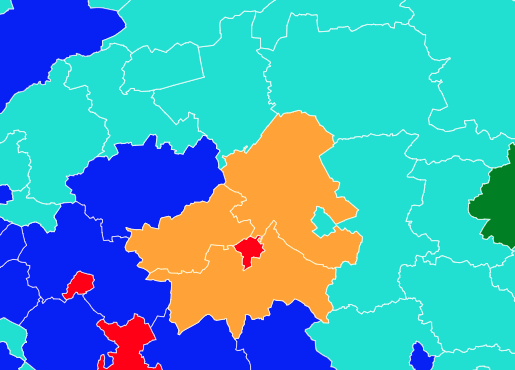
Above – More in Common / MRP’s poll 05 July 2025 showing North Cambridgeshire dropping the top two parties like a stone, noting Labour’s very very fragile hold in both NW Cambs, and Peterborough was only enabled by TeamNigel’s candidates tearing lumps out of the incumbent Conservative vote.
Also, don’t think a voting bubble will ‘protect’ Cambridge from street protests
“One societies fair won’t stop a media-driven national bandwagon”
It reflects why More In Common researched and published their in-depth report last month (July 2025) on Shattered Britain. One of the most effective policies ministers could bring in is reversing local government austerity so that the public could see the investment going into their own communities without having ministers trying to micromanage it all via their ministerial initiatives. Old habits die hard.
What annual societies fairs could enable is the collective rebuilding and strengthening of the civic society institutions from which connections to our democratic and political institutions are also made.
The path from charity volunteer to charity employee to party political office is a well-trodden one. It’s not uncommon for MPs on select committees having to refer to their register of interests when cross-examining charities or campaign group representatives that they used to work for. Similarly, it’s not uncommon for ministers especially in the field of social reform, to have experience in the charity sector.
The complexity of what this paper by Nurture Development calls ‘Associational Life’ shows the diversity and complexity of life within a strong and vibrant community.

Above – Nurture Development (2015) Communities are the atomic elements of molecular democracy
It’s one of the reasons why I have spent years urging local government here to come up with something that enables people to find groups, organisations, and campaigns that might interest them. At the moment Cambridgeshire Insight came up with this tool for local public services, while How Are You Cambridge? has come up with a tool that takes some inspiration (I think!) from the old On The Wight pages that are sadly no longer with us. One chronic problem that remains a huge barrier to informing the local public is communication. We no longer have a recognised central publication like we did in the 20th Century. For whatever reason, no one seems willing to take that one on either.
If you are interested in the longer term future of Cambridge, and on what happens at the local democracy meetings where decisions are made, feel free to:
- Follow me on BSky <- A critical mass of public policy people seem to have moved here (and we could do with more local Cambridge/Cambs people on there!)
- Like my Facebook page
- Consider a small donation to help fund my continued research and reporting on local democracy in and around Cambridge.

 The Cambridge Town Owl