
Central Government’s decision to pull funding for the relocation of Anglian Water’s sewage works at Milton, just north of Cambridge to a new site at Honey Hill means that some very expensively-produced plans are going to need revamping
It’s worth highlighting that The Government has since stated that the additional funding requirements needed to relocate the sewage works rose from £227million (the value of the original grant from the Housing Infrastructure Fund in March 2019), to over £400million today (See the end of BBC Cambridgeshire’s article here).
“In a statement, MHCLG said:
“It is vital that taxpayers’ money is used responsibly, and cost projection increases have made the relocation proposal unaffordable, with the additional £400m now required beyond the budget available.
“We are committed to ensuring Cambridge has the housing and water infrastructure it needs to reach its full growth potential as we deliver on our Plan for Change.””
Above – BBC Cambridgeshire 16 Aug 2025
Faced with the almost doubling of the original costs of relocation, it’s hardly surprising that ministers pulled the funding
Note there was an additional approval for an extra £50million in May 2024 by ministers just before the general election. Looking at the headline information, I wouldn’t have been surprised if civil servants advised ministers to pull the funding on value-for-money grounds. This is not the decision that would have been taken on party-political lines. Furthermore, because the money has not been spent, the Government’s capital budget remains intact and that funding can be reallocated (or help fill the current funding gap!)
Note with the creation of the Cambridge Growth Company, one option ministers have is to say to Peter Freeman that he needs to find an additional site for the 8,000 homes no longer being built at the water works site, and that the infrastructure needed can be paid for via a new land value capture mechanism which The Chancellor could easily put into the forthcoming budget if she so chooses.
“What happens with all of the paperwork and plans that currently apply?”
Good question.
In the Cambridge Local Plan 2018-30, the sewage works site is referenced in Policy 15.
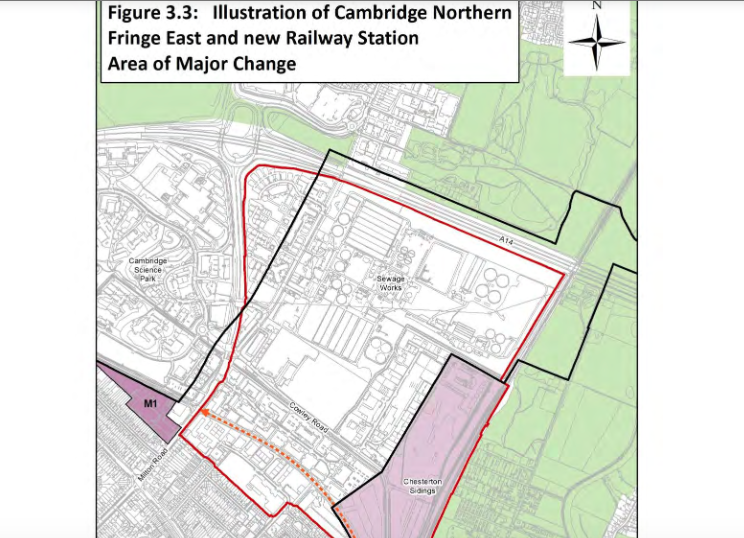
Above – Cambridge Local Plan (2018) p70 – the sewage works.
The Local Plan states that the more detailed proposals will be in the form of an area action plan – and the draft version of that – the North East Cambridge Area Action Plan, (NECAAP) is here, alongside a significant number of supporting documents that would not have come cheap. (These are nearly always produced by consultants in the private sector rather than in-house, such is the model of commissioning that became the norm since the 1980s).
The 2021 plan for North East Cambridge
I wrote about this in 2023 when Cambridge Past, Present, and Future objected to Brookgate’s ‘Great Wall of North East Cambridge’ plan – something that eventually went through as a result of a ministerial decision under the last Conservative Government.

Above – from Appendix D of the meeting where Cambridge City Councillors assessed the North East Cambridge Area Action Plan (NECAAP). This provides a much wider context of which the developers were supposed to be working in partnership with other developers.
The immediate task for planners is to refresh the NECAAP that applies to the sewage works and also the surrounding areas indicated. Furthermore, it also means that any ideas I had about building a new swimming pool at the Milton Road Garage site are probably dead in the water as up to 20,000 new residents living within walking distance would have made a new facility accessible to the residents of King’s Hedges, and the students of the North Cambridge Academy, CRC, and some of the guided busway villages,
The Milton Pong – the stench from the sewage works
As part of the huge evidence-gathering exercise for the NECAAP, consultants were commissioned by the city council to carry out odour monitoring. They produced two reports which you can see in the document library doing a keyword search (Ctrl+F) for the word ‘odour. Or you can read the Cambridge News report from 2019 here.
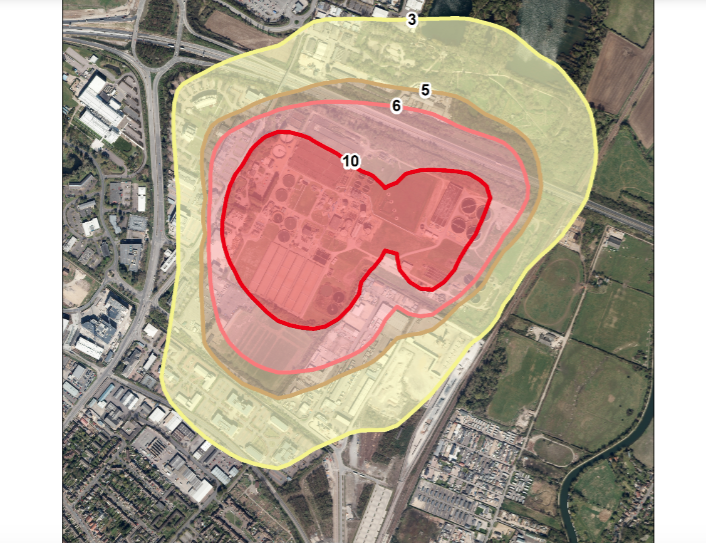
Above – Pongtastic: The 2020 updated model showing how strong the pong is and where. (p5)
“Does this then create issues for one of Cambridge’s most controversial developers?”
It might do. This is Brookgate’s new ‘city district’ mentioned earlier at Cambridge North here
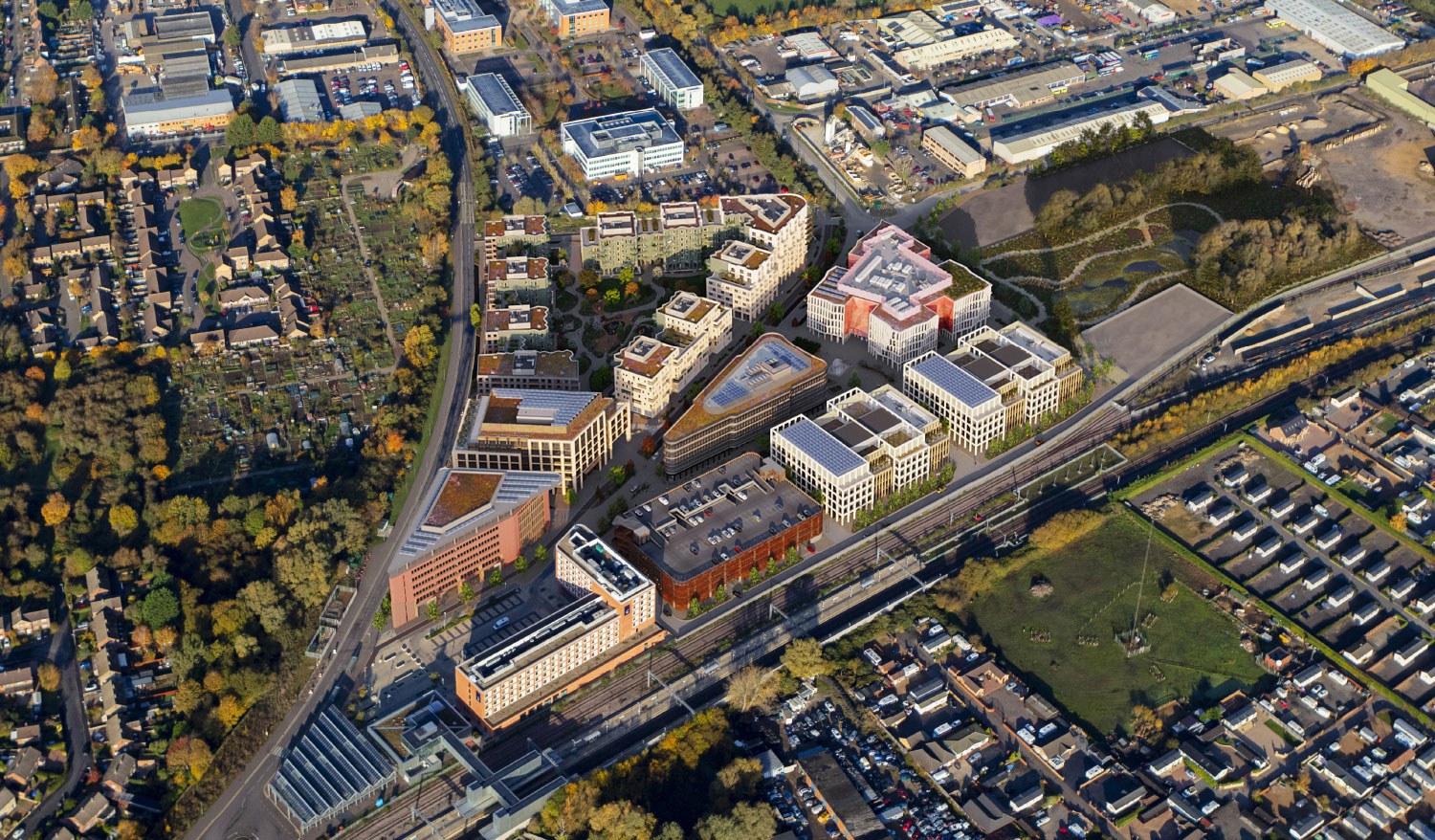
Above – What ministers signed off before the 2024 general election
The architectural style of the developers is one of significantly higher buildings compared with most of the rest of the city before they started building at Cambridge Railway Station. But again, if it wasn’t them doing it, it would be another developer stepping in, such are the financial incentives and also the ministerial support from both previous and current governments.
The risk of a wind tunnel effect
During my Whitehall days I found out the hard way what happens when architects and urban designers ignore or under-compensate for what the wind and the weather can do. Basically Victoria Street in Westminster – near where my old office once was, was already Wind-Tunnel Alley in the mid-late 2000s. And that was before the next generation of very tall buildings were approved and built.
A gentle breeze from the north-west is all that’s needed…
…to turn the station square at Cambridge North Station into a stench-filled sink, because the high sides of the proposed buildings channel the winds – that will have passed over the sewage works – down the street that heads south-eastwards into the car park, the ‘adequately-designed’ hotel, the station exit, and the guided busway stop.
“Could Anglian Water sponsor the railway station exit?”
“Welcome to Cambridge North! That stench! That’s us. Sorry!”
Accompanied by some photos of embarrassed-looking executives and investor chiefs?
“What does this mean for the Hartree development?”
There’s no announcement from their website. Some of you will be aware of some of the historical research I did for the developers following the selection by local residents to name the new district after Eva Hartree, Cambridge’s first woman mayor whose mayoral centenary is this year. My hope is that Eva’s legacy can be commemorated by naming a new future city ward that emerges from the continued expansion of our city. Given that ministers want to continue with the expansion of our city, finding suitable civic names for the new neighbourhoods will help concentrate the minds of those working on the new developments to avoid the mistakes made with previous generations of new towns – as this historical article indicates.
If you are interested in the longer term future of Cambridge, and on what happens at the local democracy meetings where decisions are made, feel free to:
- Follow me on BSky
- Like my Facebook page
- Consider a small donation to help fund my continued research and reporting on local democracy in and around Cambridge.

 The Cambridge Town Owl