But…it struggled to link it all together in a cohesive theme and wasn’t able to become greater than the sum of its parts. Why was this? Let’s have a look.
I went into town (i.e. Cambridge’s city centre – a term I’ve used since childhood and old habits die hard!) for both days of the Out of the Ordinary Festival 2025 in Cambridge to see a handful of the artists, musicians, and things that were put on for it. There was also a visible effort to solicit feedback so the results of what everyone there had to say will be interesting to hear at a future council meeting.
I wasn’t planning on writing a piece other than ‘I went to see this and here’s who were there, go and visit their social media links’ sort of piece. But one comment from one of the parents of the participants got me thinking about how this and future events are planned and fit together.
“I do however think that the whole OotO event would be better tied into the Folkie or the Strawberry Fair, or a resurrected Summer in the City. There were some great acts but not many there to watch, and lots of perplexed passers-by with no clue what or why.”
Above – Anon
“How was it publicised?”
“The city centre is basically taken over on Saturday and Sunday by the most incredible, spectacular, acrobatic, gravity-defying, humorous, energetic, colourful and physical performing arts.”
Christine McNally of Cambridge City Council to BBC Cambridgeshire
There was also the standard press publicity, with Cambridge Radio the community radio station broadcasting live on the Sunday afternoon. (I think they did part of the Saturday too.
Street Theatre as a concept is *really hard* to pull off successfully
Even more so when the roads and the street scenes are in such a decrepit state due to a decade-and-a-half of austerity imposed by a series of Conservative Governments. (If the current or future governments want to reverse that decline, coming up with a better way of funding local government in England would be a good way to start!)
The videos of the street performers show that the city council booked a number of professionals who were and are of a very high standard.
In the grand scheme of things, I think that element of it they got right. The thing that I look out for with any professional performing arts group/act is their ability to do something that is beyond the reach of most of the general public on a day-to-day basis. i.e. something that requires a high amount of skill *and* effort/preparation to pull off well. One that worked particularly successfully was the act educating the public about the conservation of wildlife – using people dressed as big birds rather than the real thing! (With the host doing his best Steve Irwin impressions!)
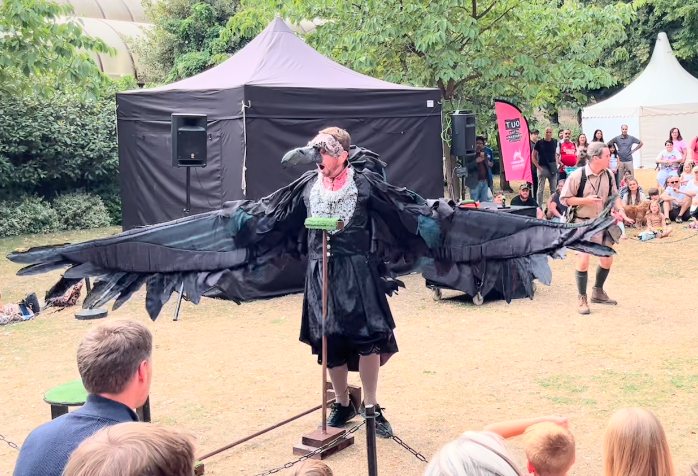
Above – man dressed as vulture
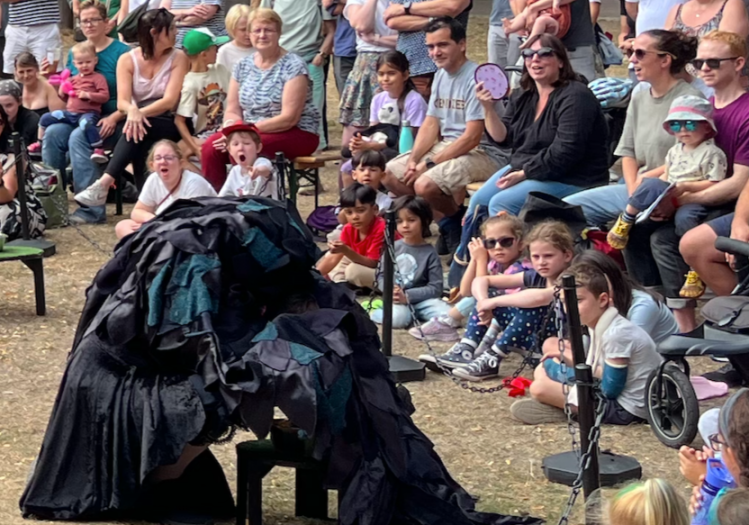
Above – Man dressed as vulture eating the pretend-poison left there by a pretend poacher – and one youngster trying to warn him off!
Musically it was good to see Melody Coles back on stage again – also advising watchers on Sunday to stick around for Isla Mae who has just done her A-levels and whose vocal range and lyrical maturity is far beyond her years. She already has 3 EPs behind her.
“So, what didn’t work?”
In the grand scheme of things, the locations did not fit together as well as they could and should have done.
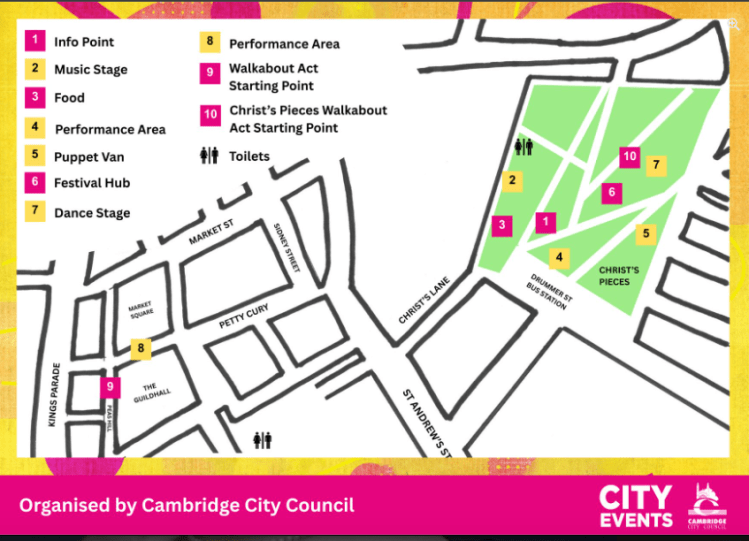
Above – the map of the stages and performance areas
Some of the temporary sites needed to be closer to each other so as to benefit from the flow of pedestrians, while others needed to be further away from each other due to the clashing of amplified music and vocals.
What does the public expect from a ‘Festival’?
Good question. I quite like this take from PTA+ here which reminds organisers [mainly in the field of school events] of the big picture. The number of definitions of what a ‘festival’ is is so numerous even the AI-bots have managed to summarise them without asking. (I’m not a fan of the latter!) Common themes include:
- A big element of fun
- A celebration
- A reason for that celebration
I think that’s where Cambridge City Council struggled with trying to identify a suitable lower-cost alternative to the Big Weekend, which I hope the new unitary council will be able to bring back. The Big Weekend was very specifically a big free summer weekender on Parker’s Piece in the city centre that not only celebrated the summer but also provided spots for local musical, performing arts, and artistic talents to showcase their works, with a headline act being the ‘attention-grabber’.
Furthermore, with everything being on one site, it made it easier for visiting families from the outside villages to base themselves in one spot for the day. You’ve got a big open space for children to run around in without traffic.
The absence of a civic presence is becoming painful to see
The fragmentation of civic and municipal branding has to be something the new unitary council gets a grip of.(And Parliament/Ministers *must* provide the new generation of unitary councils with the funding or revenue-raising powers, plus the legal powers to do this). Because at the moment the city’s collective approach to visitors and tourism is embarrassing. Ultimately it’s the result of decisions taken by central government decades ago – i.e. Thatcher’s Government compelling councils to outsource so much of what was provided for in-house. As a result there are now multiple competing brands that confuse both the residential and the visiting public.
- Cambridge BID
- Visit Cambridge
- Love Cambridge
- How are you Cambridge?
- Cambridge Festival
- Open Cambridge
- Cambridge&
- Cambridge City Events
…take your pick from the above and more that I’ve missed!
Morale is low not just across the city council and local public sector, it’s similar across society as well
Both Melody Coles and Isla Mae mentioned the latter in their monologues between their songs. It’s very hard to generate a celebratory atmosphere given what’s happening in wider society. The promoters of ‘brand Cambridge’ can only pretend for so long that our city is somehow economically immune to all of this. We’re not. And it shows. No amount of public art can hide the fact that Cambridge’s prime shopping area – Grand Arcade – has three high profile units that are either vacant or are currently occupied by pop-up or non-prime outlets.

Above – The Grand Arcade’s main entrance where both All Saints and Ted Baker recently exited the scene
What’s really striking is that this is meant to be the peak tourist season. And this is *after* the removal of the shop units at the other end of Grand Arcade which has since been replaced by a bar/cinema offering (which so far seems to be doing quite well), alongside the closure of most of the shops that were in The Grafton Centre as it transforms from a once prime retail & leisure site (as it was in the mid-1990s) into a sci-tech bubble space.
And if this is Cambridge, I dread to think what everywhere else is like.
Signs of the times – the empty local shop units next to million pound houses
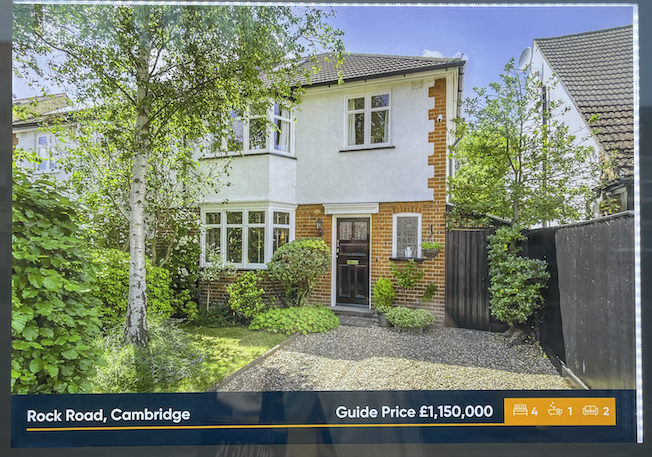
Above – an interwar semi-detached house on Rock Road, up the road from Rock Road Library
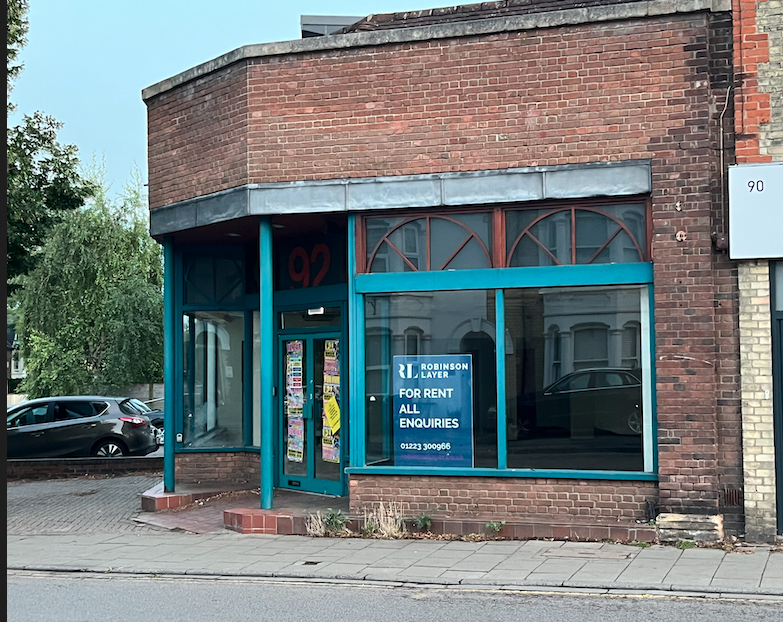

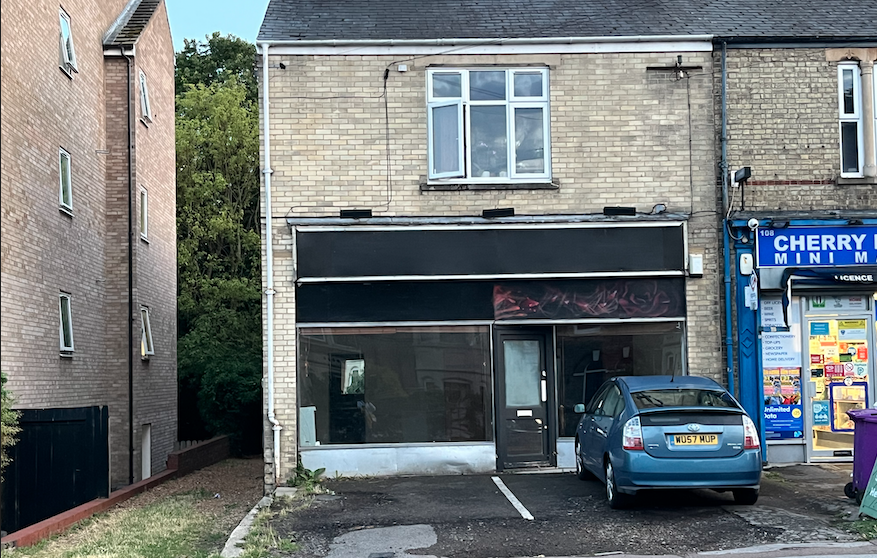
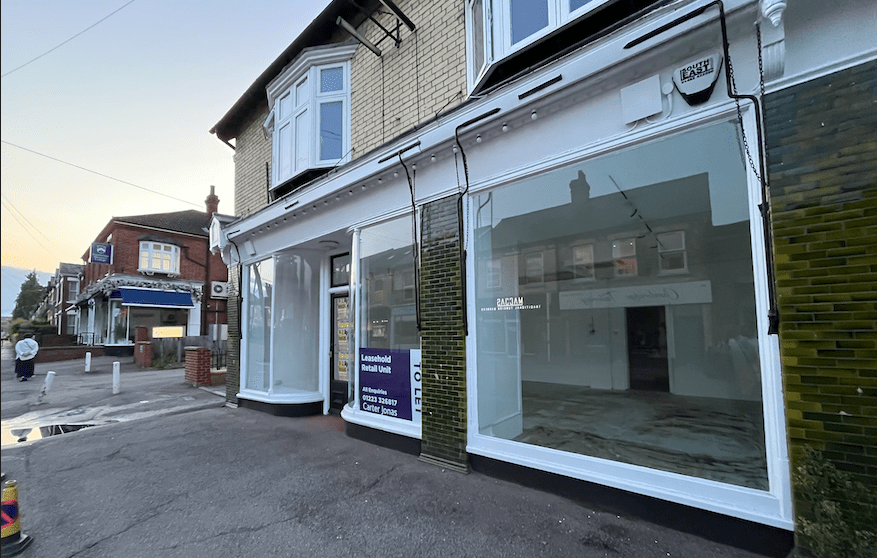
Above – clockwise from top left: The old betting shop that was previously a bank and post office during my lifetime on the corner of Rock Road, now empty. Top centre, the old Lloyds Bank branch, now empty. Top right, the old launderette, later a tattoo parlour, now empty (I think awaiting redevelopment/extension). Bottom, a former domestic interiors shop. Now empty.
Four empty units – all also within a 5 minute walk from Hills Road Sixth Form College and the Cambridge Leisure Park (and the Clifton Road Trading Estate too). Have we reached the era of late-stage disaster capitalism where too many asset holders are demanding too much from those renting said assets? And if so, how in the world do ministers unwind this?
Parliament’s back a week Monday but I’m not expecting anything substantive on this! But some ministerial update about the future of Cambridge would be nice.
If you are interested in the longer term future of Cambridge, and on what happens at the local democracy meetings where decisions are made, feel free to:
- Follow me on BSky
- Spot me on LinkedIn
- Like my Facebook page
- Consider a small donation to help fund my continued research and reporting on local democracy in and around Cambridge.

 The Cambridge Town Owl